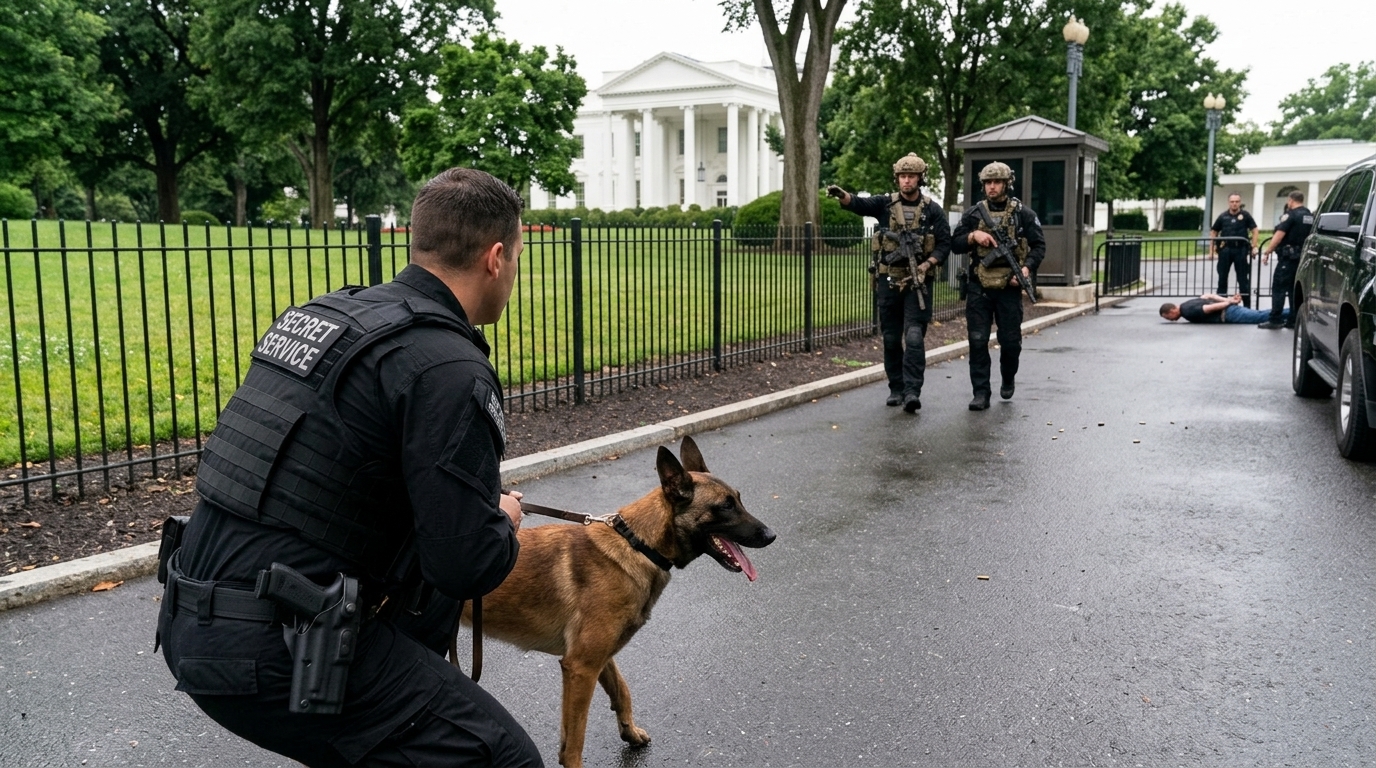
On the afternoon of May 23, 2026, the heart of American democracy was jolted by a volley of gunfire that brought the specter of political violence and the security challenges of the digital age back into the spotlight. The U.S. Secret Service confirmed that its agents shot and killed an armed suspect who opened fire at a security checkpoint near the White House. Despite the intensity of the moment, President Donald Trump, who was inside the building at the time, was not in immediate danger, although the commotion resulted in the injury of an innocent bystander.
The Chronology of the Confrontation and Immediate Response
According to official reports, the suspect approached the security checkpoint at the intersection of 17th Street and Pennsylvania Avenue, an area under constant and rigorous surveillance. Under circumstances that remain unclear, the man drew a weapon and began firing toward uniformed officers. The Secret Service's response was instantaneous. In a coordinated operation lasting only seconds, agents returned fire, neutralizing the perpetrator on the spot.
Tragically, during the exchange of fire, a civilian walking in Lafayette Square was caught in the crossfire and injured. Immediate first aid was provided by Secret Service medical personnel before the individual was transported to a nearby hospital, where their condition is reported as stable. The area was immediately cordoned off, with specialized units and the FBI taking control of the scene to collect evidence and search for potential accomplices or explosive devices.
Technology in the Service of Protection
In the context of 2026, White House security no longer relies solely on human presence. This incident highlighted the role of advanced Artificial Intelligence systems integrated into the security perimeter. According to sources within the Secret Service, "smart" surveillance systems had already flagged the suspect as a "person of interest" seconds before the first shot was fired, due to his nervous behavior and movement patterns analyzed by threat-prediction algorithms.
However, the fact that the gunman managed to get so close to a critical checkpoint raises serious questions. Critics argue that over-reliance on automated analysis can create a false sense of security or cause delays in human intervention due to the need for data verification. The FBI investigation is expected to examine whether there was a gap in security protocols or if the perpetrator used technological means to bypass the White House's digital "shield."
Political Implications and the Climate in Washington
President Trump, in a brief social media post shortly after the incident, praised the bravery of the Secret Service agents, stating that "America remains strong and secure." Nevertheless, the political atmosphere in the capital is electric. The country is in a period of intense polarization, and such incidents often serve as a catalyst for new confrontations regarding gun control, internal security, and the role of federal agencies.
Analysts suggest that this attack could be used as a justification for further tightening security measures in Washington, turning the city into an even more closed "security zone." Already, members of Congress are calling for an emergency briefing from the Director of the Secret Service, while discussions on the need to strengthen counter-terrorism legislation have already begun in the halls of the Capitol. The challenge for the administration is to balance the pressing need to protect the Commander-in-Chief with maintaining the open character of the capital's public spaces.
Conclusions and the Path Forward
The incident of May 23 will be remembered as a reminder of the fragility of peace at the heart of power. While the Secret Service acted with exemplary precision in neutralizing the threat, the injury of a civilian and the nature of the attack itself suggest that security challenges are evolving faster than the means to address them. As the investigation continues, attention turns to the suspect's motive and whether this action was part of a larger plot or the act of a "lone wolf" exploiting the chaos of the times.
In a world where information and violence travel at the speed of light, the security of the White House remains the ultimate symbol of state sovereignty. The successful protection of the President is a victory for security services, but the bloodshed on the streets of Washington is a defeat for social cohesion. The coming weeks will be decisive in how the government chooses to respond to this challenge, with technology and politics once again in a reciprocal and often conflictual relationship.