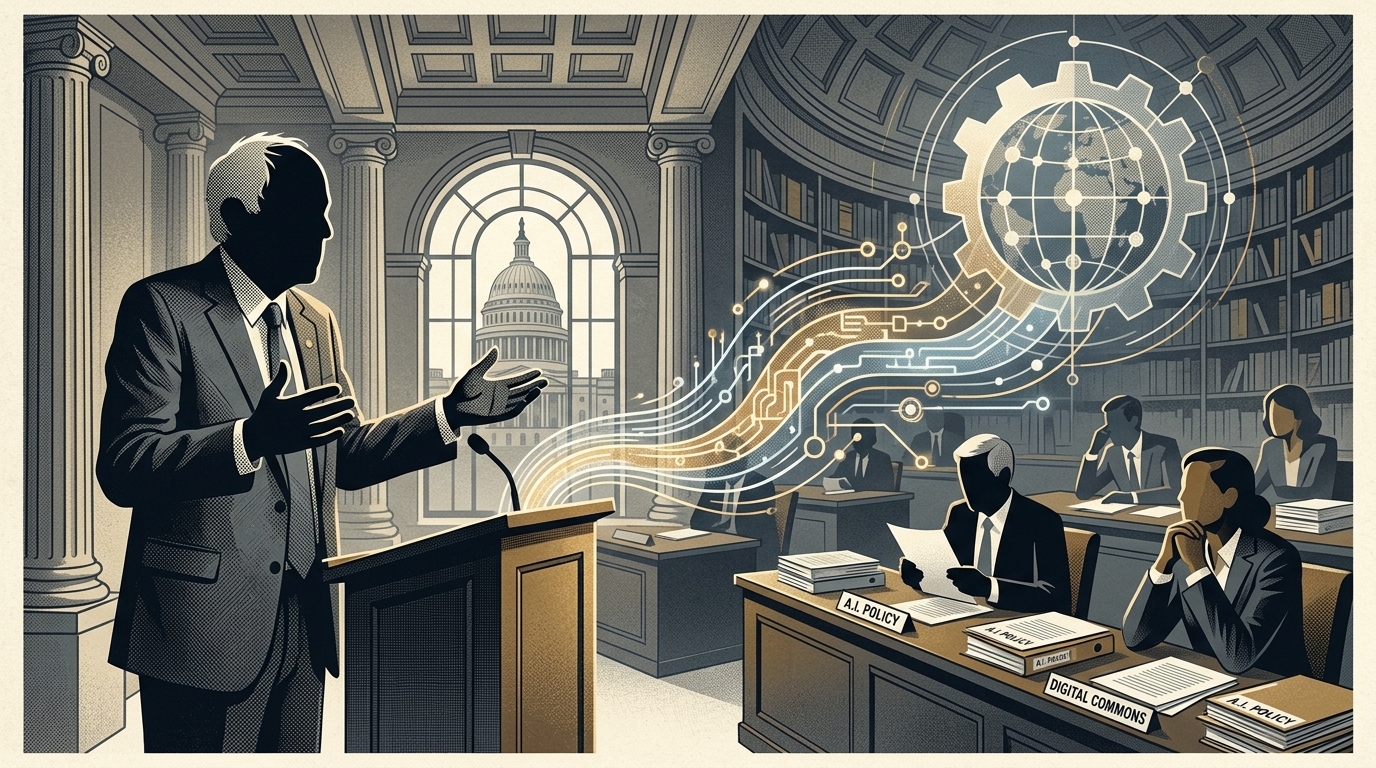
In an era where Artificial Intelligence (AI) has ceased to be a futuristic experiment and has become the backbone of the global economy, Vermont Senator Bernie Sanders has made an intervention expected to define the political agenda for years to come. During his speech at the 'Broadband Breakfast' conference, Sanders passionately defended a radical plan for the nationalization of core AI infrastructure, arguing that this technology is far too consequential to be left exclusively in the hands of Silicon Valley oligopolies.
AI as a Public Utility
Sanders' argument is rooted in the premise that AI, much like electricity and running water in the 20th century, has become an essential infrastructure for social and economic life. According to the Senator, the current trajectory of AI development leads to an unprecedented concentration of wealth and power. "We cannot allow three or four companies to hold the keys to human knowledge and productivity," he stated emphatically. His plan envisions the creation of a National Compute Council, which would manage large data centers and foundation models as 'public goods.'
The proposal isn't just about ownership; it's about access. Sanders argues that small businesses, researchers, and non-profits should have guaranteed, low-cost access to computing power (compute), ensuring that innovation isn't stifled by the infrastructure costs currently controlled by Microsoft, Google, and Amazon.
The Social Contract and the Great Displacement
A central point of Sanders' rhetoric is addressing the labor insecurity caused by automation. The 'Great Displacement,' as the mass replacement of jobs by AI agents in 2026 is now called, has hit both manual and cognitive professions. Sanders proposes that profits generated by nationalized AI be directed into a Labor Transition Fund, which would finance Universal Basic Income (UBI) and retraining programs.
"If technology is going to replace workers, then the fruits of that technology must belong to the workers and not to Wall Street shareholders," Sanders emphasized.
This approach radically shifts the narrative from "taxing robots" to a model of direct social ownership. His critics, however, point out that such a move would lead to a massive flight of capital and scientific talent abroad, undermining U.S. national security.
Geopolitics and the Innovation Dilemma
The debate over AI nationalization does not occur in a vacuum. The rise of China, which already implements a model of tight state control over algorithms and data, creates a geopolitical dilemma. Sanders argues that democratic nationalization is the only answer to authoritarian state capitalism. Instead of having a 'black box' of algorithms controlled by private entities, he proposes code transparency and public oversight of training data.
- Transparency: Public access to algorithms making decisions on healthcare and employment.
- Ethics: Elimination of biases through public oversight rather than corporate self-regulation.
- Environment: State management of the massive energy consumption of data centers with a shift to renewables.
Reactions and Future Prospects
The tech industry reacted instantaneously, with representatives of major conglomerates speaking of the "death of innovation." They argue that state control will slow the development of critical applications in medicine and climate change. However, popular support for Sanders' proposal seems to be growing as citizens feel increasingly powerless against algorithmic dominance.
2026 appears to be the year when humanity must decide: Will Artificial Intelligence be the ultimate tool for enrichment for the few, or the common heritage of human intellect? The battle Sanders ignited at Broadband Breakfast is just the beginning of a long and painful conflict over the future of our digital civilization.