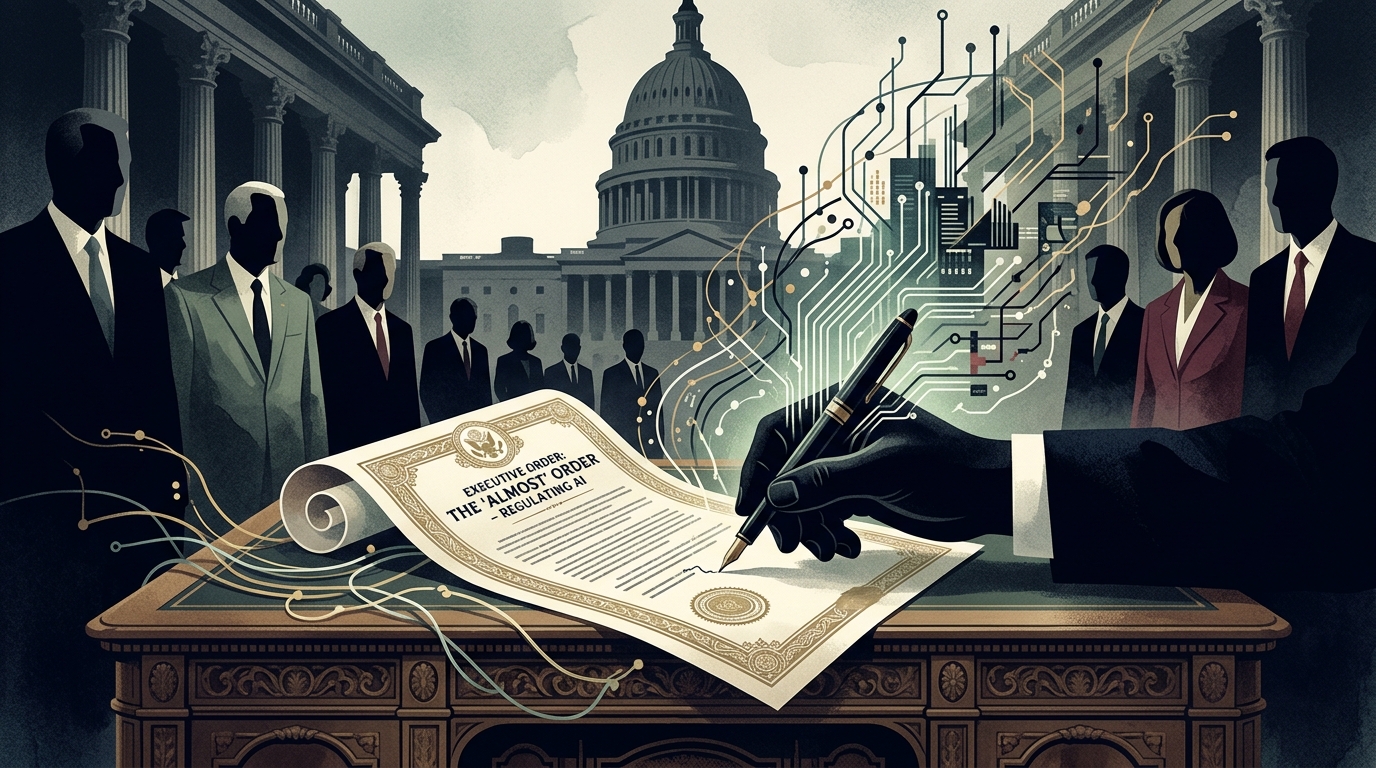
Washington recently found itself on the precipice of a historic shift in technological policy, as an executive order that could radically alter the trajectory of Artificial Intelligence (AI) in the U.S. came within inches of being signed by President Donald Trump. According to an exposé by Politico, the draft order represented an aggressive departure from the Biden administration’s policies, prioritizing deregulation and national power over safety guardrails. However, the sudden postponement of the signing raises significant questions about internal White House dynamics and the burgeoning influence of Silicon Valley titans.
The 'America First' Philosophy in Technology
The core ethos of the draft order, obtained by reporters, was unmistakable: AI is not viewed as a risk to be contained, but as a primary instrument of geopolitical dominance. The text describes the need for an 'AI Manhattan Project,' suggesting a massive mobilization of state and private resources to ensure the U.S. stays ahead of China. In stark contrast to Joe Biden’s Executive Order 14110, which focused on risk management and safety testing, the Trump draft seeks to dismantle the 'bureaucratic hurdles' that its authors claim are stifling American innovation.
A significant portion of the document is dedicated to infrastructure. The order envisioned expedited permitting for new data centers and, crucially, a strengthening of the energy grid to support AI's massive power demands. The rhetoric directly links energy independence with technological supremacy, proposing the use of nuclear power and fossil fuels to feed the 'intelligence factories' of the future.
The Clash Over Safety and 'Woke' Bias
One of the most contentious elements of the draft is its explicit attack on the 'safety and ethics' frameworks established by the previous administration. The proposal calls for the elimination of 'woke' constraints on AI models, arguing that efforts to mitigate bias often result in censorship and the infringement of free speech. This point reflects the views of a specific faction in Silicon Valley that views safety regulations as a Trojan horse for a particular ideological agenda.
Furthermore, the order proposes the creation of an 'AI Strategy Council' composed largely of industry executives and military officials, largely bypassing consumer protection agencies. This shift of power from regulators to market players is at the heart of the friction that reportedly led to the last-minute delay in the Oval Office.
Why Was the Signing Halted?
Despite the document being ready for signature, Trump opted to delay the process. Analysts suggest this is due to an internal tug-of-war between two main camps. On one side are the 'accelerationists,' backed by figures like Elon Musk and venture capital firms like Andreessen Horowitz, who advocate for total freedom and open-source development. On the other side are national security hawks who fear that total deregulation and the promotion of open-source models could allow adversaries like China to misappropriate American intellectual property.
"Artificial intelligence is the new gold, and no one wants to hand the map of the mine to their enemies, even if it means less freedom for their friends," a source close to the deliberations remarked.
The delay indicates that the balance between 'open innovation' and 'national protectionism' remains the most challenging puzzle for the current administration. The question is no longer if such an order will be signed, but which faction will succeed in embedding its final priorities into the text.
Global Implications and Market Impact
If signed in its current form, the order’s ramifications will be global. The European Union, which has just begun implementing its AI Act, would find itself in a precarious position. While Europe bets on regulation and fundamental rights, the U.S. appears to be choosing a path of unbridled competition. This could spark a 'capital and talent flight' toward the U.S., while simultaneously ushering in a new era of technological protectionism.
In conclusion, Trump’s 'almost' executive order is not merely an administrative document; it is a manifesto for how a superpower intends to wield the most transformative technology of our century. The wait for its final version keeps not only Silicon Valley but world capitals in a state of high suspense.