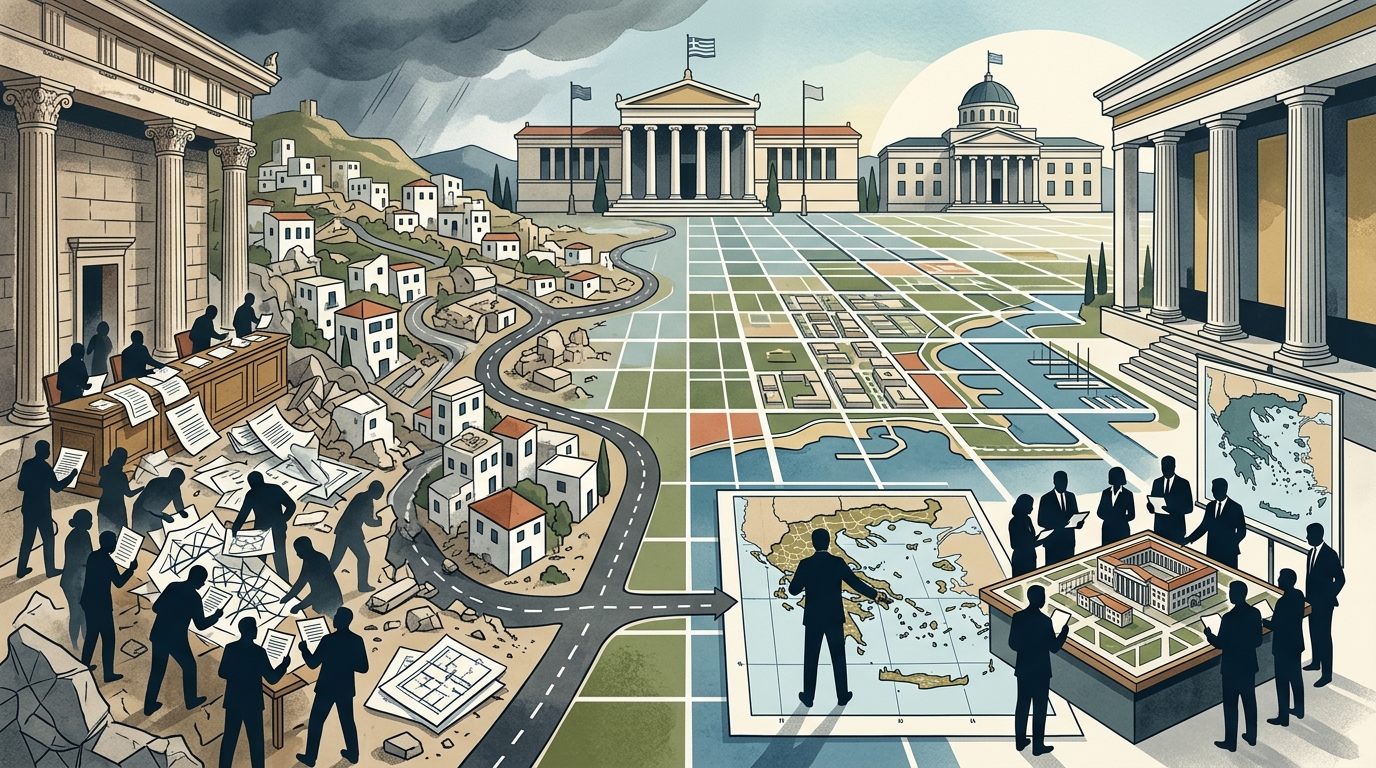
For decades, Greece was the European outlier in land management. A lack of clear rules, overlapping jurisdictions, and a notorious bureaucratic "jungle" created a landscape where investment felt like a gamble and environmental protection like a mere wish. Today, with the reform presented by Minister of Environment and Energy Stavros Papastavrou, the country is attempting a leap toward institutional maturity, introducing a truly holistic spatial planning framework for the first time.
The Architecture of the New Reform
The heart of the government's strategy lies in the Local Urban Plans (TPS) and Special Urban Plans (EPS). These are not merely technical documents but the "roadmap" for development over the coming decades. Minister Papastavrou emphasized that the goal is to cover 80% of the territory with modern urban regulations by the end of the current term—an ambition financially backed by the Recovery and Resilience Facility (RRF).
The reform focuses on three pillars: legal certainty, protection of natural capital, and acceleration of the green transition. For an investor, knowing exactly what is permitted and where—without the fear of cancellations by the Council of State (CoE) due to lack of spatial documentation—is the strongest possible incentive. Simultaneously, the delineation of settlements and the definition of land uses put a stop to the unregulated construction that has marred the Greek landscape for half a century.
Tourism and Industry: A Delicate Balance
One of the most critical points of the Minister’s address concerned the Special Spatial Frameworks for Tourism and Industry. In the case of tourism, the challenge is twofold: avoiding saturation in popular destinations and encouraging investment in less developed regions. The new design introduces "carrying capacity" criteria—a concept that was previously theoretical but is now becoming legally binding.
In the industrial and energy sectors, spatial planning acts as a catalyst for decarbonization. The siting of Renewable Energy Sources (RES) remains a thorny issue, with local communities often reacting against wind turbine installations. The government promises that the new planning will be based on scientific data, balancing the need for clean energy with respect for the landscape and biodiversity.
Digitalization and Transparency
The innovation accompanying this effort is the Single Digital Map. This platform will allow every citizen and professional to view building conditions, protected zones, shoreline lines, and forest boundaries in real-time. "Transparency is the best enemy of corruption," Ministry sources note, emphasizing that digitalization reduces contact with bureaucracy and eliminates subjective law interpretations by local urban planning offices.
Challenges and Risks Ahead
Despite the positive outlook, the road is not without obstacles. Implementing the TPS requires the cooperation of municipalities, many of which lack technical services. Furthermore, time is of the essence, as RRF funds come with strict deadlines. Papastavrou admitted that the reform is "an exercise in persistence and precision," as Greece is called to do in a few years what other partners did over decades.
Ultimately, holistic spatial planning is not just an administrative process. It is Greece's attempt to define itself in the 21st century: a country that respects its history and nature while simultaneously offering a stable, modern, and attractive environment for economic activity. If this reform succeeds, it will be the most significant legacy for future generations, transforming Greece from a "plot for exploitation" into an organized European state.