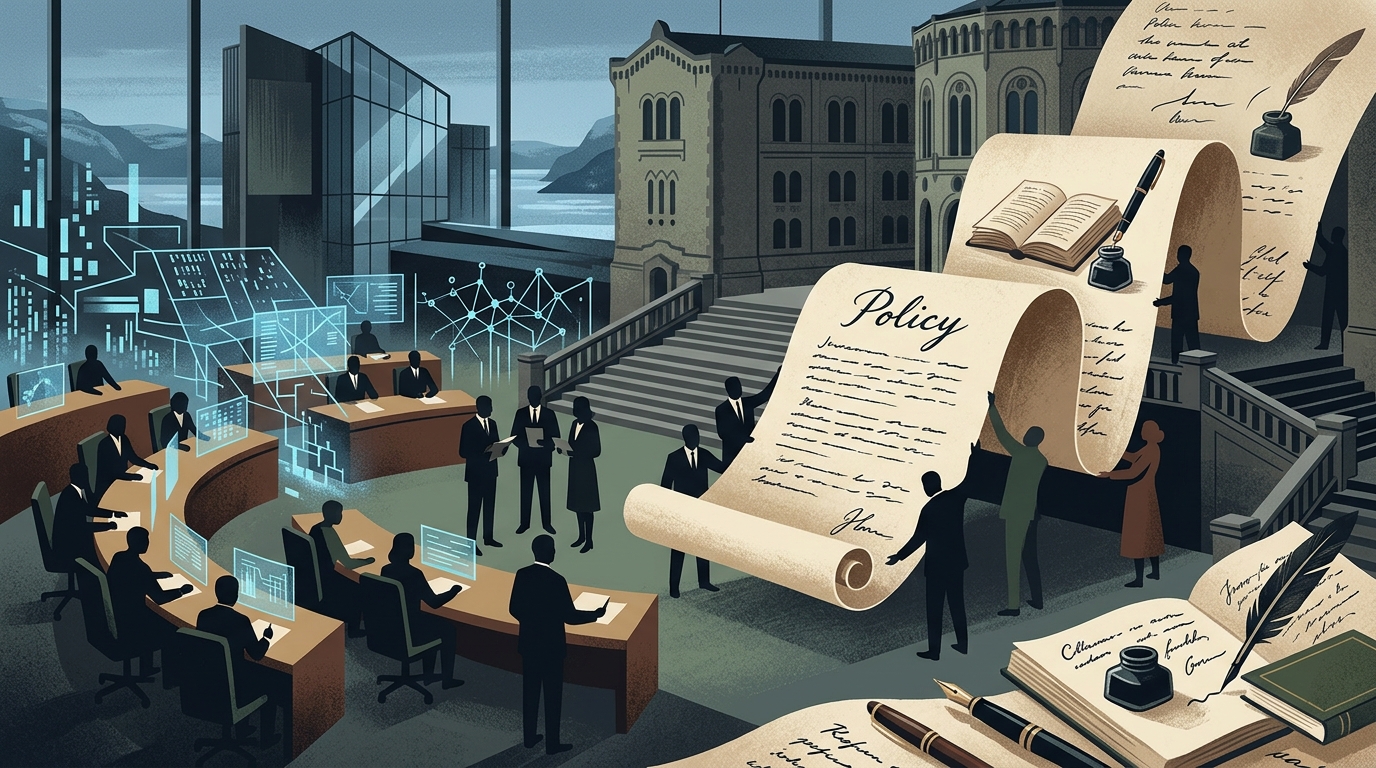
In an era where the rest of the world seems to be diving headfirst into the embrace of Generative AI, Norway—a nation traditionally at the forefront of digital transformation—has decided to pull the emergency brake. The Norwegian government's recent decision to enact a near-total ban on AI tools for junior school pupils and drastically curb their use in secondary education marks a historic turning point in global educational policy.
A Return to Pen and Paper
Norway’s Minister of Education, Kari Nessa Nordtun, has been explicit: excessive screen exposure and the premature introduction of algorithms into the learning process may be undermining fundamental skills in reading, writing, and critical thinking. This new directive is not merely a technical prohibition but a philosophical repositioning. In junior schools, the use of AI tools like ChatGPT or Claude will be almost entirely excluded, while for older students, their use will be permitted only under strict supervision and for specific pedagogical purposes.
This decision is rooted in a growing body of research suggesting that the 'digital ease' offered by AI can lead to cognitive atrophy. When an eight-year-old student can simply ask a bot to write an essay or solve an arithmetic problem, the process of 'trial and error'—crucial for brain neuroplasticity—is dangerously bypassed. Norwegian educators now argue that physical contact with books and handwriting are not anachronisms but essential tools for deep learning and memory retention.
The Failure of the 'Digital Experiment'
For over a decade, Nordic countries were viewed as the gold standard for the digital classroom. Every student had their own tablet or laptop, and textbooks were largely replaced by digital platforms. However, results from international assessments (such as PISA) showed a concerning decline in reading performance and concentration spans. Norway, observing this data, concluded that technology did not function as a catalyst but as a distraction.
"We must protect our children from becoming guinea pigs in a technological experiment whose long-term consequences we do not fully understand," stated a member of the educational policy committee in Oslo.
Norway’s move follows the example set by Sweden, which last year announced a return to printed books in schools, investing millions of euros to restore traditional libraries. The message is clear: technology must serve pedagogy, not the other way around.
Political and Social Implications
This ban is not without its detractors. Some technologists and parents argue that excluding children from AI will leave them behind in a global job market that demands 'AI literacy.' However, the Norwegian government counters that true digital literacy is not about using the tool, but understanding how it works—something that requires a strong foundation in logic and language first, which is best built through analog means.
- Restricting access to chatbots during school hours.
- Implementing stricter filters on school networks to prevent AI use for homework.
- Training teachers to detect AI-generated content.
- Increasing oral exams and in-class written tests without internet access.
In a broader context, Norway’s stance reflects a growing distrust of Big Tech. There are serious concerns regarding the privacy of minors' personal data, as the data students input into AI models is often used to train these systems without clear consent or transparency. The Norwegian Data Protection Authority has been vocal about the risks of embedding opaque algorithms into the core of the public education system.
Conclusion: A Balance for the Future
Norway is not denying the future; it is attempting to harness it. The decision to curb AI in schools is a bold statement that human development has its own pace, which does not always align with the speed of microprocessors. As 2026 progresses, we are likely to see other European nations follow this path of 'digital detoxification,' seeking a middle ground between innovation and the intellectual integrity of future generations. The Norwegian model suggests that to move forward in the AI age, we might first need to take a step back to the basics.