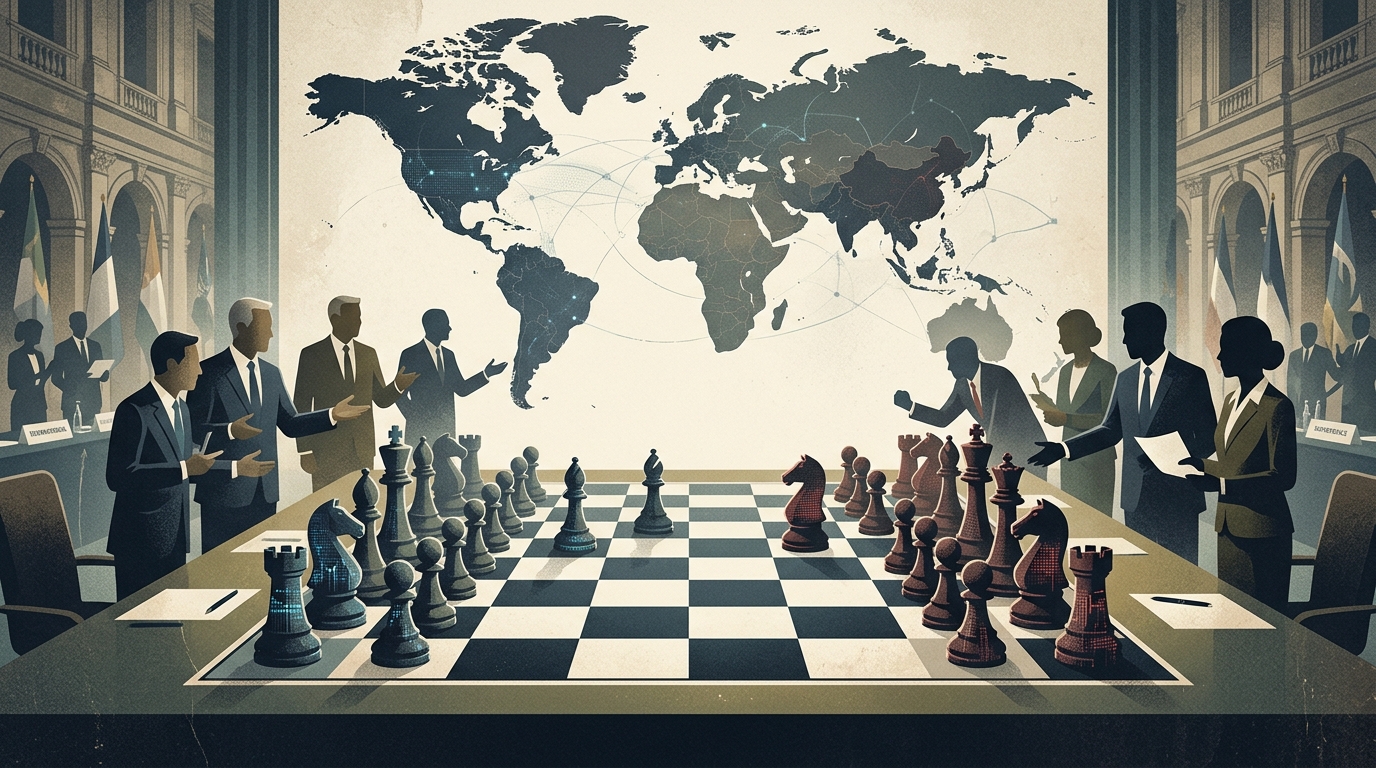
As we navigate through 2026, the global stage no longer resembles the era of globalization and free technological exchange, but a modern iteration of the 1950s. Only this time, the object of desire is not nuclear warheads, but semiconductors and generative intelligence algorithms. Artificial Intelligence (AI) has ceased to be viewed as a mere productivity tool and has been elevated to the ultimate weapon of geopolitical power, igniting the fuse of a new Cold War between East and West.
The Silicon Curtain and Chip Diplomacy
The front line has been drawn in the factories of Taiwan and the laboratories of Silicon Valley. The United States, through a series of stringent export controls, is attempting to strangle China's access to advanced computing power. What began as a trade war under the Trump administration and escalated under Biden has now taken on existential dimensions. Washington believes that whoever controls the AI infrastructure will control the global economic and military system for decades to come.
On the other hand, Beijing is responding with an unprecedented mobilization of resources to achieve technological self-sufficiency. The Chinese "AI 2030" strategy aims for complete independence from Western technologies. The creation of a "Silicon Curtain" is now a reality: two distinct AI ecosystems are developing in parallel, with different standards, different ethical principles, and, most importantly, different goals for surveillance and control.
The Militarization of Intelligence
In the realm of armaments, AI is radically changing the doctrine of warfare. We are no longer talking just about autonomous drones, but about strategic decision-making systems capable of analyzing billions of data points in milliseconds, offering a tactical advantage that the human brain is unable to track. The integration of AI into nuclear commands and early warning systems creates a new, extremely fragile balance of terror.
- Autonomous Weapon Systems: The transition from "human-in-the-loop" to "human-out-of-the-loop" operations.
- Cyber Warfare: The use of LLMs to create invisible malware and automated disinformation campaigns.
- Cognitive Warfare: The ability to influence public opinion through large-scale, personalized psychological operations.
"Artificial Intelligence is to the 21st century what nuclear energy was to the 20th. The difference is that AI is invisible, pervasive, and requires no uranium to become dangerous—only code."
The Ideological Clash and the Future of Democracy
Beyond power, the new Cold War is deeply ideological. The West promotes a model of "human-centric" and "trustworthy" AI, at least in theory, with regulatory frameworks like the European Union's AI Act. Conversely, the authoritarian model utilizes AI as the ultimate tool for social engineering and repression, featuring social credit systems and ubiquitous facial recognition.
The stake is whether democratic values can survive in an environment where algorithmic efficiency might be deemed more important than individual liberty. "AI diplomacy" is now forcing third-party nations, from Africa to Southeast Asia, to choose sides. Will they base their national infrastructure on the American cloud or Chinese hardware? This choice will dictate their political trajectory for the next century.
Conclusion: A Fragile Peace
The risk of an accident or unintentional escalation is greater than ever. As major powers retreat into technological fortresses, the need for an international treaty on AI control—similar to those for nuclear weapons—becomes imperative. However, at this stage, distrust prevails. Artificial Intelligence is no longer a promise for the future but the battlefield of the present, where the "fuse" has already been lit, and no one seems willing to extinguish it.