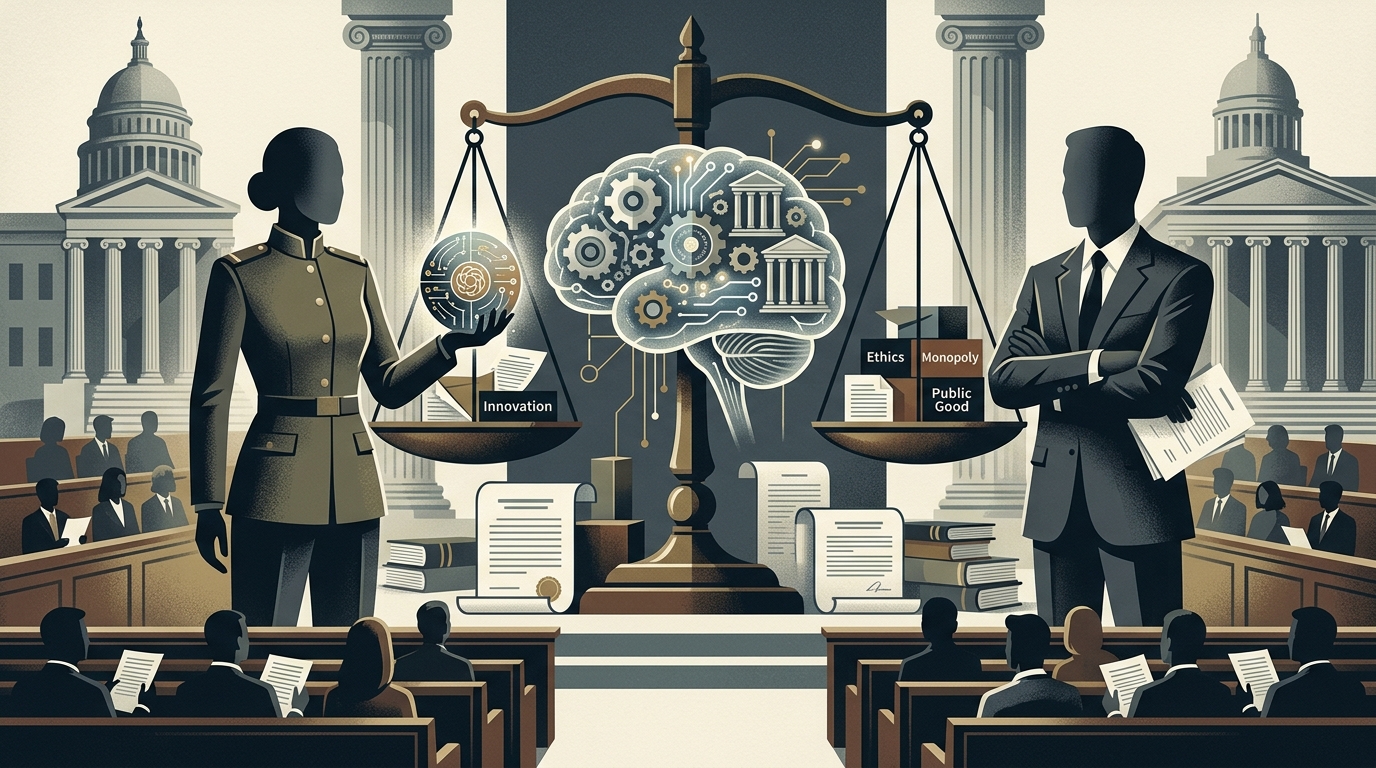
The atmosphere inside the San Francisco courtroom today, April 30, 2026, feels more like a Greek tragedy than a standard corporate litigation. On one side stands Elon Musk, the billionaire who provided the critical seed funding for OpenAI in its infancy. On the other is Sam Altman, the visionary executive who transformed a boutique research lab into the dominant force of the global tech landscape. The essence of this case isn't merely about capital or market share; it is a fundamental debate over whether artificial intelligence belongs to humanity or to the shareholders of a private corporation.
The 'Founding Agreement' – Fact or Fiction?
Musk’s legal team contends that OpenAI has committed a historical breach of its "founding agreement"—an informal yet, in Musk's view, binding promise that the entity would remain a non-profit dedicated to developing Artificial General Intelligence (AGI) for the benefit of all. According to documents presented to the court, Musk alleges that the close-knit partnership with Microsoft has effectively turned OpenAI into a "de facto closed-source subsidiary" of the Redmond giant.
Musk’s attorneys produced internal emails from 2015 in which Altman and Greg Brockman appeared to agree that OpenAI should serve as a counterweight to Google and other profit-driven incumbents. "OpenAI has been transformed into a closed-source, maximum-profit seeker for the largest technology company in the world," Musk’s counsel argued during opening statements. The defense, however, countered by emphasizing that no formal, signed contract ever existed that explicitly forbade the creation of a for-profit arm—a move they claim was essential to secure the billions required for the compute power necessary to stay competitive.
The AGI Enigma: When Does a Tool Become a Mind?
A central pillar of the trial revolves around the definition of AGI. OpenAI’s complex licensing agreement with Microsoft grants the latter rights to OpenAI’s technology only until the point at which AGI is achieved. Once the system is deemed to have reached "general intelligence," Microsoft’s commercial license terminates. Musk argues that GPT-5, or the more advanced internal models currently being scrutinized in camera, already constitutes a form of AGI, and that OpenAI is deliberately suppressing this classification to maintain Microsoft’s revenue stream.
Testimony from Ilya Sutskever, read into the record, shed light on the internal friction that led to Altman’s brief ousting in 2023. Sutskever apparently harbored deep concerns regarding the velocity of development and the erosion of safety protocols in favor of commercial deployment. This trial brings a philosophical question to the legal fore: Who gets to decide when a machine is "intelligent"? Is it a board of directors, a federal judge, or the collective scientific community?
The Microsoft Shadow and Geopolitical Stakes
Microsoft’s presence looms large over the proceedings, despite not being a named defendant. Revelations regarding the "capped-profit" structure suggest a sophisticated corporate architecture designed to navigate the constraints of non-profit status while attracting massive private investment. Musk characterizes this structure as a "shell game" intended to privatize public knowledge for private gain.
Furthermore, the trial occurs as the EU and US are grappling with AI governance frameworks. A ruling in Musk’s favor could potentially force OpenAI to open-source its models. Such a development would radically shift the balance of power in the global AI race, impacting everything from Silicon Valley startups to national security strategies. The court is essentially being asked to adjudicate the commercialization of the most transformative technology in human history.
Conclusion: A Battle for Control of the Future
As the trial progresses, it is becoming clear that this is far more than a personal vendetta between two of the world's most powerful men. It is a collision of two distinct worldviews regarding the future of technology. On one hand, the "open and free" model argues that the existential risks of AI necessitate total transparency. On the other, the "controlled development" model posits that only through massive capital and proprietary safety layers can the technology be safely shepherded into existence.
The court’s eventual decision will set a precedent for how non-profits can transition into commercial entities and whether nebulous promises to "humanity" carry legal weight. In a world increasingly governed by algorithms, the Musk-Altman trial is arguably the most significant legal confrontation of the 21st century.