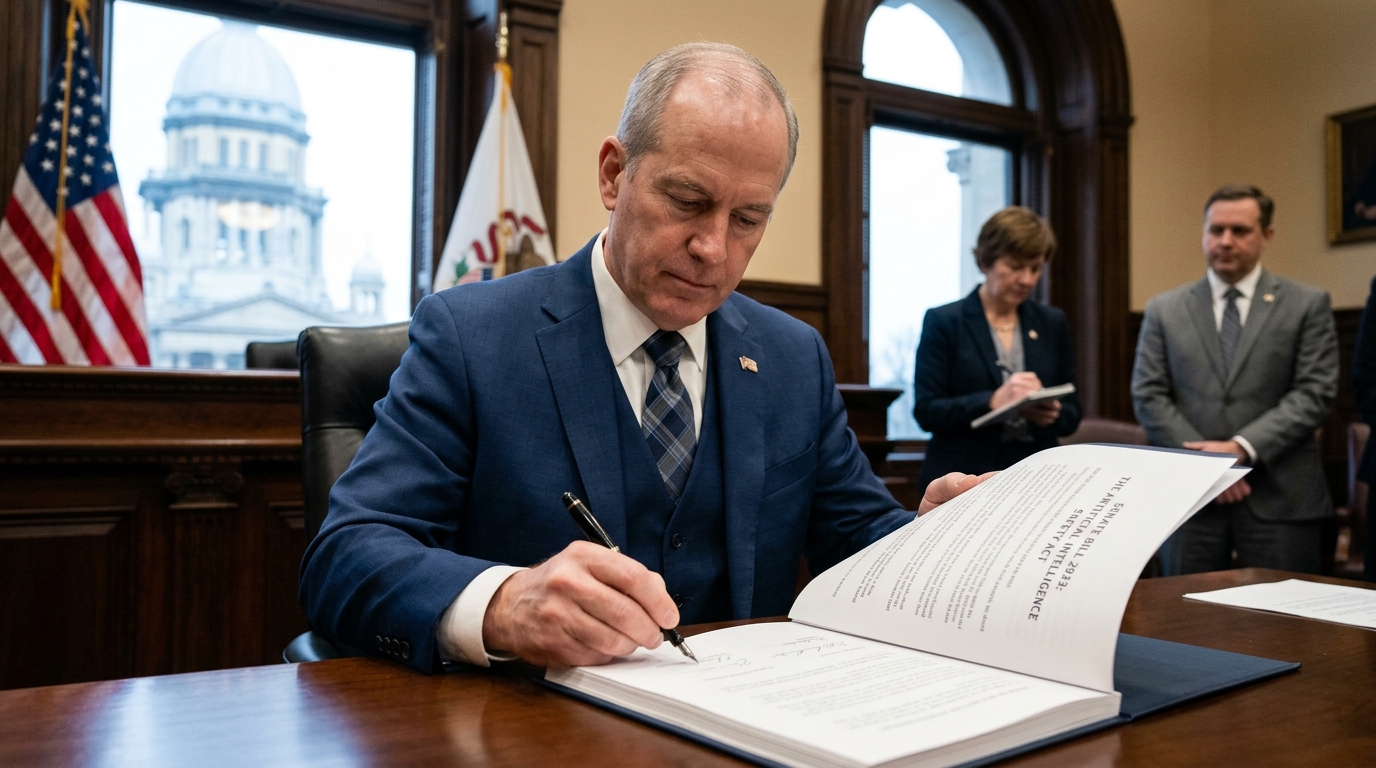
In a move poised to reshape the landscape of technological governance in the United States, Illinois Governor J.B. Pritzker has signed comprehensive AI safety legislation into law. This new mandate makes Illinois one of the first states to require mandatory external audits of so-called "frontier models"—the most advanced and powerful AI systems currently being developed by tech giants. This legislative leap comes at a time when federal gridlock in Washington D.C. has left a vacuum, prompting individual states to define the rules of engagement for a technology that promises to transform global society.
The Anatomy of the New Mandate
The law specifically targets models that possess the computational scale to trigger significant societal shifts or potential catastrophic risks. Under the new provisions, companies developing these high-capacity models are now required to undergo annual audits conducted by independent third parties. These audits are not merely technical check-ups; they are designed to scrutinize algorithmic bias, cybersecurity vulnerabilities, and the potential for models to be weaponized or used in the creation of harmful content.
Furthermore, the legislation demands that companies provide detailed disclosures regarding their training data. While intellectual property and trade secret protections remain, the law enforces a level of transparency previously unseen in the industry. "We cannot allow technology to move faster than our ability to understand and govern it," Governor Pritzker remarked during the signing ceremony in Chicago, emphasizing that public safety must take precedence over corporate bottom lines.
Illinois as a Regulatory Laboratory
This isn't the first time Illinois has taken the lead in protecting digital rights. Building on the legacy of the Biometric Information Privacy Act (BIPA), the state has proven it is not afraid to challenge Silicon Valley's status quo. The new AI safety law is viewed as the natural evolution of this tradition. Analysts suggest this move could trigger a "domino effect," compelling other states to adopt similar or even more stringent measures, effectively creating a de facto national standard in the absence of federal action.
However, the reaction from the tech sector has been polarized. While some firms welcomed the clarity provided by established rules, others warned that heavy-handed auditing could stifle innovation and lead to capital flight toward states with more laissez-faire regulatory environments. The specter of "digital migration" is a common refrain, but Illinois is betting that its market access and deep talent pool are too significant for companies to ignore.
Challenges and Ethical Dilemmas
One of the primary challenges in implementing the law lies in the definition of a "frontier model." As technology evolves at an exponential pace, what is considered cutting-edge today may become commonplace tomorrow. The legislation includes provisions for regular reviews of technical criteria to ensure it remains relevant. Additionally, the question of who qualifies as an "independent auditor" remains contentious. Who possesses the high-level expertise required to audit models that even their creators struggle to fully interpret?
The ethical dimension is equally critical. The law places a heavy emphasis on protecting marginalized communities from the biases often baked into algorithmic systems. By mandating bias audits, Illinois is attempting to ensure that Artificial Intelligence does not amplify the social injustices of the past. This represents a significant victory for civil liberties organizations that have spent years lobbying for such oversight.
Conclusion: A New Era of Accountability
The signing of this law marks the end of the "Wild West" era for AI in the United States. Illinois is sending a clear message: innovation is welcome, but accountability is non-negotiable. As the world watches the development of AI with a mixture of awe and trepidation, initiatives like Governor Pritzker's offer a roadmap for how democratic societies can navigate an unchartered future. The question is no longer whether regulation will occur, but how quickly other jurisdictions will adapt to this new reality of oversight.