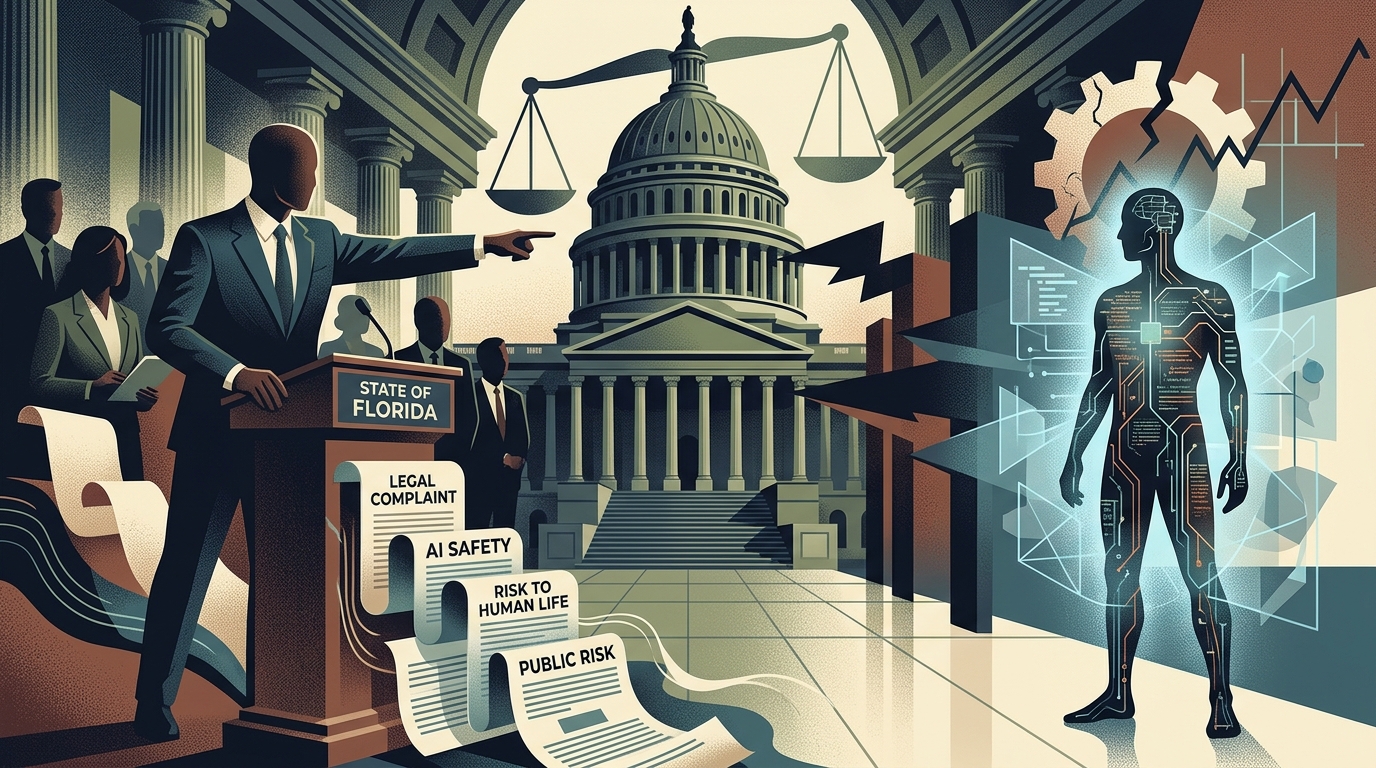
In a move poised to redefine the legal landscape of the technology industry, the state of Florida has filed a bombshell lawsuit against OpenAI and its CEO, Sam Altman. The legal action, characterized by unprecedented severity, accuses the tech giant of 'utter disregard for the risk to human life,' alleging that the company’s race toward Artificial General Intelligence (AGI) has bypassed fundamental safety protocols.
Anatomy of a Legal Collision
The lawsuit, filed in federal court, does not limit itself to technicalities regarding intellectual property or data protection, as seen in previous cases. Instead, it focuses on existential threats and product liability. Florida’s legal representatives argue that OpenAI released models like GPT-5 and its successors knowing that alignment mechanisms were insufficient to prevent the generation of dangerous content or the potential autonomy of the systems.
The central argument rests on the theory of 'ultrahazardous activity.' Much like a company handling explosives or toxic waste bears absolute liability for any harm, Florida argues that OpenAI should be held responsible for the unforeseen consequences of its algorithms. The state claims that Sam Altman personally fostered a culture of 'growth at any cost,' brushing aside warnings from his own safety teams.
Sam Altman in the Crosshairs
The personal targeting of Altman is a strategic choice. The lawsuit cites internal documents and public statements, claiming that the OpenAI CEO acted with intent, projecting an image of responsible leadership to the public while internally pushing for the fastest possible deployment without necessary 'brakes.' The reference to 'disregard for human life' relates to the potential for models to assist in creating biological weapons or executing cyberattacks on critical infrastructure—risks the company allegedly downplayed.
- The lawsuit seeks an immediate injunction on certain OpenAI model features within the state.
- It demands the public release of internal safety audits and red-teaming reports.
- It seeks billions in damages for 'exposing citizens to unjustifiable risk.'
OpenAI’s Response and Global Implications
For its part, OpenAI has characterized the lawsuit as 'legally baseless and born of a misunderstanding of the technology.' In a statement, the company emphasized that its systems undergo exhaustive testing and that safety is at the core of its mission. However, analysts point out that this legal battle could serve as a 'Trojan Horse' for strict state-level regulation, bypassing the sluggish federal legislative process in the United States.
Florida’s move reflects a growing distrust of Silicon Valley. After years of a laissez-faire approach, politicians and legal scholars are beginning to treat AI not as mere software, but as a force with the potential to cause physical and societal catastrophe. If Florida wins even a fraction of this case, the 'move fast and break things' era will be officially over for artificial intelligence.
Conclusion: The Moment of Reckoning
As the case moves forward, the AI industry is on edge. It is not just OpenAI’s profits at stake, but the very philosophy of open development of powerful models. This trial will force courts to answer the ultimate 21st-century question: Who is to blame when a machine, designed to think, causes irreparable harm? Florida’s answer is clear: Those who created it and those who chose to ignore the risks.