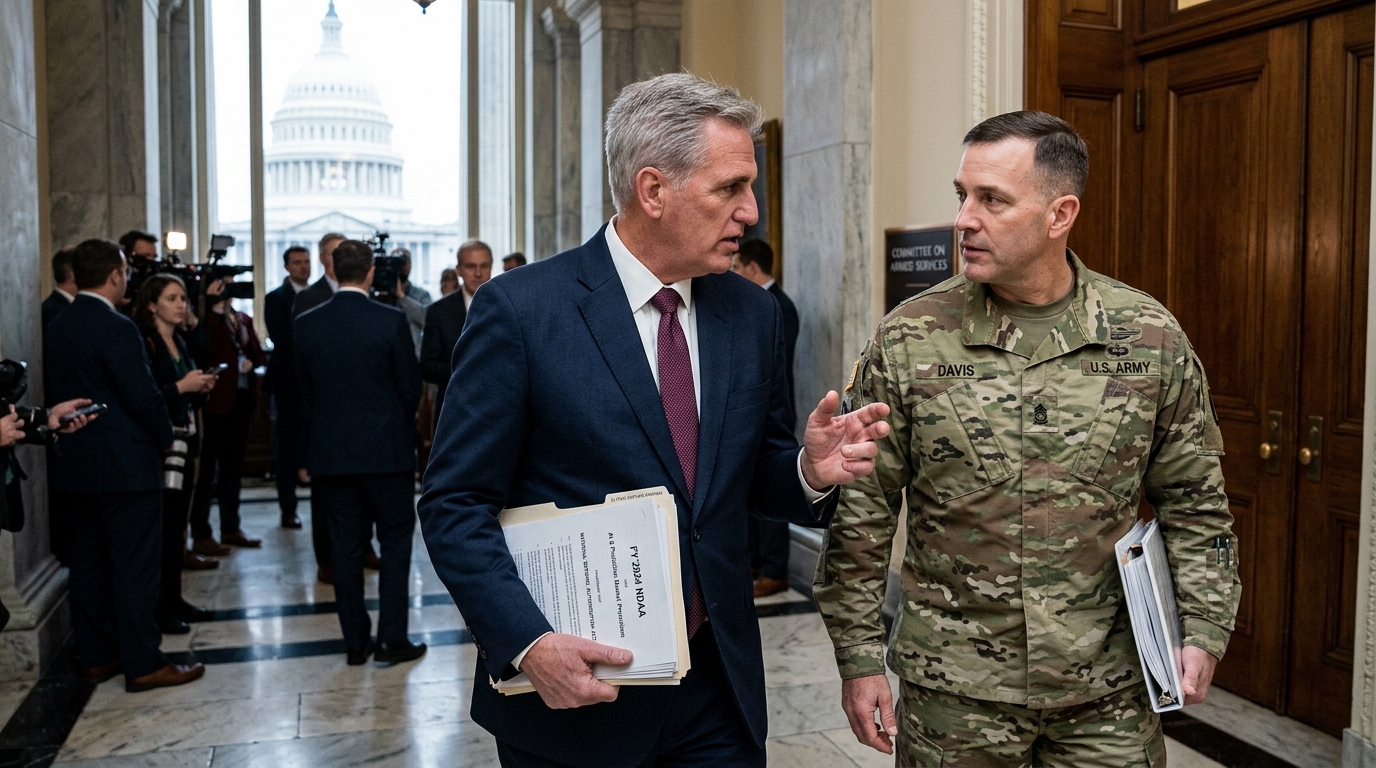
In the hallowed halls of the Capitol, the annual process for the National Defense Authorization Act (NDAA) is traditionally a battlefield for national security priorities. However, the 2026 iteration for Fiscal Year 2027, as revealed by Punchbowl News, introduces some of the most disruptive changes in the history of the American military. It is no longer just about planes, ships, and missiles; the focus is shifting decisively toward Artificial Intelligence (AI) and, surprisingly, "prediction markets" as strategic analysis tools.
AI as the New Backbone of Defense
The integration of AI into the NDAA is not a surprise, but the scale and specificity of the new provisions are unprecedented. The bill provides for the creation of accelerated pathways for the adoption of Generative AI at all levels of command. From logistics and equipment maintenance to real-time analysis of satellite imagery, AI is ceasing to be an experimental tool and becoming the central pillar of operational readiness.
These provisions directly target competition with China, which has invested billions in "intelligentized warfare." The US seeks to ensure that its own systems can process data at speeds exceeding human perception, allowing commanders to make split-second decisions. However, funding is not limited to software; it extends to the necessary infrastructure—from specialized semiconductors to high-security data centers.
The Gamble on Prediction Markets
Perhaps the most controversial addition to the new NDAA is the institutionalization of pilot programs using prediction markets to forecast geopolitical events. Prediction markets are platforms where participants "bet" on the probability of an event occurring—such as an invasion, a coup, or a missile test. The theory behind this is the "wisdom of the crowd": financial incentives drive participants to reveal their true assessment, often offering more accurate forecasts than traditional intelligence services.
The idea is not new—DARPA attempted to introduce something similar in the early 2000s, but the plan was canceled after an outcry that the Pentagon was creating a "death market." Today, however, the rise of platforms like Polymarket and Kalshi has changed the climate. Proponents argue that these markets can act as an early warning system, complementing spy reports with the cold logic of financial incentives.
Geopolitical and Ethical Challenges
The shift toward a military based on algorithms and economic models raises serious questions. First, there is the issue of accountability. If an AI recommends a strike based on probabilistic analysis, who bears the responsibility for any collateral damage? The NDAA includes clauses for "responsible use," but critics fear that the speed of developments will outpace the regulatory framework.
Furthermore, using prediction markets for national security carries the risk of manipulation. Hostile forces could theoretically "bet" heavily on an outcome to mislead US analysts. Despite these challenges, the consensus in Washington seems to be that abstaining from these technologies is a greater risk than adopting them. In a world where information is the dominant weapon, the ability to predict the future—whether through code or markets—is the ultimate strategic advantage.
Conclusion: The Dawn of Algorithmic Defense
The FY2027 NDAA is not just a budget; it is a manifesto for the future of power. The convergence of Silicon Valley and the Pentagon is nearing completion. As AI is integrated into the core of the defense machine and prediction markets become tools of statecraft, the US is entering an era where war is fought not only on the ground but also in the realm of probabilities. The challenge for the coming years will be to ensure that, amidst this ocean of data and bets, human judgment and ethical values remain the final fail-safe.