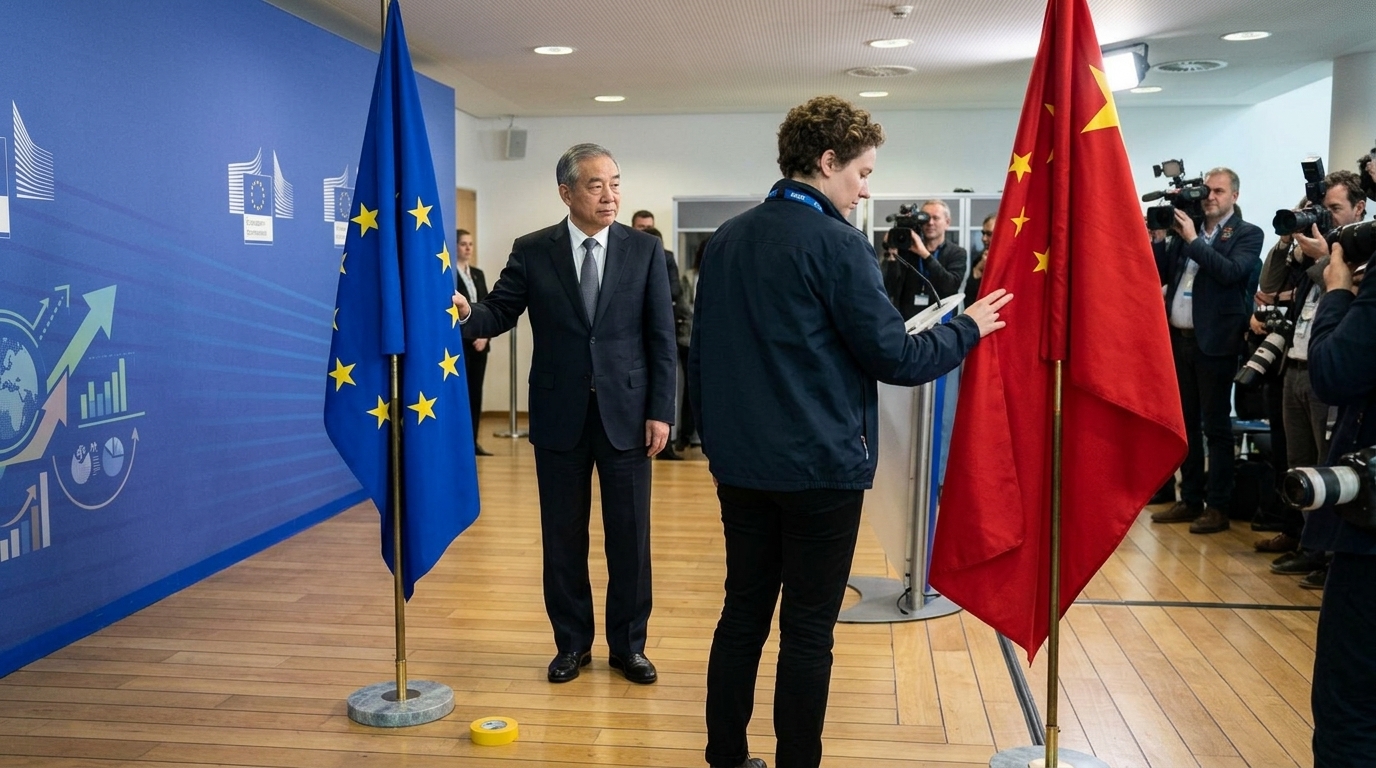
The geopolitical chessboard of the global economy is trembling following Beijing's latest warnings to Brussels. As the European Commission accelerates the implementation of its 'Made in Europe' strategy, China has made it clear that it will not remain a passive observer. This conflict is not merely about tariffs and trade balances; it is about dominance in the Fourth Industrial Revolution, where Artificial Intelligence and green technologies serve as the new 'nuclear weapons' of economic power.
The EU’s Strategic Autonomy and the Chinese Counter-Argument
The 'Made in Europe' plan, part of the broader Net-Zero Industry Act (NZIA), aims to decouple the continent from Chinese supply chains. Following the painful lesson of energy dependence on Russia, the EU is striving not to repeat the same mistake with critical raw materials and renewable energy technology. However, for Beijing, this move is interpreted as pure protectionism that violates World Trade Organization (WTO) rules.
The Chinese Ministry of Commerce issued an unusually sharp statement, emphasizing that the EU is 'weaponizing' the green transition to exclude Chinese groups from the European market. The warning is explicit: if Brussels proceeds with unilateral actions, Beijing will take 'all necessary measures' to protect the interests of Chinese enterprises. This translates into a potential trade war that could hit vital European sectors, from Germany’s automotive industry to France’s luxury goods and the South’s agricultural exports.
The Stakes of AI and Rare Earths
At the heart of this confrontation lies the production of semiconductors and the development of AI systems for manufacturing. China controls the majority of the world's rare earth processing, which is essential for every 'smart' device and electric vehicle. The threat of restricting exports of these materials is Beijing’s strongest card. On the other hand, the EU, through 'Made in Europe,' is subsidizing domestic microchip production, attempting to close the technological gap.
- Restrictions on gallium and germanium exports by China.
- European investigations into Chinese state subsidies for electric vehicles (EVs).
- Potential retaliatory tariffs on European spirits and pork products.
- The battle over industrial AI standards.
The use of AI in supply chain management now allows nations to pinpoint the vulnerabilities of their rivals with surgical precision. China utilizes sophisticated algorithms to predict European market needs and adjust its production, making competition extremely difficult for European SMEs that lack the same access to data and capital.
Europe’s Dilemma: Protectionism or Decline?
The Commission President is under immense pressure. On one side, Washington is pushing for a tougher stance against China, aligned with the American strategy of 'de-risking.' On the other, major European industries fear that losing the Chinese market would be catastrophic. The German car industry, for instance, is heavily dependent on sales in China to fund its transition to electromobility.
"We cannot build Europe's future on the ruins of free trade, but we also cannot allow ourselves to become an industrial museum," stated a senior European diplomat.
China's response to 'Made in Europe' is not just a reaction; it is a statement of power. Beijing believes the West is trying to 'pull up the ladder' now that China has reached the top of the technological pyramid. This conflict is expected to escalate in the coming months as the EU nears the finalization of new public procurement regulations that will give a clear advantage to European products.
Conclusions and Outlook
Greece and other peripheral nations find themselves in a precarious position. While strengthening European industry is welcome, potential Chinese sanctions could harm agricultural exports and tourism. The need for a balanced approach is more urgent than ever. Artificial Intelligence may play the role of a 'referee,' helping analyze the impacts of every trade decision, but the final choice remains political. 'Made in Europe' is a survival bet for the EU, but the price of confrontation with the Asian giant may prove heavier than Brussels anticipated.