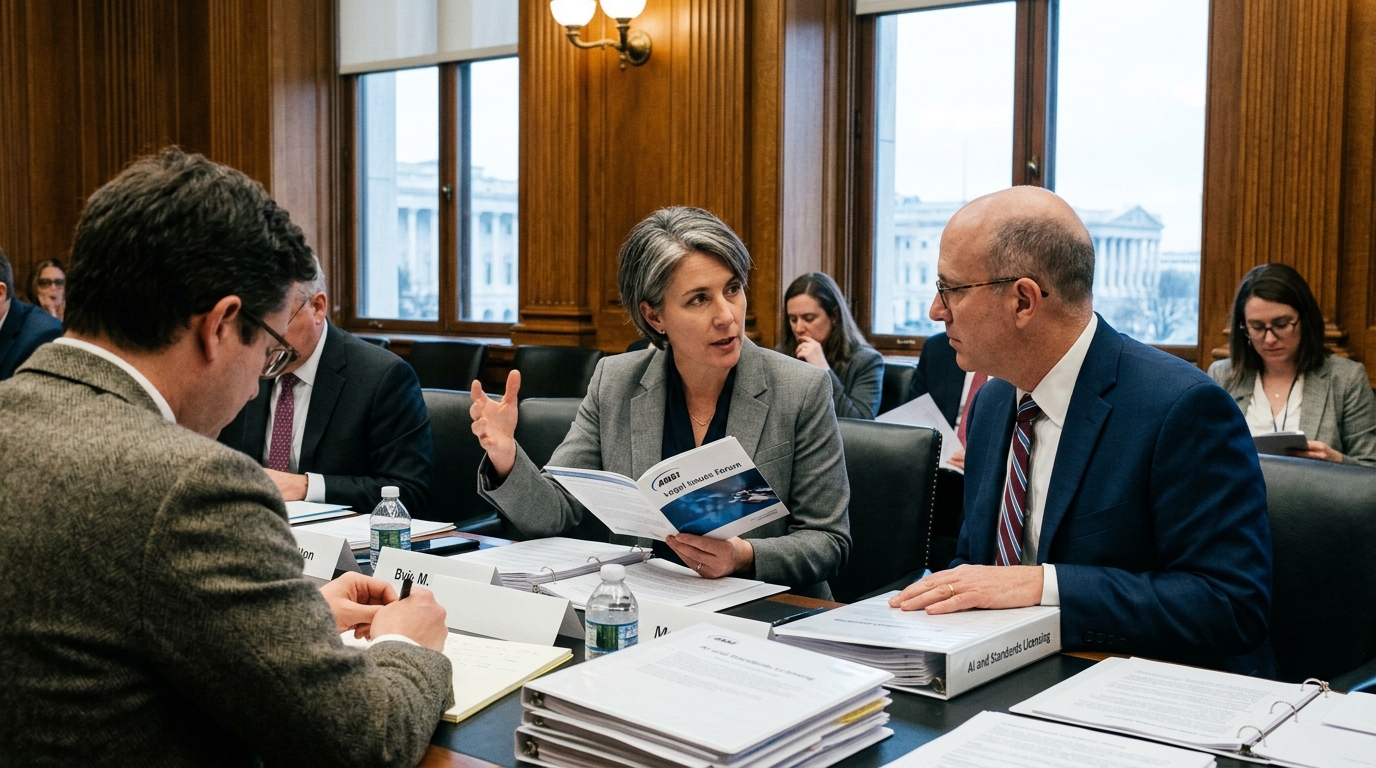
In an era where Artificial Intelligence (AI) is no longer a future promise but a daily generative reality, the institutions governing global technical infrastructure are facing unprecedented challenges. The American National Standards Institute (ANSI) has announced its annual Legal Issues Forum, which this year focuses exclusively on how AI is reshaping the landscape of standards licensing and intellectual property (IP) protection. This move highlights a critical turning point: the intersection of algorithmic systems with the rigid frameworks of technical specifications demands a radical reassessment of our legal foundations.
The IP Challenge in the Age of Large Language Models
The central issue occupying the forum is the use of protected technical standards to train AI models. Standards Development Organizations (SDOs) traditionally rely on revenue from selling and licensing their documents to fund their operations. However, as Large Language Models (LLMs) ingest vast amounts of data, including these specifications, the question arises: does this use constitute 'fair use' or is it a copyright infringement?
The debate is not merely theoretical. If AI can accurately reproduce technical specifications without the user purchasing the official document from ANSI or ISO, the economic model of global standardization risks collapse. Forum participants are expected to analyze recent court rulings and propose new licensing models that allow for AI training while ensuring the sustainability of the organizations that produce the standards.
The Evolution of FRAND Licensing and AI
Another critical point is the evolution of FRAND (Fair, Reasonable, and Non-Discriminatory) terms. Standards involving patents—known as Standard Essential Patents (SEPs)—form the backbone of telecommunications and information technology. With AI being integrated into nearly every technological sector, determining what constitutes a 'reasonable royalty' is becoming extremely complex.
- How does automated code and design generation affect the value of a patent?
- Who owns the rights when an AI improves upon an existing standard?
- Can an algorithm be considered an 'inventor' within the context of standards licensing?
These questions require answers that harmonize patent law with the speed of technological evolution. The complexity increases when considering that AI can now identify patent infringements in real-time, but also create 'defensive' IP walls that make it difficult for new players to enter the market.
Liability, Safety, and the Future of Governance
Beyond economics and rights, the forum will examine the burning issue of legal liability. Technical standards exist to guarantee safety and interoperability—from electrical plugs to cybersecurity protocols. When AI is used to draft these standards, the question of liability in the event of a failure becomes blurred.
"Standardization is the language of trust in the global economy. If AI alters this language without a clear legal framework, that trust will be shaken," industry analysts note.
The need for transparency is imperative. The forum will discuss the possibility of mandatory watermarking or other identification methods for AI-generated content within official standards documents. Furthermore, the role of regulatory intervention, such as the EU AI Act, and how it interacts with ANSI’s voluntary standards, will be scrutinized.
Conclusion: Toward a New Social Contract for Technology
The ANSI Legal Issues Forum is not just a meeting of lawyers; it is an attempt to build a new 'social contract' for the digital age. The balance between the open innovation promised by AI and the protection of intellectual labor required by standards is delicate. As we move toward 2027, the decisions made in such forums will determine whether AI acts as an accelerator of global progress or as a factor of legal and economic destabilization. The challenge for ANSI is to remain the guardian of quality in a world where the quantity of information grows exponentially, but authenticity and responsibility remain scarce commodities.