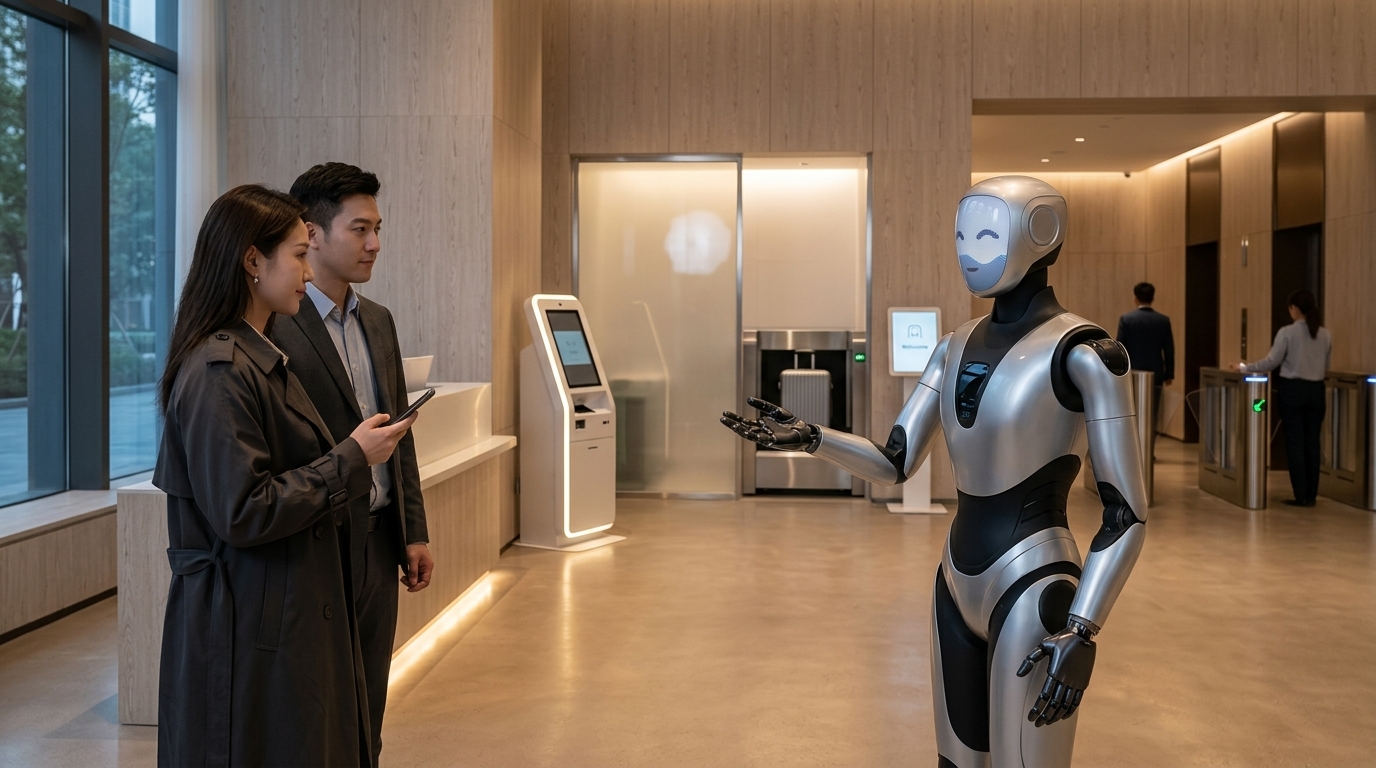
In the heart of Shenzhen, the city often dubbed the "Silicon Valley of Hardware," a revolution is underway. Pudu Robotics, one of the global leaders in service robotics manufacturing, has announced its most ambitious project to date: the creation of the world's first hotel operated exclusively by artificial intelligence and robotic units. With a scheduled launch in 2027, this venture is not merely a display of technological prowess but a radical reassessment of the concept of hospitality.
The Architecture of Autonomy
Pudu Robotics' plan envisions an ecosystem where every interaction, from the moment a guest enters the gates until their departure, is managed by specialized robots. The check-in process will be conducted via biometric sensors and voice assistants powered by Large Language Models (LLMs), capable of conversing naturally in dozens of languages. Luggage will be transported to rooms by autonomous delivery units, while the cleaning of common areas and guest rooms will be performed by robots equipped with UV-C disinfection technology and advanced navigation systems.
The most intriguing aspect, however, concerns room service. Pudu Robotics intends to integrate its already successful robot servers, such as the BellaBot, into a closed network directly connected to the hotel's fully automated kitchen. Orders will be prepared by robotic arms and delivered to the guest's door without the slightest human intervention. This model promises zero errors, 24/7 availability, and an unprecedented sense of privacy for the visitor.
Social and Economic Context
This move by China does not occur in a vacuum. The country is facing a severe demographic crisis, with its working-age population shrinking rapidly. The service sector, and hospitality in particular, is struggling to find staff for low-skilled but high-intensity positions. Full automation is viewed by Beijing as a "new quality productive force" that can sustain economic growth despite a declining workforce.
"We are not just building a hotel. We are building the blueprint for the cities of the future, where technology serves humanity in an invisible yet perfectly efficient manner," a Pudu Robotics executive stated during the plan's presentation.
However, analysts warn of the challenges. Hospitality is etymologically and historically linked to human contact, smiles, and empathy. Can a robot, no matter how advanced, replace the warmth of a host? Furthermore, serious issues of cybersecurity and data protection arise. In a building filled with cameras, sensors, and facial recognition systems, the line between service and surveillance becomes perilously thin.
The Challenge of the Uncanny Valley
One of the greatest obstacles Pudu Robotics must overcome is the so-called "Uncanny Valley"—the discomfort humans feel when machines look too much, but not perfectly, like humans. For this reason, the company is opting for a design that is functional and "friendly" (cute-tech), avoiding anthropomorphic aesthetics that could alienate guests. The bet for 2027 is whether the public will accept the hotel as a luxurious, high-tech experience or view it as a sterile and cold environment. What is certain is that Shenzhen is preparing to write the next chapter in the history of tourism, and the world is watching with bated breath.