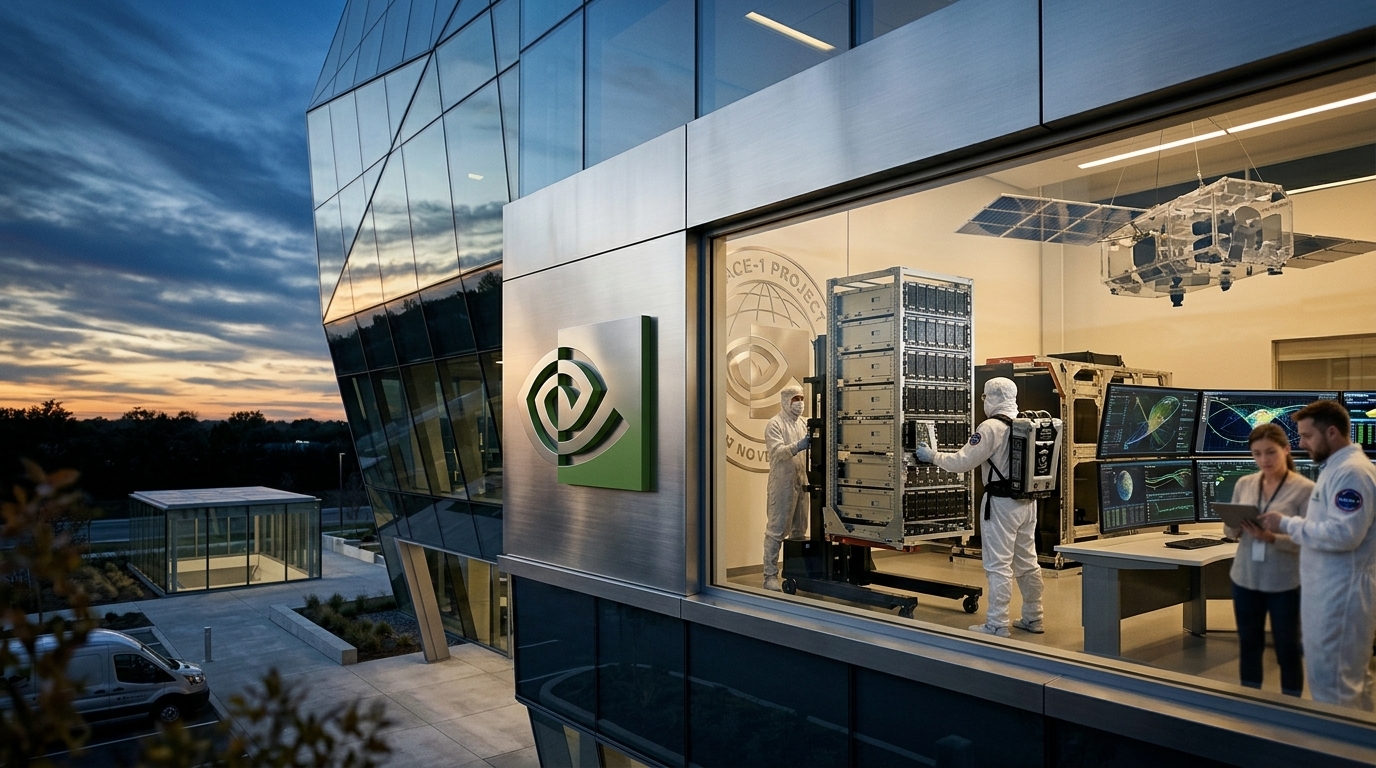
Nvidia’s dominance in artificial intelligence is no longer confined to terrestrial data centers that consume vast amounts of energy and occupy acres of land. With its sights set on the stars, the semiconductor giant is accelerating its efforts to create Space-1, an ambitious computing system designed specifically for Low Earth Orbit (LEO). Recent job postings for engineers specializing in radiation hardening, vacuum thermal management, and orbital systems confirm that Nvidia views space not just as a communication channel, but as the next great frontier for edge computing.
The Strategy Behind Space-1
Nvidia’s move to bring its GPU power to orbit is a logical evolution of its "Edge AI" strategy. Today, thousands of satellites circling the planet collect unimaginable amounts of data—from high-resolution imagery for precision agriculture to signals for military intelligence. However, sending this raw data back to Earth for processing creates a massive latency problem and requires enormous bandwidth. Space-1 aims to solve this by enabling data processing directly in orbit. Imagine a satellite that doesn’t just send a photo of a wildfire but uses AI to analyze its path in real-time and sends direct instructions to ground forces immediately.
Engineering for the Extremes: From Silicon to the Vacuum
Moving Nvidia’s chips into space is no simple feat. Traditional data centers rely on giant cooling systems and are protected by the Earth's atmosphere. In space, the challenges are threefold: radiation, heat, and power. Cosmic rays can cause errors in electronic circuits (bit-flips), making it essential to develop "radiation-hardened" semiconductors that maintain their speed without being destroyed. Furthermore, in the vacuum of space, there is no air to carry heat away from the chips. Nvidia must invent new ways to dissipate heat through radiation, using advanced materials previously seen only in experimental NASA craft. The company's hiring spree indicates it is investing in top aerospace talent to bridge the gap between Silicon Valley and astrophysics.
The Geopolitics of Orbital Computing
Beyond the technical aspects, Space-1 has profound geopolitical implications. Possessing computing power in space offers a strategic advantage that no terrestrial infrastructure can match. In a world where AI dominance equates to national power, a company’s (and by extension, its allies') ability to control data from above is decisive. Already, Nvidia’s collaborations with firms like SpaceX and Microsoft Azure Space signal the creation of a new ecosystem. This ecosystem could bypass national jurisdictions and the limitations of terrestrial networks, creating a new form of "digital sovereignty" that hovers above national borders. The European Union, while watching closely, finds itself once again in a chasing position, trying to balance the need for technological autonomy with its dependence on American tech.
Implications for the Global Economy and Environment
Finally, moving data centers to space could offer an unexpected solution to AI’s energy problem. On Earth, the energy consumption of data centers is a major environmental concern. In space, solar energy is abundant and uninterrupted. Although launch costs remain high, the long-term operation of AI infrastructure powered exclusively by the sun—without burdening the terrestrial power grid—is an attractive prospect. Nvidia seems to be betting on a future where the "Cloud" is not just a metaphor, but a physical reality surrounding the planet, providing intelligence to every corner of the Earth, from the most remote sea to the most densely populated metropolis.