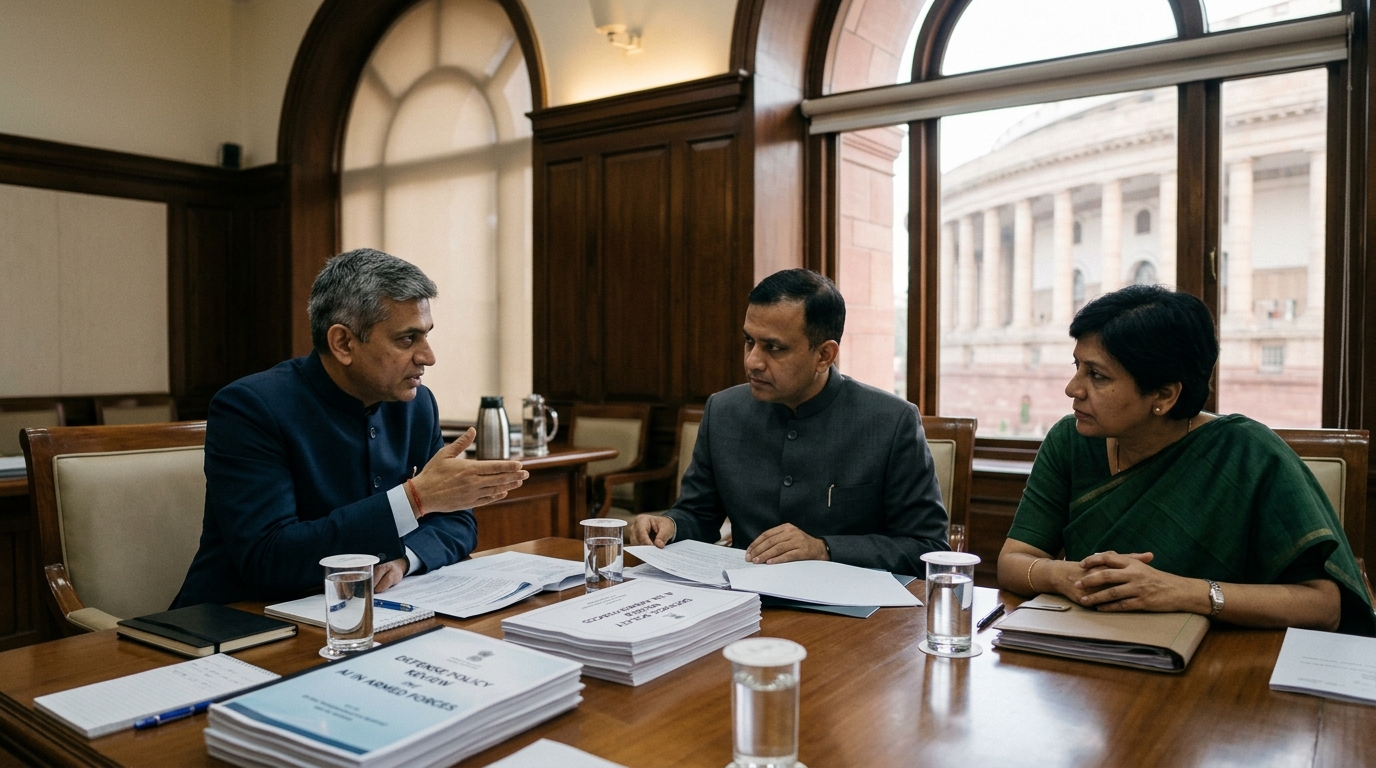
As we navigate the middle of 2026, India stands at a decisive geopolitical crossroads. With tensions in Asia reaching a fever pitch, New Delhi is accelerating the integration of Artificial Intelligence (AI) into its armed forces, evolving the traditional 'Atmanirbhar Bharat' (Self-Reliant India) doctrine into a digital-first military strategy. The revised defense policy on AI is not merely a technical upgrade; it is a fundamental reimagining of how the world’s most populous nation perceives national security, deterrence, and the balance of power against formidable neighbors like China and Pakistan.
The Doctrine of Digital Sovereignty and the Role of DAIPA
The backbone of India's strategic shift lies in the empowerment of the Defence AI Council (DAIC) and the Defence AI Project Agency (DAIPA). These bodies are tasked with the monumental challenge of converting the vast oceans of data generated by the armed forces into actionable, real-time intelligence. The political leadership has made it clear that reliance on foreign algorithms is a liability to national sovereignty. Consequently, India is funneling billions of rupees into domestic R&D for autonomous systems, predictive maintenance of legacy hardware, and AI-driven satellite imagery analysis.
This policy is built upon four critical pillars: Data Fusion, System Autonomy, Cybersecurity, and Human Capital Development. Already, more than 75 AI-powered products have been inducted into the arsenal, ranging from sophisticated drone swarms to AI-assisted mine detection systems. However, the primary challenge remains the integration of these disparate systems into a cohesive network capable of executing multi-domain operations (MDO) across land, sea, air, and space.
The Dragon's Shadow: An Asian AI Arms Race
India’s defense posture cannot be analyzed in a vacuum, away from China's overarching influence. Beijing has set an ambitious goal to become the global AI leader by 2030, and India is feeling this pressure directly along the Line of Actual Control (LAC) in the Himalayas. The deployment of AI for high-altitude surveillance and logistics is no longer a luxury but a necessity. Indian military planners are acutely aware that in a future conflict, the speed of decision-making—the OODA loop (Observe, Orient, Decide, Act)—will be dictated by algorithmic efficiency.
This 'algorithmic race' introduces significant security risks to the Asian continent. There is a growing concern regarding 'automated escalation.' If an Indian autonomous system misinterprets the maneuvers of a Chinese counterpart, the retaliatory response could occur in milliseconds. Without robust safeguards, this could lead to a cycle of escalation that bypasses human diplomacy, potentially triggering a conflict that neither side intended to start.
"Artificial Intelligence is no longer just a force multiplier; it is the new high ground. Sovereignty in the 21st century will be won or lost based on the integrity of one's code and the speed of one's processors," notes a senior official from the Indian Ministry of Defence.
Ethical Thresholds and the 'Human-in-the-loop' Mandate
Despite the aggressive push for automation, India remains officially committed to the 'Human-in-the-loop' principle. The new policy framework explicitly states that the final decision to employ lethal force must rest with a human operator. However, critics argue that as the 'tempo of war' increases, the human element risks becoming a rubber stamp. When an AI provides a target recommendation in a split second, a soldier may lack the cognitive time or the information to override the machine's suggestion.
Furthermore, India faces a strategic dilemma regarding its partnerships. The Initiative on Critical and Emerging Technology (iCET) with the United States offers a pathway to advanced technology transfer. Yet, this creates a dependency that New Delhi is historically wary of. Balancing the need for cutting-edge Western hardware with the desire for 'strategic autonomy' is the delicate tightrope that Indian diplomacy must walk in the coming years.
- Developing indigenous semiconductor capabilities to power military-grade AI.
- Establishing dedicated 'Digital Warrior' units across the Army, Navy, and Air Force.
- Leveraging the private sector and startups through the iDEX (Innovations for Defence Excellence) program.
- Addressing the threat of AI-generated misinformation and deepfakes in psychological warfare.
In conclusion, India is not merely reacting to technological trends; it is attempting to set the rules of engagement in Asia. The success of this new defense policy will depend on the nation's ability to bridge the gap between bureaucratic inertia and technological agility, all while maintaining an ethical compass in an increasingly algorithmic world.