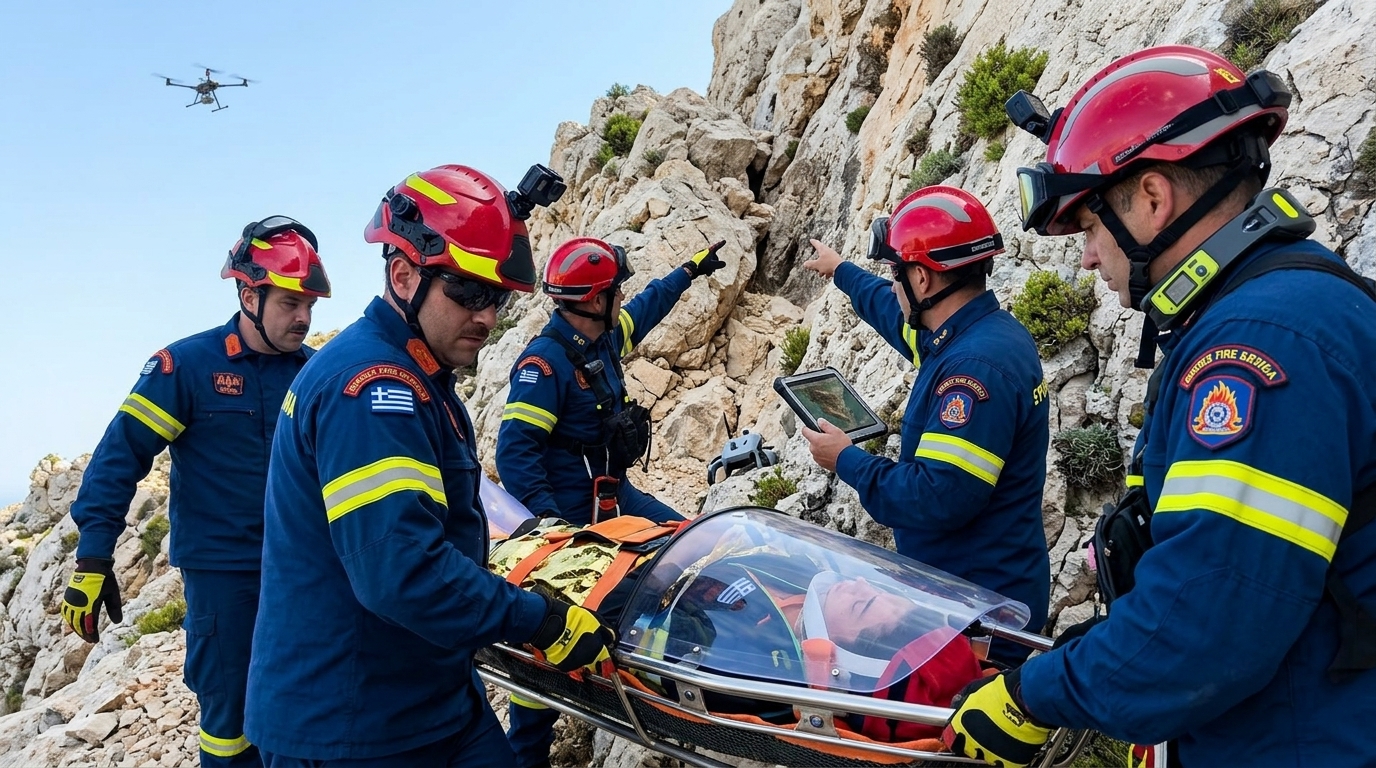
On Saturday, the local community of Zakynthos and security authorities faced yet another incident that highlights the challenges of tourism in rugged, inaccessible areas. A 48-year-old Dutch national, part of a trekking group, was seriously injured after falling in the Korakonisi area—a place of unparalleled natural beauty but also high risk due to its treacherous terrain. The mobilization of the Fire Service and EKAB (Emergency Medical Service) was immediate, with rescuers making superhuman efforts to reach and safely transport the injured woman. However, beyond the undeniable bravery of the first responders, this incident serves as a catalyst for a deeper discussion on how Artificial Intelligence and emerging technologies can transform Search and Rescue (SAR) operations.
The Challenge of "Instagrammable" Danger
In the age of social media, the quest for the perfect photographic moment often leads visitors to unmapped or dangerous paths. Korakonisi, much like the famous Navagio (Shipwreck) beach, acts as a magnet that tests the limits of human caution and state readiness. Greece's geomorphology, characterized by steep cliffs and rugged mountains, demands more than traditional rescue methods. This is where AI begins to play a pivotal role. Predictive Risk Assessment systems can now analyze tourist movement data, weather patterns, and accident history to warn authorities about high-risk areas in real-time.
- Geospatial data analysis to identify dangerous passages and unstable ground.
- Algorithms predicting tourist behavior based on popular trends on social media platforms.
- Automated 112 emergency alerts triggered when a user enters a designated "red zone."
Drones and Computer Vision: Eyes in the Sky
In the Zakynthos operation, the approach was conducted by ground forces, which often costs precious time. Integrating drones equipped with thermal imaging cameras and Computer Vision software can reduce the time required to locate an injured person by up to 80%. These systems don't just "see" an image; they can identify the human form amidst dense vegetation or jagged rocks, even under low-light conditions. Furthermore, AI enables drones to fly autonomously in swarms, covering vast areas in minutes and transmitting 3D maps of the terrain to rescuers before they even reach the site.
"Technology does not replace the rescuer; it provides the critical information needed to avoid risking lives unnecessarily," state civil protection experts.
Towards a Smart Civil Protection System
The case of the 48-year-old Dutch tourist also underscores the importance of wearables. Although not mentioned in this specific case, the future of tourism safety lies in "Smart National Parks." Imagine digital bracelets or apps that, via Edge AI technology, can detect a sudden fall (fall detection) and automatically send precise GPS coordinates to authorities, even without cellular coverage, by utilizing Low Earth Orbit (LEO) satellite links. Greece, as a premier global tourist destination, must invest in such infrastructure, evolving "traditional" rescue into a digitally supported precision operation.
In conclusion, the successful outcome in Zakynthos is a triumph of human fortitude. However, for our country to remain a safe destination in the dawn of 2026, the convergence of cutting-edge technology with the operational expertise of security forces is the only way forward. Artificial Intelligence is no longer a theoretical concept but the essential tool that will ensure every adventure in Greece's natural wonders has a happy ending.