As we navigate the second quarter of 2026, the question looming over the global economy is no longer whether Artificial Intelligence (AI) will change the world, but who holds the keys to that change. Generative AI, which began as a promise to democratize creativity, has evolved into the most expensive and strategic battlefield in the history of technology. Its ownership is no longer confined to a few lines of code; it spans from rare earth mines and Taiwanese semiconductor plants to the massive data center complexes that consume the energy of small nations.
The Iron Triangle of Power: Hardware, Data, and Talent
To understand who truly owns AI, we must deconstruct its value chain. At the summit are the "Lords of Silicon." Companies like Nvidia, which solidified its dominance in 2025 with the Blackwell architecture, control the computational power without which no model can be trained. Without access to tens of thousands of GPUs, even the most brilliant algorithms remain theoretical exercises.
The second pillar is data. Recent legal battles between major publishing houses and OpenAI/Google have highlighted a harsh truth: generative AI is the result of "digital mining" of the entire human intellectual output. Who owns the right to the collective memory of the internet? While platforms like Reddit and X (formerly Twitter) have locked their data behind expensive paywalls, Big Tech has already managed to "swallow" the public web, creating an oligopoly of knowledge.
Open vs. Closed Software: A False Dichotomy?
The battle between the "closed" model (OpenAI, Google, Anthropic) and the "open" model (Meta, Mistral) has taken on political dimensions. Meta, with its Llama series, argues that open-source software is the only defense against centralization. However, critics point out that even "open" AI requires such massive capital to run that it ultimately depends on the cloud infrastructures of Amazon (AWS) or Microsoft (Azure). In other words, even if the code is free, the "house" it lives in belongs to the usual suspects.
"Artificial Intelligence is not just a software tool; it is the new infrastructure of our cultural and economic reality. Whoever controls its foundations controls the future of work and truth."
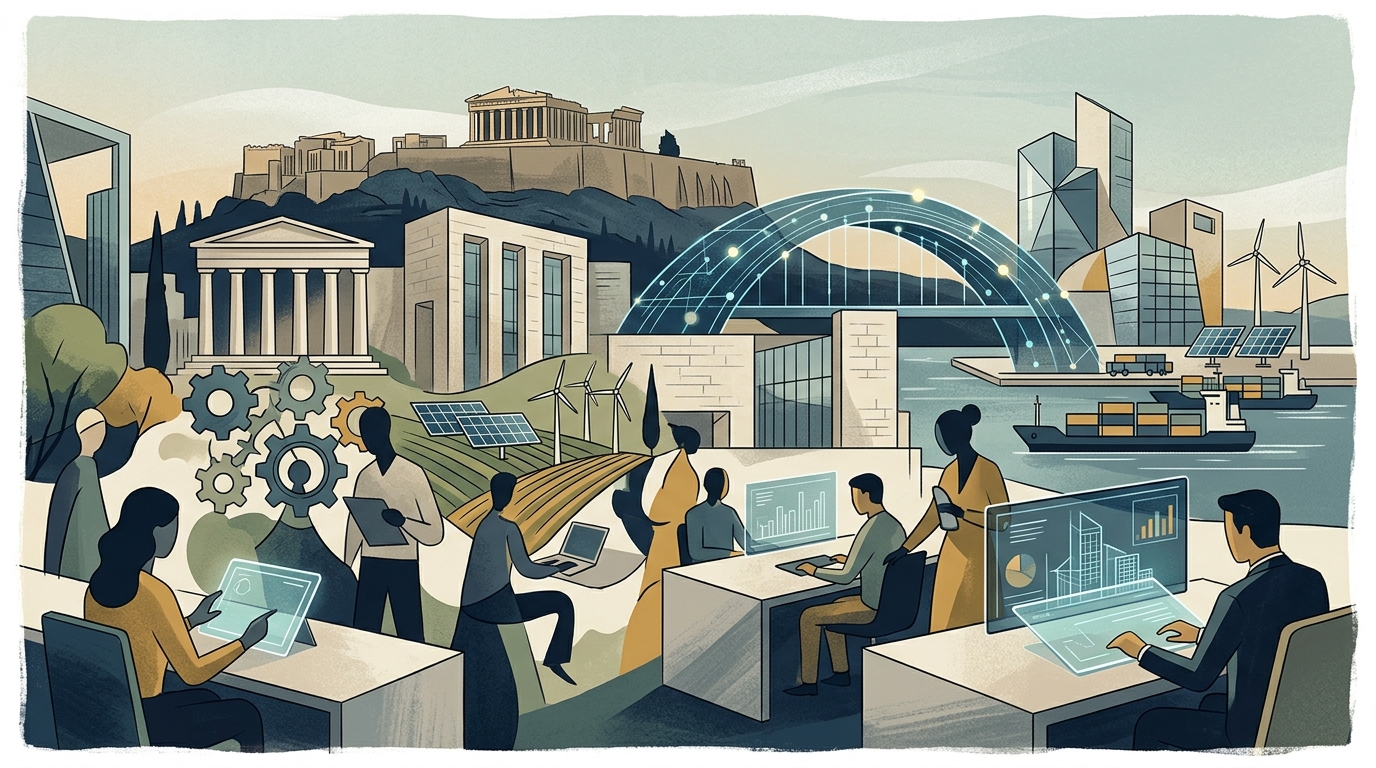
In Europe, the push for "digital sovereignty" through the AI Act has yielded results, but reliance on American technology remains structural. Greece, as part of this ecosystem, attempts to position itself through investments in data centers, but true ownership remains distant, residing in the servers of Silicon Valley.
The Geopolitics of Intelligence
Beyond corporations, there is the factor of nation-states. The US and China are engaged in an "Algorithmic Cold War." Owning generative AI is now considered equivalent to owning nuclear weapons in the 20th century. The ability to generate content, influence public opinion, and automate the economy is the ultimate form of "soft power." When we ask "who owns AI," the answer is not a single name, but a web of interests connecting the US Department of Defense with Microsoft shareholders and engineers in Beijing.
Conclusion: Towards a New Social Contract
Generative Artificial Intelligence theoretically belongs to all of us, as it was trained on our own words, images, and ideas. In practice, however, it belongs to those who have the capital to maintain it. The challenge for 2026 and beyond is the creation of models that belong to the community, ensuring that "artificial" intelligence does not lead to an "artificial" feudalism, where the many produce the data and the few reap the value.