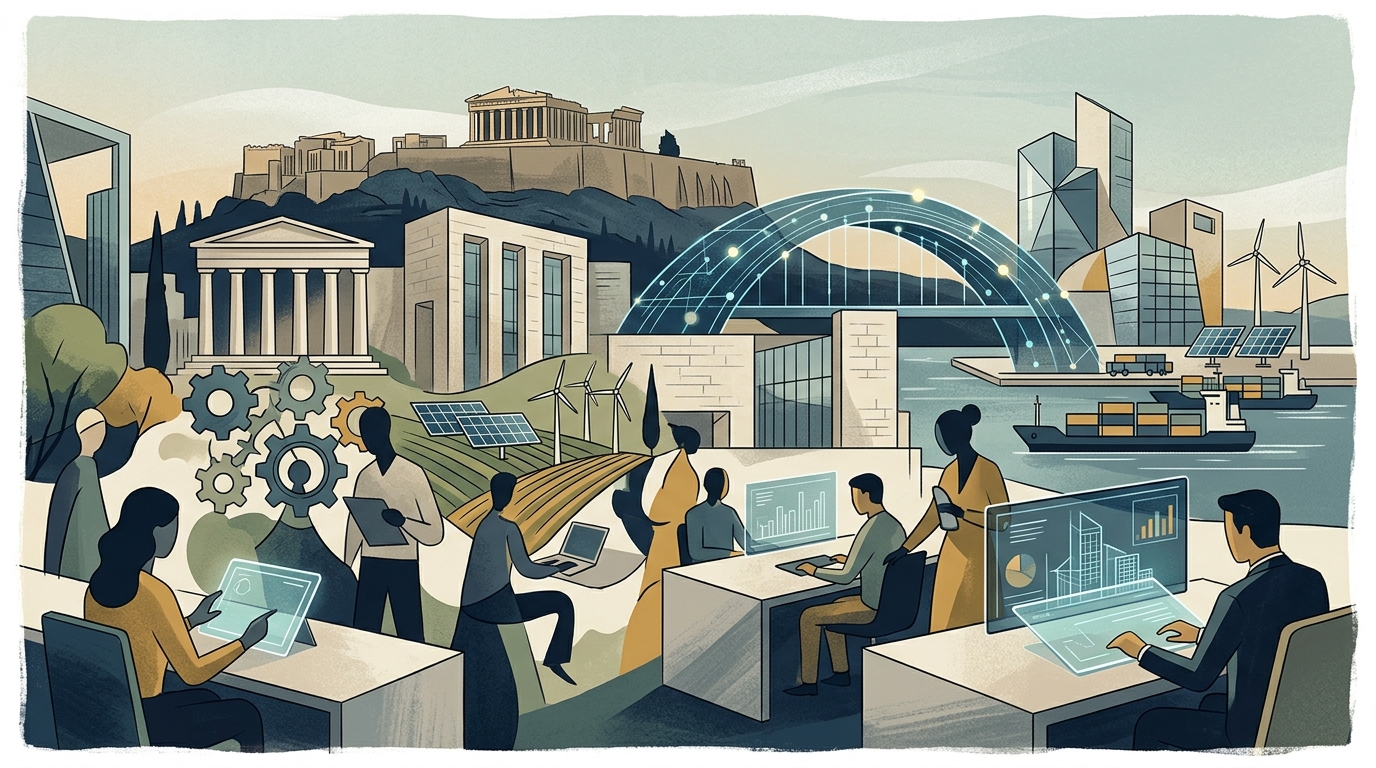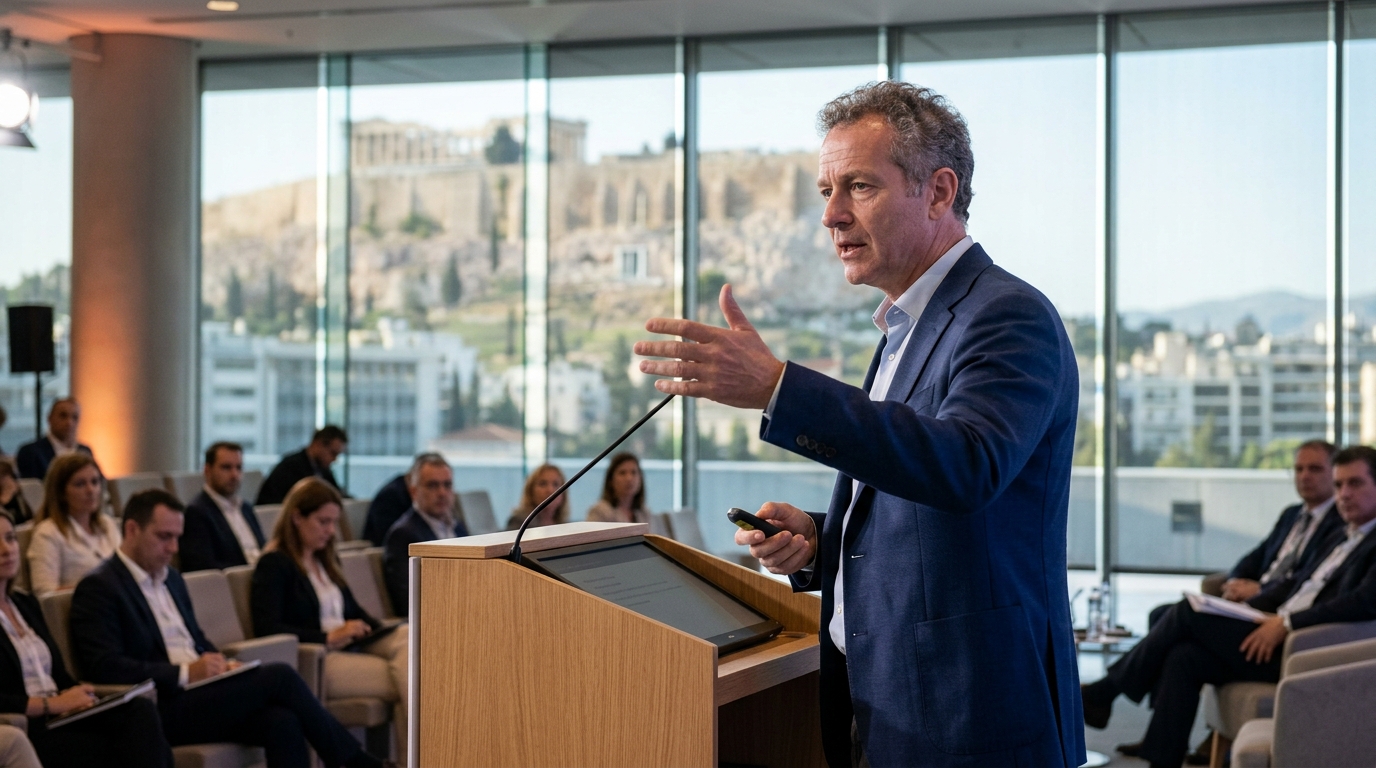
The recent remarks by Theodoros Skylakakis, Greece's Minister of Environment and Energy, at the Liberal.gr conference, were far more than a routine political address; they served as a manifesto for the impending "digital storm." With the provocative phrase "forget everything you knew until today," Skylakakis framed an era where Artificial Intelligence (AI) ceases to be a mere support tool and becomes the central axis around which economy, administration, and social organization revolve. His analysis underscores that the pace of evolution is so rapid that traditional models of prediction and action are becoming fundamentally obsolete.
Breaking with the Past and Exponential Velocity
According to the Minister, the primary difference between the current technological revolution and previous ones (such as the industrial or the first digital revolution) lies in its exponential nature. While societies in the past had decades to adapt, AI imposes changes within months. This creates an "adaptation gap" that could prove fatal for businesses and states that exhibit inertia. Skylakakis emphasized that the capacity for data processing and the automation of complex cognitive tasks are altering the cost structure in every sector of production.
"We are not facing just another technological improvement, but a total revision of how we perceive productivity and human intervention," he noted.
The Transformation of Public Administration and Labor
One of the most critical points of his intervention concerned the role of the state. For Greece, a country historically struggling with bureaucracy, AI offers a historical opportunity for a "leapfrog" moment. Skylakakis argued that AI could eliminate delays in decision-making, optimize expenditure control, and provide personalized services to citizens. However, this presupposes a radical retraining of the workforce.
In the labor market, the prediction is clear: jobs based on repetitive cognitive processes are at risk of extinction. Conversely, value is shifting toward critical thinking, creativity, and the ability to manage the AI systems themselves. The Minister warned that education must change profoundly, focusing less on memorizing information—which AI already masters—and more on synthesis and solving complex problems.
The Energy Nexus: A Two-Way Relationship
As the head of the Ministry of Environment and Energy, Skylakakis linked AI to the grand challenge of climate change. Managing Renewable Energy Sources (RES) is an extremely complex equation due to the volatility of weather patterns. Here, AI plays a decisive role in creating "smart grids" that can predict demand and balance supply in real-time.
- Predicting production from wind and solar farms with split-second accuracy.
- Optimizing energy consumption on an industrial scale.
- Reducing energy costs through algorithmic management of storage systems.
However, there is another side to the coin: AI itself is energy-intensive. The data centers required to train large language models consume vast amounts of electricity. Skylakakis pointed out that Greece, with its rich RES potential, could become a hub for hosting such infrastructure, turning a technological necessity into an economic advantage.
The Ethical Dimension and Social Cohesion
In conclusion, the Minister's analysis did not overlook the risks. The AI invasion could widen social inequalities if there is no provision for those left behind. The question is not whether the technology will prevail—that is taken for granted—but whether the transition will occur under terms of social justice. The need for a new "social contract" in the age of algorithms is imperative, as the concentration of power in a few tech giants threatens democratic balance.
Ultimately, Theodoros Skylakakis's message is a wake-up call. Artificial Intelligence is not the future; it is the present reshaping the past. Adaptation is no longer an option but a condition for survival for the state, businesses, and citizens at the dawn of a new, uncharted era.