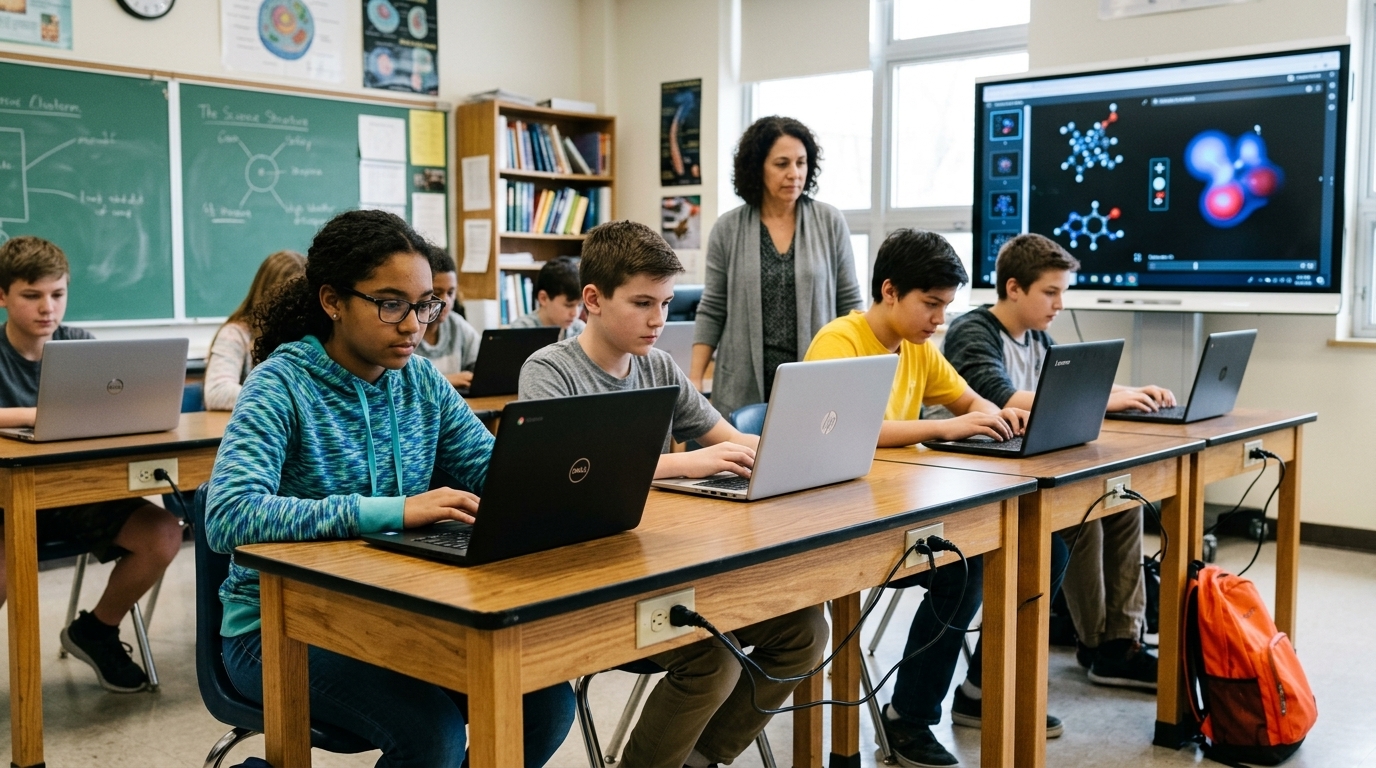
Education globally is reaching a critical inflection point. According to recent findings highlighted by Fortune Greece, Artificial Intelligence (AI) has transitioned from a futuristic concept to a daily reality for thousands of students. Nearly three out of ten students are already utilizing generative AI tools for their schoolwork—a trend that underscores a widening chasm between the velocity of technological evolution and the adaptability of traditional educational frameworks.
Tools such as ChatGPT, Claude, and Gemini have effectively become 'invisible classmates' in the home environment. Students turn to them for solving complex equations, drafting essays, or demystifying intricate scientific theories. However, this convenience comes with a significant caveat: profound parental anxiety. One in two parents expresses deep concern over their children’s growing dependence on technology, fearing that critical thinking and innate creativity are being sacrificed on the altar of efficiency.
The Digital Transition and the Obsolescence of Rote Learning
For decades, educational systems—particularly in the Mediterranean—have leaned heavily on memorization and the reproduction of information. The advent of AI renders this model obsolete. When a machine can synthesize an analysis of the Iliad in seconds, traditional assessment methods lose their utility. Experts argue that the challenge is not to ban AI—an impossible feat—but to redefine what 'learning' means in the 21st century.
Students who use AI correctly treat it as a personalized tutor. They can prompt the model to quiz them on a subject or provide diverse examples of a mathematical concept. Conversely, the risk of 'intellectual lethargy' is real. If a student merely copies the output without engaging with the underlying logic, the educational process is effectively nullified. This thin line between academic support and plagiarism is exactly what is causing sleepless nights for both parents and educators.
Parental Fears: From Dependency to Alienation
Research indicates that 50% of parents worry about the erosion of foundational skills. There is a palpable fear that children will never learn how to conduct independent research, synthesize unique viewpoints, or endure the productive struggle of solving a difficult problem. The instant gratification provided by AI could lead to a low tolerance for frustration—a vital psychological trait for adult success.
Furthermore, serious issues regarding privacy and data security remain unresolved. Many of these platforms harvest vast amounts of user data. Parents, often less technologically fluent than their children, feel ill-equipped to guide them through this new landscape. The absence of a robust national framework for AI in schools further exacerbates this sense of insecurity and helplessness.
Toward a New Educational Social Contract
The solution lies not in prohibition, but in the comprehensive training of educators and parents alike. AI has the potential to be the ultimate tool for inclusivity, assisting students with learning disabilities in following the curriculum at their own pace. However, this requires a radical shift: moving from evaluating the 'result' to evaluating the 'process'.
- Prompt Engineering Education: Students must learn how to ask the right questions to get meaningful answers.
- Critical Analysis: Teaching children how to identify 'hallucinations' or misinformation produced by AI.
- Tech Ethics: Implementing classroom discussions on when AI usage is ethically sound versus when it crosses the line.
In conclusion, artificial intelligence acts as a magnifying glass for the systemic flaws in our current educational models. If schools remain spaces for the mere transfer of static knowledge, AI will render them redundant. But if they transform into hubs for critical thinking, collaboration, and ethical judgment, AI will become the most powerful ally for the next generation of learners.