In the world of technology, nothing is truly free. This old Silicon Valley axiom is taking on a new, physical dimension with the emergence of the startup Shift. This company isn't just offering an app or a digital service; it is entering our most private space—our home—with a proposal that sounds too good to be true: free cleaning. However, the real currency in this transaction isn't euros or dollars, but movement data, spatial information, and an understanding of the chaos that prevails in an average household.
Shift, following in the footsteps of the Large Language Model (LLM) revolution, seeks to create what experts call "Physical AI." While ChatGPT was trained on the text of the internet, the robots of the future need a corresponding library of physical movements to navigate a world designed not for machines, but for humans.
The Challenge of the "Unstructured Environment"
For decades, robots were confined to factory floors, where every movement was programmed with millimeter precision in a controlled environment. The home, however, is a programmer's nightmare. A toy left on the floor, a moved chair, or a different lighting angle can confuse a traditional robotic system. This is the so-called "Sim-to-Real gap."
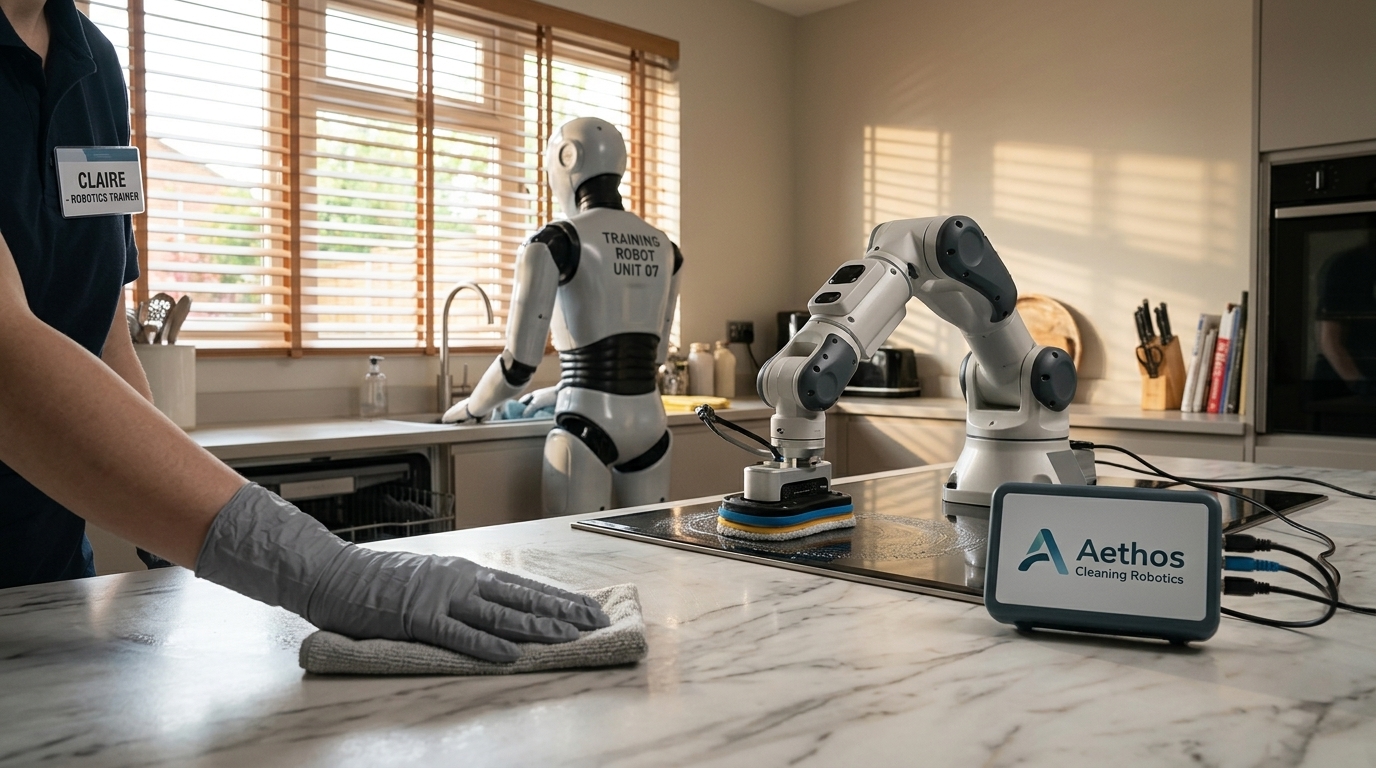
Shift realized that computer simulations are not enough. For a robot to learn how to fold a shirt or distinguish a dirty plate from a clean one, it needs thousands of hours of real-life video. By sending humans to clean homes while wearing specialized cameras and sensors, or by using teleoperated prototypes, the company collects "golden data." This data feeds deep learning models that teach machines the common sense of the physical world.
"We aren't just training a vacuum; we are training an intelligence that understands the geometry and utility of human space," industry executives note.
The Teleoperation Model
One of the most interesting elements of Shift's approach is the use of teleoperation. In many cases, the cleaning tasks are not performed autonomously by a robot, but by a human operating the robot remotely via VR (Virtual Reality). This method, known as "Imitation Learning," allows the AI to "see" what the human is doing and attempt to replicate it.
This creates a new form of labor. The "cleaners of the future" may never step foot inside the home they are cleaning, but instead work from a control center miles away. Their job is twofold: to complete the task and, crucially, to produce the training material that will eventually make their own labor obsolete. It is a paradox of the modern AI economy that raises significant ethical questions.
Privacy: The Price of Convenience
The introduction of cameras and sensors into homes in exchange for a free service brings the issue of privacy to the forefront. What happens to the faces of residents, their personal belongings, or the private moments captured? Shift claims to use advanced algorithms to anonymize data, blurring faces and sensitive information before the data reaches training servers.
However, history has shown that data is difficult to keep entirely secure. The prospect of a company owning 3D maps of millions of homes is something that should concern regulators. In Europe, under the light of GDPR and the new AI Act, such practices will come under strict scrutiny. The question remains: is a clean kitchen counter worth the digital mapping of our private lives?
The Road to the General Purpose Robot
The ultimate goal for Shift and its competitors (such as Figure AI or Tesla with Optimus) is the "General Purpose Robot." A machine that won't just do one job but can adapt to any household need. This market is estimated to be worth trillions of dollars, as aging populations in developed countries create a massive shortage of labor for home and elderly care.
Shift's strategy of offering free services to collect data is a high-risk, high-reward move. If it manages to gather the largest and highest-quality dataset of domestic activity, it could become the "Google of Physical Data." In a world where digital intelligence has already been conquered, the battle is now shifting to the physical world, where dust, tangled cables, and messy rooms represent the new frontier of innovation.