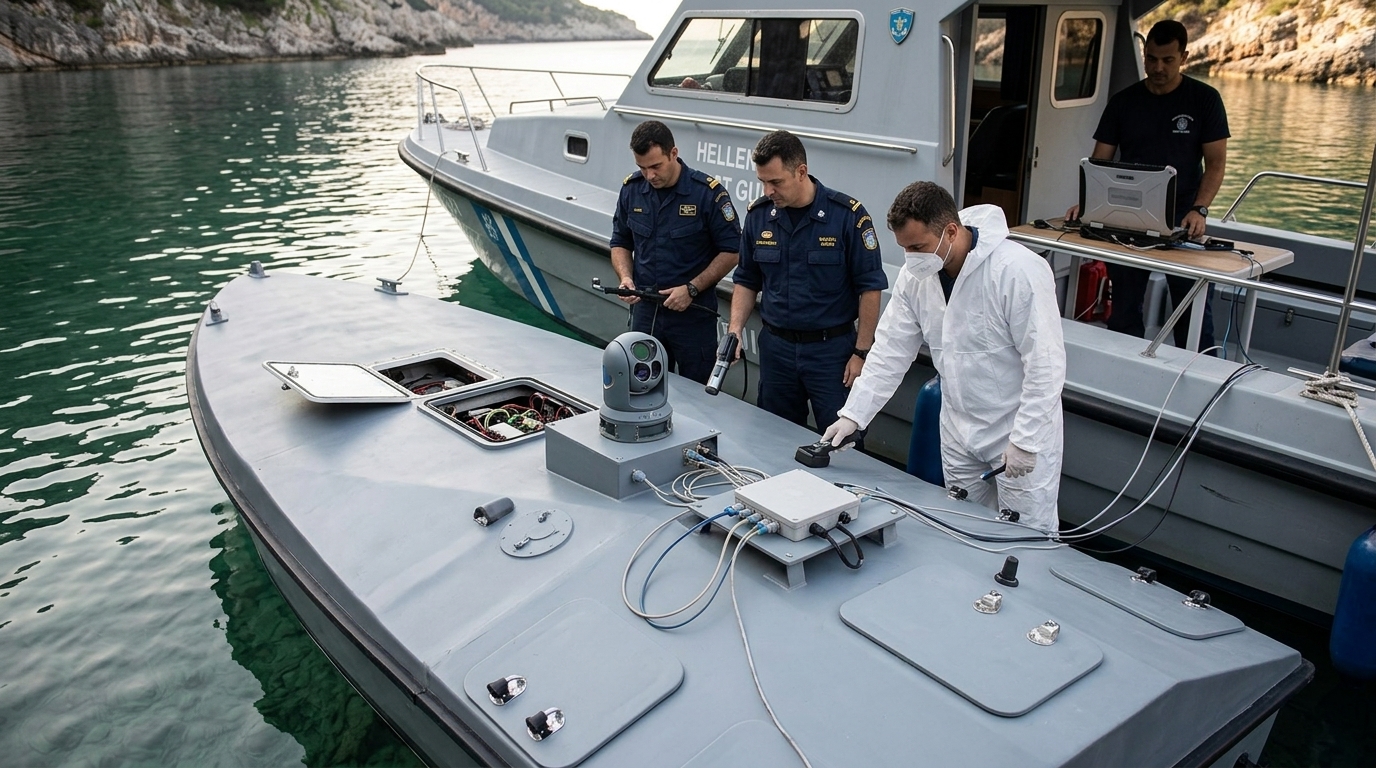
The discovery of an Unmanned Surface Vehicle (USV) loaded with approximately 100 kilograms of explosives off the coast of Lefkada is more than just a local police incident. It serves as a stark reminder that asymmetric warfare technologies, once confined to active conflict zones like the Black Sea or the Red Sea, have now seeped into the heart of the Mediterranean. The vessel, found drifting unmanned, is being meticulously examined by specialized units of the Hellenic Navy and Counter-Terrorism forces, as authorities scramble to solve the puzzle of its origin and intended target.
The Technology of the 'Invisible' Foe
Sea drones have fundamentally altered naval doctrine over the past two years. Their use in the Ukraine conflict proved that low-cost vessels can inflict disproportionate damage on multi-billion dollar naval assets. The craft found in Lefkada appears to belong to this category: a low radar signature, the capacity to carry significant explosive payloads, and remote-control systems allowing operation from vast distances. The presence of 100kg of high explosives suggests that the objective was not mere harassment but the total destruction of a target—be it a ship or critical maritime infrastructure.
Geopolitical Scenarios and Questions
Security analysts are considering three primary scenarios. The first involves the leakage of military hardware from the Ukrainian front through illicit smuggling networks. It is no secret that the Mediterranean serves as a transit hub for illegal weaponry. The second scenario links the incident to escalating tensions in the Middle East and the potential use of such tools by non-state actors (proxy groups) to send messages to Western interests. The third, and perhaps most concerning for internal security, involves organized crime syndicates upgrading their arsenals to control maritime routes or conduct high-stakes extortion.
The Challenge for Greek Authorities
For Greece, with its sprawling coastline and thousands of islands, the appearance of an explosive USV in the Ionian Sea represents a security nightmare. Maritime border surveillance, which has traditionally focused on managing migration flows and deterring conventional threats, must now adapt to a new reality. Detecting such vessels requires advanced electronic warfare systems, infrared sensors, and continuous aerial surveillance via drones. The fact that the drone was discovered in Lefkada, far from the traditional 'hot spots' of the Aegean, indicates that no part of Greek territory can be considered immune to these emerging threats.
Conclusions and Future Implications
The Lefkada case is likely the tip of the iceberg. As drone technology becomes increasingly accessible, the 'democratization' of destructive power allows small groups to threaten regional stability. The Mediterranean, a central artery of global trade, remains vulnerable. The response cannot be purely national; it requires close intelligence cooperation at the EU and NATO levels. The security of our seas no longer depends solely on the size of our fleet, but on our ability to detect the 'invisible' before it reaches our shores.
- Immediate need to upgrade coastal surveillance systems with AI-driven detection.
- Strengthening international cooperation to track the proliferation of military-grade drone components.
- Reassessing risk profiles for commercial shipping and high-end tourism in the Ionian.