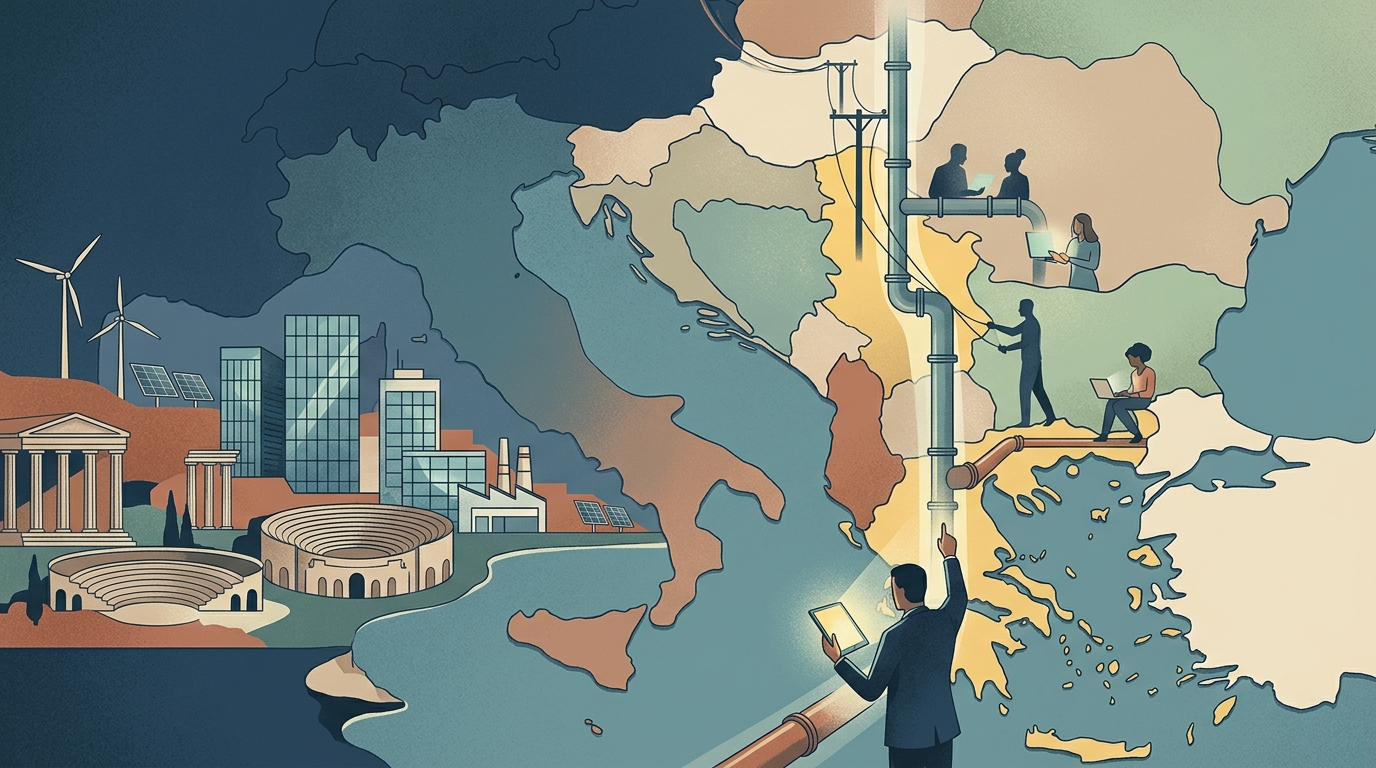
In an era where energy security has become the focal point of European diplomacy, the "Vertical Corridor" strategy is emerging as the most ambitious project to reshape the energy map of Southeast Europe. Stavros Papastavrou, in recent statements, emphasized the criticality of building a "dense and reliable regional energy network," which will function not merely as a fuel carrier but as the cohesive fabric bringing the Western Balkans closer to the European core.
The Architecture of Energy Independence
The Vertical Corridor is not a theoretical concept but a chain of infrastructure stretching from Greece to Bulgaria, Romania, and Hungary, reaching as far as Slovakia, Moldova, and Ukraine. The core philosophy behind the project is the capacity for bidirectional flow (reverse flow), allowing natural gas—and eventually hydrogen—to move from South to North, breaking the historical monopoly of Russian pipelines that fed the region from the East.
Greece, through the Alexandroupolis LNG Terminal (FSRU) and the upgrade of the National Natural Gas System (DESFA), is becoming the "entry point" for liquefied natural gas from the US, Egypt, and Qatar. Mr. Papastavrou stressed that this interconnectivity is the key to resilience against geopolitical blackmail. "The integration of the energy market can be a first step for the integration of the Western Balkans into the European family," he noted, linking the technocratic nature of infrastructure with high-level political strategy.
Focusing on the Western Balkans
The inclusion of the Western Balkans in the Vertical Corridor is a move of deep political symbolism. For decades, the region remained energy-isolated or dependent on obsolete infrastructure. Creating a modern network offers countries like North Macedonia, Serbia, and Albania an alternative route aligned with European standards.
- Strategic Convergence: Energy interconnection requires a common regulatory framework, forcing Balkan nations to adopt the EU Acquis Communautaire more rapidly.
- Economic Growth: Access to cheaper and diversified energy sources reduces production costs for local industries.
- Stability: Shared infrastructure creates bonds of interdependence that deter regional tensions.
According to Mr. Papastavrou, the Vertical Corridor is "dense" because it includes multiple routes and "reliable" because it is based on cutting-edge technology. Ukraine's participation in this scheme adds an extra dimension, as the country possesses the largest gas storage facilities in Europe, which can be used to buffer the entire continent during winter peaks.
Challenges and the Hydrogen Future
Despite the optimism, significant challenges remain. Financing such projects requires public-private partnerships and the full support of the European Commission. Furthermore, there is the issue of the "green transition." Mr. Papastavrou was clear: the infrastructure being built today for natural gas must be "hydrogen-ready." This ensures that these pipelines can carry green hydrogen in the future, preventing them from becoming "stranded assets" in a net-zero world.
"We are not just building pipelines for today. We are constructing the backbone of tomorrow's European energy sovereignty, where Greece will have a central, regulatory role," stated Mr. Papastavrou.
In conclusion, the Vertical Corridor represents Athens' and its partners' response to the need for a new security architecture. It is a project that transcends Greek borders and places the country at the heart of developments, turning geography into a geopolitical advantage. Its success will be judged by the speed of implementing interconnections and the stability of political alliances in the sensitive Balkan region.