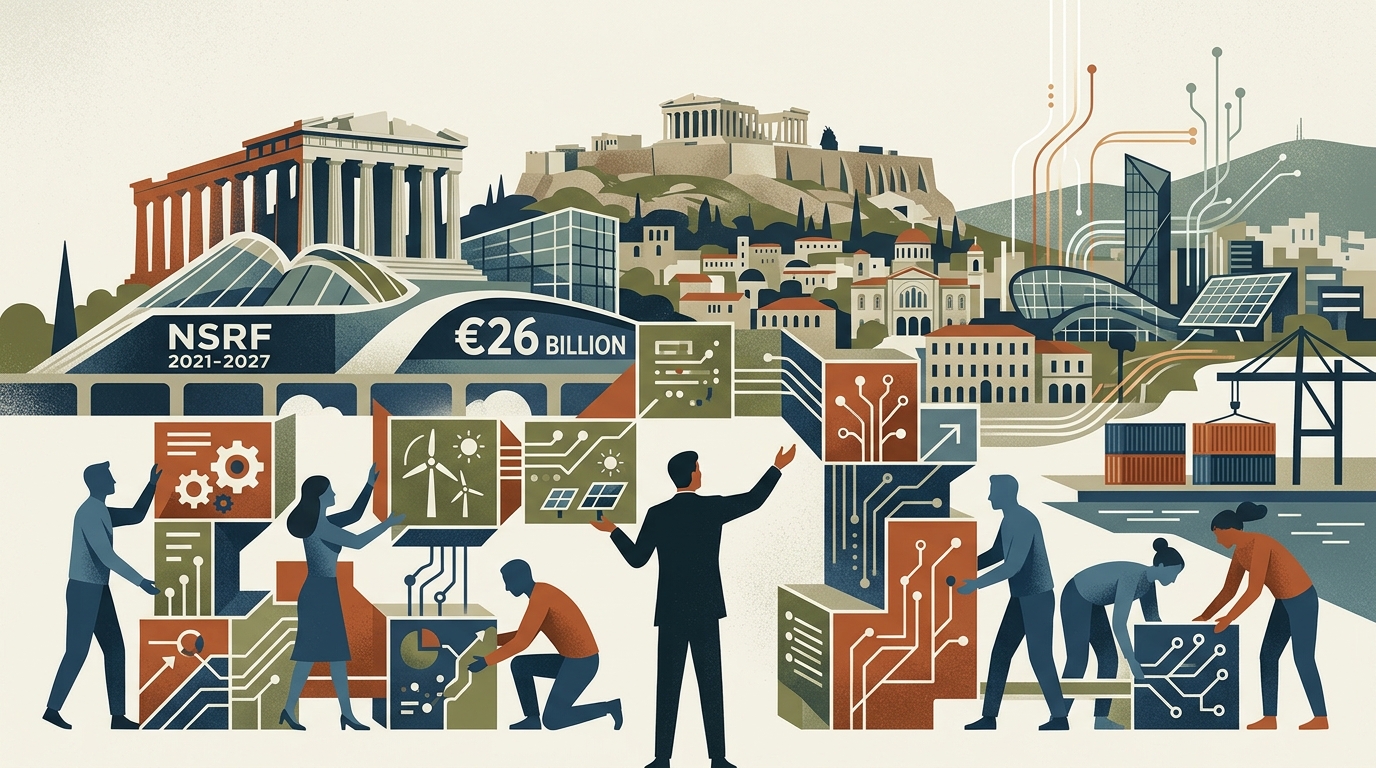
Greece stands at a pivotal juncture in its economic history as the NSRF (ESPA) 2021-2027 program enters its most mature implementation phase. With a total budget reaching €26.2 billion (€20.9 billion from the EU and €5.3 billion from national resources), this program is not merely a liquidity injection but the central pillar for the country's structural transformation. The news that Greece holds the 4th position in the European Union regarding fund absorption is a rare example of administrative efficiency by Greek standards; however, the real question remains: how do these resources translate into sustainable growth for the average citizen?
The Five Pillars of Growth
The new NSRF is not a horizontal financing scheme but a targeted strategy based on five key policy objectives. First and foremost is a "Smarter Europe," focusing on innovation, digitalization, and the strengthening of small and medium-sized enterprises (SMEs). Here, the weight falls on connecting research with production—a perennial deficit of the Greek economy. Businesses are called upon to abandon the traditional low-cost model and invest in cutting-edge technologies, from artificial intelligence to big data analysis.
The second pillar, a "Greener Europe," absorbs the lion's share of resources, aligning with the European Green Deal. Investments in renewable energy sources, the energy upgrading of buildings (through programs like "Exoikonomo"), and waste management are vital. In an era of climate crisis, Greece seeks to transform into an energy hub for Southeast Europe while simultaneously reducing energy costs for households and industries.
Infrastructure and Social Cohesion
Despite the emphasis on technology, classic infrastructure remains in the spotlight. A "More Connected Europe" concerns strategic transport networks. Completing major road axes, upgrading the railway network—a task that gained dramatic importance following the Tempi tragedy—and developing ports are top priorities. The goal is to reduce transport costs and enhance the outward orientation of Greek products.
However, the heart of NSRF 2021-2027 beats in a "More Social Europe." With over €3 billion directed toward employment, education, and social inclusion, the program attempts to heal the deep wounds of the previous decade. Training in digital skills, supporting vulnerable groups, and strengthening the National Health System are areas where fund absorption must be accompanied by a substantial qualitative upgrade of services.
The Challenge of Absorption vs. Effectiveness
Ranking 4th in the EU is an impressive title, but history has taught us that rapid absorption does not always guarantee proper utilization. In the past, many funds were wasted on "window-dressing" projects or subsidies that created no added value. Today, the existence of the Recovery and Resilience Facility (RRF) alongside the NSRF creates unprecedented pressure on the state mechanism. The risk of project "congestion" and the lack of specialized labor in the construction sector are visible threats.
- Digitalization: Over €1 billion for the full digitalization of the state and services to the citizen.
- SMEs: Special programs for access to low-interest loans and innovation grants.
- Regional Development: One-third of the resources is managed directly by the country's 13 Regions, promoting decentralization.
In conclusion, NSRF 2021-2027 is the last major "package" that can change Greece's fate. It is not just about accounting figures but about the country's ability to stand as an equal on a competitive global map. Its success will be judged not by how much money is disbursed, but by whether, in 2030, the Greek economy is more resilient, greener, and, above all, fairer.