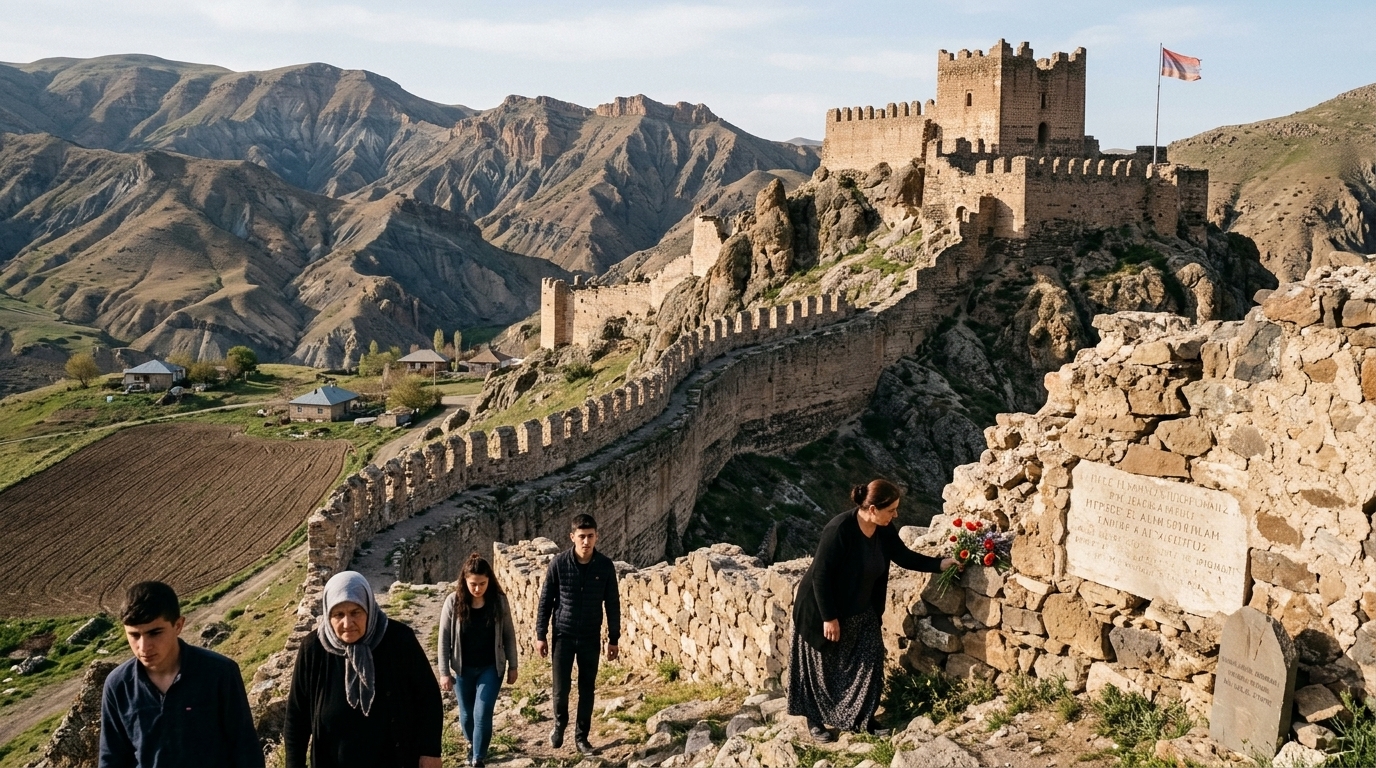
May in Nikopolis of Pontus is not merely a season of blooming; it is a ghost month, where the scents of spring mingle with the smell of scorched stone and the echoes of laments that never faded. The city, known today as Şebinkarahisar in the Giresun province, stands as a stone witness atop a precipitous volcanic rock, narrating a story that spans from the glory of the Roman Empire to the nadir of human brutality during the early decades of the 20th century.
The City of Victory: From Pompey to Byzantium
The history of Nikopolis began in 66 BC, when the Roman general Pompey the Great decisively defeated Mithridates VI Eupator, the last great king of Pontus. To immortalize his victory, Pompey founded "Nikopolis" (Nicopolis ad Lycum), settling veterans and locals there. Its location was not accidental: it sat at the crossroads of routes connecting Central Anatolia with the Black Sea and Armenia.
During the Byzantine period, Nikopolis evolved into one of the strongest strongholds in the region. Its walls, which still inspire awe today, were reinforced by Justinian, making the city an impregnable refuge. For centuries, Nikopolis was a center of Hellenism and Christianity, an episcopal see that radiated culture in an often turbulent frontier. Its economy was based on rich alum mines, a material essential for dyeing fabrics, which gave it the later name Şebinkarahisar (Black Alum Castle).
The Black May of 1915: Resistance and Sacrifice
The fate of Nikopolis changed dramatically with the rise of the Young Turks and the onset of World War I. In May and June 1915, the plan for the extermination of the Christian populations of the East began to be implemented with relentless methodology. The Armenians and Greeks of the city, seeing the arrests of community leaders and the first executions, realized that there was only one choice: resistance or death.
Approximately 5,000 residents took refuge in the ancient castle, turning it into a fortress of despair. For weeks, they faced the regular Ottoman army with meager means. The siege was merciless. Food supplies ran out, water became scarce, but the resolve for freedom remained unshaken. The fall of the castle in late June led to one of the most heinous massacres of the period. The men were executed, and the women and children were led on "death marches" toward the Syrian desert. May had become the harbinger of absolute darkness.
Memory as a Political and Human Act
Today, touring the ruins of Nikopolis is not a simple tourist activity. It is a dive into the collective memory of Pontian and Armenian Hellenism. The Greek houses in the lower town, though ruined, retain their architectural identity, reminding us of an era of prosperity and coexistence that was violently interrupted. The memory of Nikopolis remains alive through refugee associations in Greece, which pass down stories of the "Kastro" and the sacrifices of their ancestors from generation to generation.
Highlighting the history of Nikopolis is not just about the past. It is about the present and future of the region. In an era where historical revisionism is often used as a political tool, the truth of Nikopolis's walls remains non-negotiable. Recognizing the crimes of 1915-1923 is not an act of revenge but a necessary prerequisite for peace and understanding in Southeastern Europe and Asia Minor.
Conclusion: The Victory of Memory
Nikopolis began as a city of victory for a Roman general, but it ended up symbolizing a different kind of victory: the victory of memory over oblivion. Every May, when the sun illuminates the steep cliffs of Pontus, the history of Nikopolis returns to remind us that cities do not die as long as there are people who whisper their names. The "City of Victory" may have lost its inhabitants, but it gained its place in the eternity of historical consciousness.