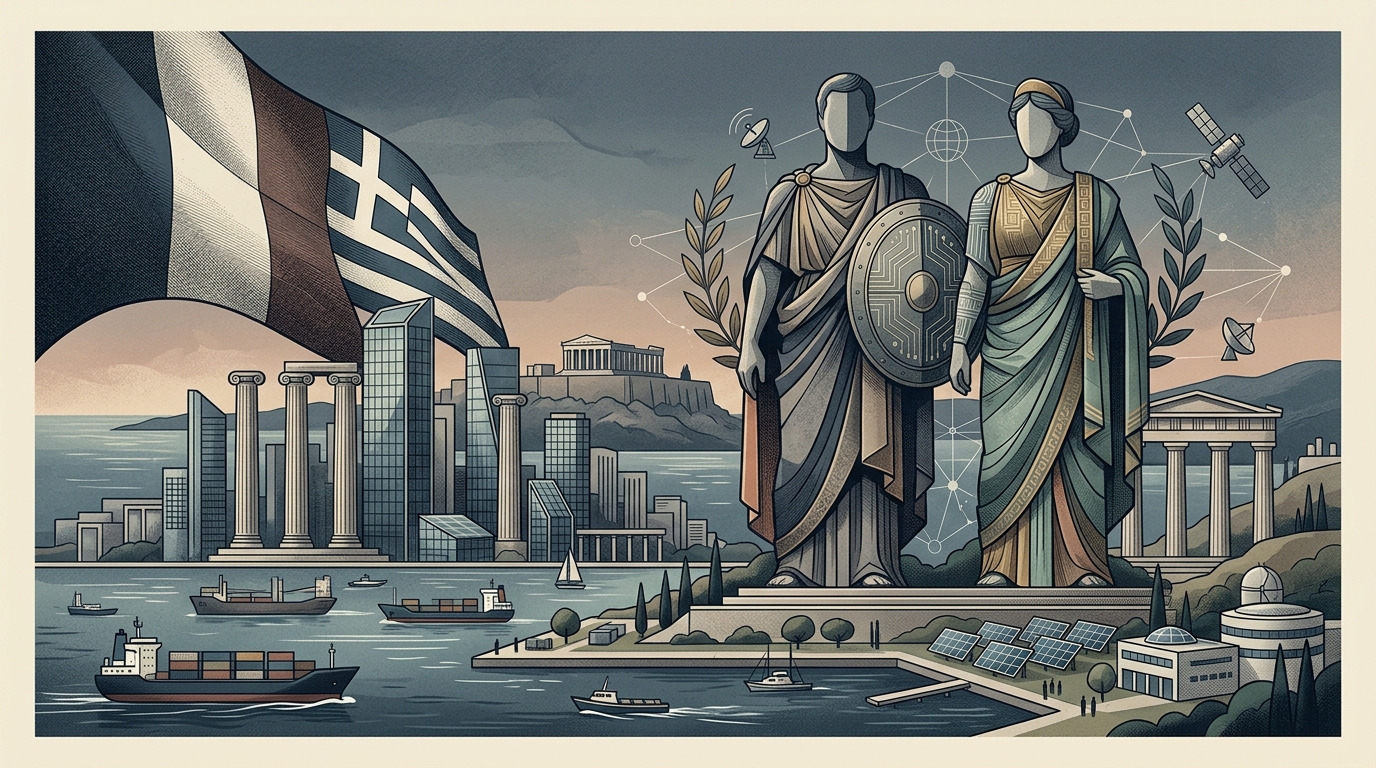
In an atmosphere charged with historical gravity and strategic resolve, Greek Prime Minister Kyriakos Mitsotakis and French President Emmanuel Macron ratified a new chapter in Greco-French relations at the Maximos Mansion. The signing of nine bilateral agreements is not merely a routine diplomatic procedure, but a tangible confirmation of an alliance that aspires to be the cornerstone of European defense architecture in the 21st century.
The Mutual Defense Clause: Beyond Formalities
The focal point of the two leaders' statements was the much-discussed "mutual defense assistance clause." Emmanuel Macron, with sharp and clear rhetoric, emphasized that France's commitment to Greece is not a hollow promise or a series of diplomatic pleasantries. "The mutual defense clause is a reality that binds our armed forces," the French President underlined, sending a clear message to all directions—and particularly towards Ankara—that Greece's territorial integrity is a red line for Paris.
For his part, Kyriakos Mitsotakis described the agreement as a "historic achievement" that transcends the narrow geographical borders of the two nations. His reference to "France and Greece marching together" was not just a reminder of traditional ties (dating back to the era of Konstantinos Karamanlis and Valéry Giscard d'Estaing), but a statement of intent for the future of the Eastern Mediterranean. Through this partnership, Greece is not only being upgraded militarily with Rafale jets and Belharra frigates but is also becoming the key pillar of the French strategy for "European Strategic Autonomy."
The Nine Agreements: A Holistic Framework of Cooperation
While defense dominated the agenda, the nine agreements signed cover a wide range of sectors, proving that the Athens-Paris relationship is multi-layered. The agreements include:
- Defense Technology and Industry: Strengthening cooperation between the defense industries of both countries for joint system development.
- Climate Change and Civil Protection: Creating immediate response mechanisms for natural disasters, against the backdrop of climate crisis challenges in the Mediterranean.
- Culture and Education: Enhancing student exchange programs and joint archaeological research.
- Migration: Coordination at the European level for managing flows and protecting the EU's external borders.
This strategic deepening comes at a time when Europe is seeking its footing between the shifting sands of US and Chinese influence. Macron sees Greece as the ideal partner to prove that Europe can protect itself without relying exclusively on the NATO umbrella, although both leaders were quick to clarify that the agreement functions complementarily to the North Atlantic Alliance.
Geopolitical Implications and the "Shadow" of Turkey
It is no secret that the strengthening of the Athens-Paris axis causes irritation on the other side of the Aegean. The mutual defense clause acts as a powerful deterrent. As analysts explained, France's presence in the Eastern Mediterranean is no longer just diplomatic but operational. Joint exercises and the permanent presence of French naval units in the region are the natural continuation of the signatures at Maximos Mansion.
"The security of Greece is also the security of Europe. When a member of our family is threatened, we must be there, not just with words, but with actions," Emmanuel Macron stated emphatically.
In conclusion, the Mitsotakis-Macron meeting was not just another ceremonial visit. It was the sealing of a geopolitical choice. Greece chooses to align with the French vision for a strong, autonomous Europe, and France chooses Greece as the forward outpost of its interests in the region. In a rapidly changing world, the Mediterranean "Entente Cordiale" seems more necessary than ever.