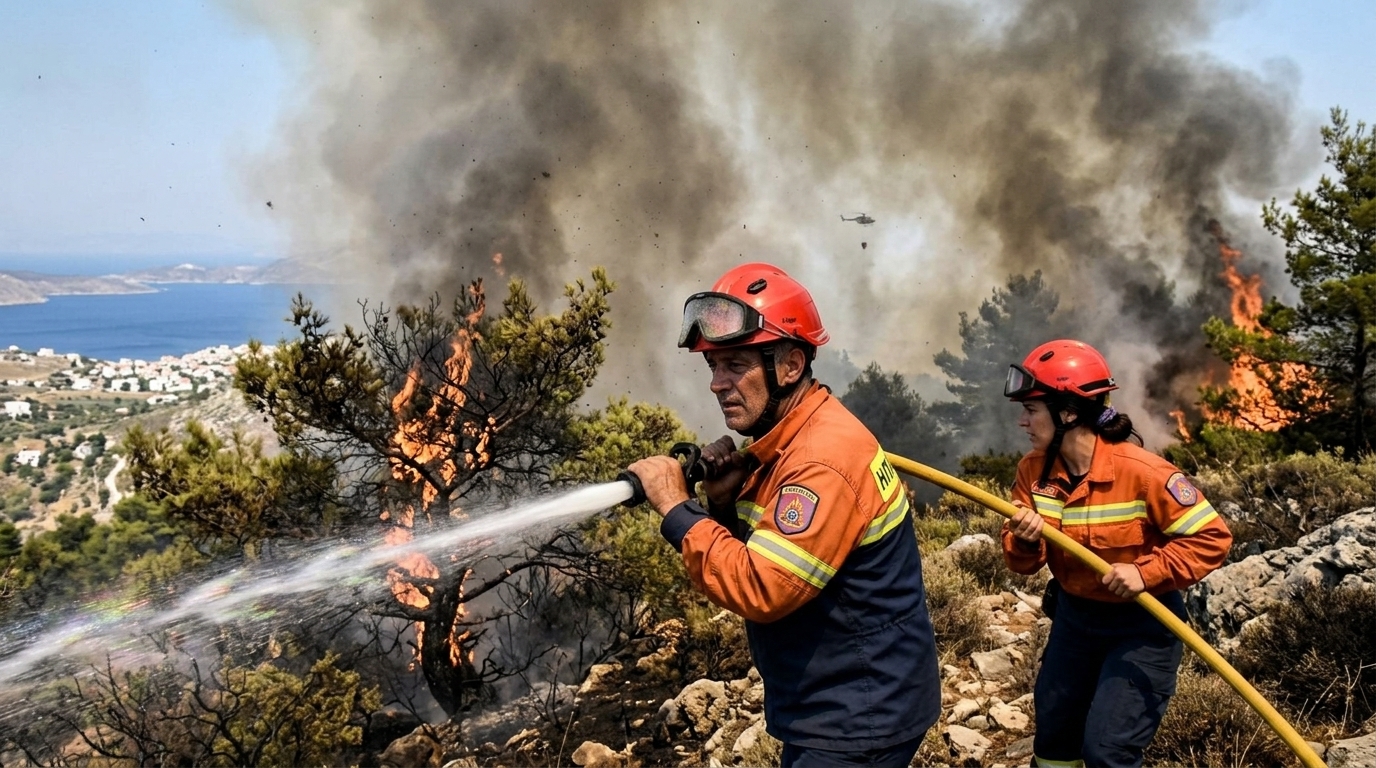
Kalymnos, the historic island of sponge divers, faced one of the most harrowing challenges of the summer season on the night of Saturday, July 4, 2026. A wildfire, which broke out under circumstances still being investigated around 23:00, spread rapidly due to high winds and dry low vegetation. The mobilization of the Fire Service was immediate, yet the rugged terrain and the darkness made the task of ground forces exceptionally difficult during the initial hours of the operation.
The Operation Timeline and Mobilization
The fire originated in an area characterized by low brushwood, but wind gusts quickly pushed it toward mountainous ridges, threatening to trap forces and expand into denser vegetation. Firefighting units from the local station rushed to the scene, supported throughout the night by volunteer groups and local residents who assisted with every available resource. The strategy focused on creating firebreaks to prevent the blaze from advancing toward inhabited settlements.
As dawn broke on Sunday, July 5, the situation began to improve. The contribution of aerial assets—including the new surveillance and firefighting drones integrated into the Civil Protection fleet over the last two years—was decisive. These drones, equipped with advanced thermal imaging, allowed coordinators to pinpoint active hotspots through the thick smoke and direct water drops with surgical precision. By early morning, the Fire Department announced that the fire was under partial control, though significant forces remain on-site to guard against potential reignitions.
Climate Crisis and Island Vulnerability
The incident in Kalymnos is not an isolated event. In the Greece of 2026, the fire season has lengthened dramatically, often starting in mid-April and extending into November. The Aegean islands, due to their geographical isolation and limited water resources, are among the most vulnerable zones to climate change. The severe drought that hit the Dodecanese last winter has turned low vegetation into tinder, ready to ignite at the slightest spark.
- The urgent need for permanent stationing of aerial assets on major Aegean islands.
- Strengthening local volunteer teams with modern equipment and standardized training.
- Utilizing AI systems for real-time fire behavior prediction and resource allocation.
- Strict enforcement of penalties for negligence leading to environmental disasters.
Data analysis from the National Observatory of Athens indicates that the frequency of nocturnal fires has increased by 15% over the past three years. This presents a new challenge: the requirement for assets capable of operating effectively in the dark, which until recently was a major handicap for Greek firefighting efforts.
Technology in the Service of Prevention
In this context, the integration of AI technology into the '112' emergency system and operations centers has begun to yield results. In the Kalymnos case, the early warning system functioned efficiently, informing residents of nearby settlements to remain alert without inducing panic. However, technology alone is insufficient. The chronic understaffing of forestry services remains the 'Achilles' heel' of the state mechanism.
"We cannot rely solely on aircraft. The battle is won on the ground, through forest management and proactive prevention," stated a local Kalymnos official.
The aftermath for Kalymnos involves assessing the environmental damage. Fortunately, initial reports suggest that only low vegetation was burned, with no damage to homes or critical infrastructure. However, the alarm has been sounded once again, reminding us that fortifying our islands against extreme weather phenomena must be a national priority, transcending political agendas and bureaucratic hurdles.
Conclusion
The fire in Kalymnos was brought under control thanks to the self-sacrifice of firefighters and volunteers. Yet, as we move into the peak of the 2026 summer, constant vigilance is required. Climate resilience is no longer a theoretical concept but a daily battle for survival for the local communities of the Mediterranean.