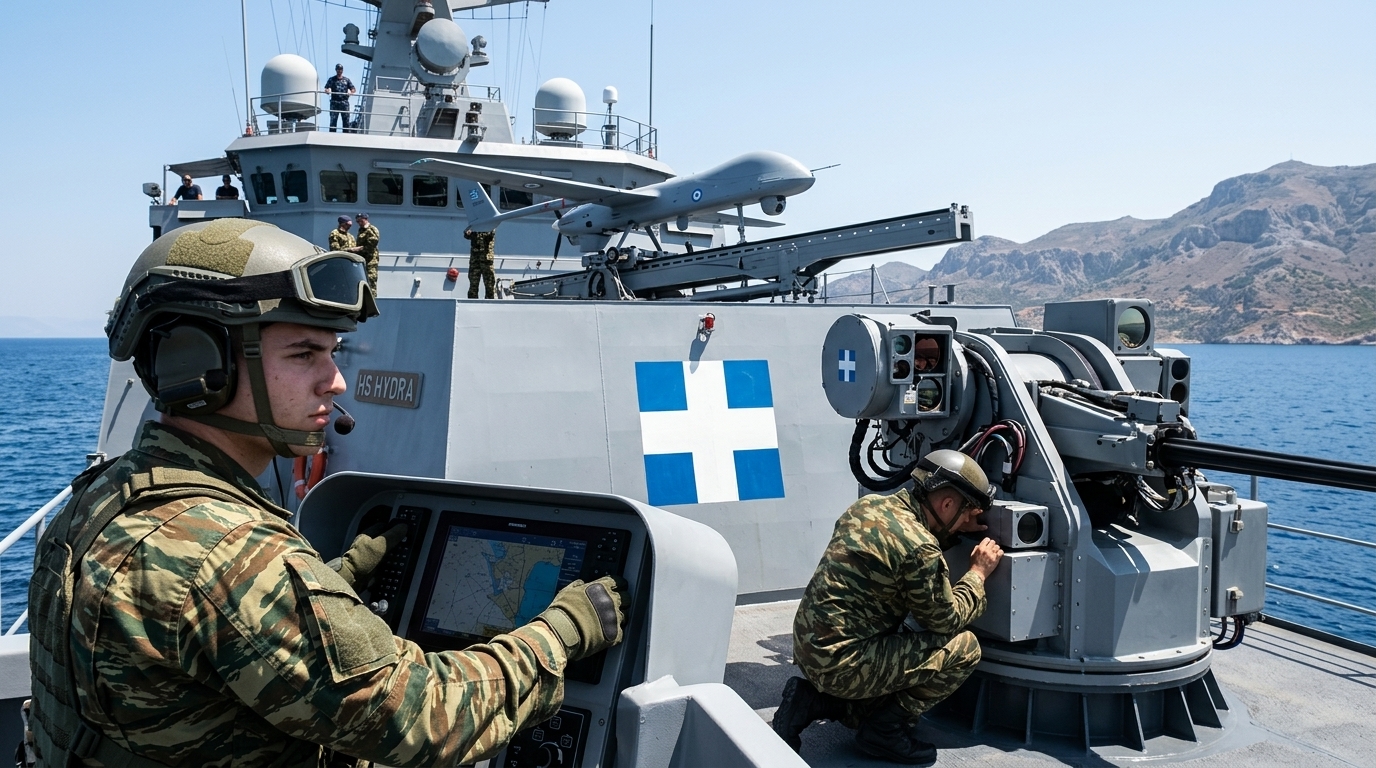
For decades, Greek defense policy was characterized by an "off-the-shelf buyer" model. The country spent vast sums acquiring ready-made weapon systems from abroad, with minimal involvement from domestic industry in terms of added value. Today, this paradigm is shifting radically. The need for strategic autonomy, combined with the rapid evolution of Artificial Intelligence (AI) and unmanned systems, is pushing the Greek government and the private sector into a new era of co-production and domestic research.
The Revolution of Drones and Unmanned Systems
The conflict in Ukraine and developments in the Caucasus have proven that the future of the battlefield belongs to drones. Greece, recognizing this gap, has implemented programs such as "Archytas" and "Grypas." Greek groups, such as HAI (Hellenic Aerospace Industry), in collaboration with leading Greek universities, are developing VTOL (Vertical Take-Off and Landing) systems intended for surveillance and operations in the challenging environment of the Aegean Sea.
However, innovation does not stop there. Private companies like UCANDRONE and SAS Technology have already presented armed drones and loitering munitions systems, which are vying for a place not only in the Greek arsenal but also in international markets. The use of AI for autonomous navigation and target recognition is the "key" that transforms a simple flying machine into a strategic asset.
Shipyards and Frigates: The Return of Heavy Industry
The FDI (Belharra) frigate program served as the catalyst for the revitalization of Greek shipyards. Naval Group has already signed dozens of contracts with Greek companies for the supply of equipment, ranging from metal structures to advanced electronic systems. The participation of groups like METKA (Mytilineos) and Intracom Defense (IDE) proves that Greek industry possesses the expertise to meet strict NATO standards.
The next major challenge is participation in the American Constellation-class frigate program, as well as the modernization of the MEKO frigates. Here, the stakes are twofold: securing work for the Elefsina and Skaramangas shipyards and integrating Greek combat management and communication systems—a field where companies like Scytalys (EFA Group) excel internationally.
"The defense industry is no longer just a matter of national security, but a critical pillar of our national economy and technological sovereignty," government sources state.
AI and Cyber Defense: The Invisible Front
Beyond iron and steel, modern warfare is conducted across networks. The establishment of the Hellenic Defense Innovation Center (ELKAK) marks the country's effort to create a "Silicon Valley ecosystem" for defense. The focus is shifting toward cybersecurity, Big Data analysis for threat prediction, and the use of AI in real-time decision-making.
Companies like Theon Sensors, a global leader in night vision systems, are now integrating AI algorithms for image enhancement and automatic threat detection. This "smart" defense technology is what attracts foreign investors and creates high-specialization jobs, helping to reverse the brain drain.
Challenges and Outlook for the Next Decade
Despite the optimism, challenges remain. Procurement bureaucracy, the need for stable research funding, and intense international competition require a long-term national strategy that does not change with every government transition. Connecting academic research with production remains the goal, so that innovations born in the labs of our Technical Universities can be transformed into operational products.
The next decade will determine whether Greece manages to become an exporter of defense technology or remains trapped in a model of high spending without reciprocal benefits. With European defense spending soaring, the window of opportunity for Greek groups is wide open.