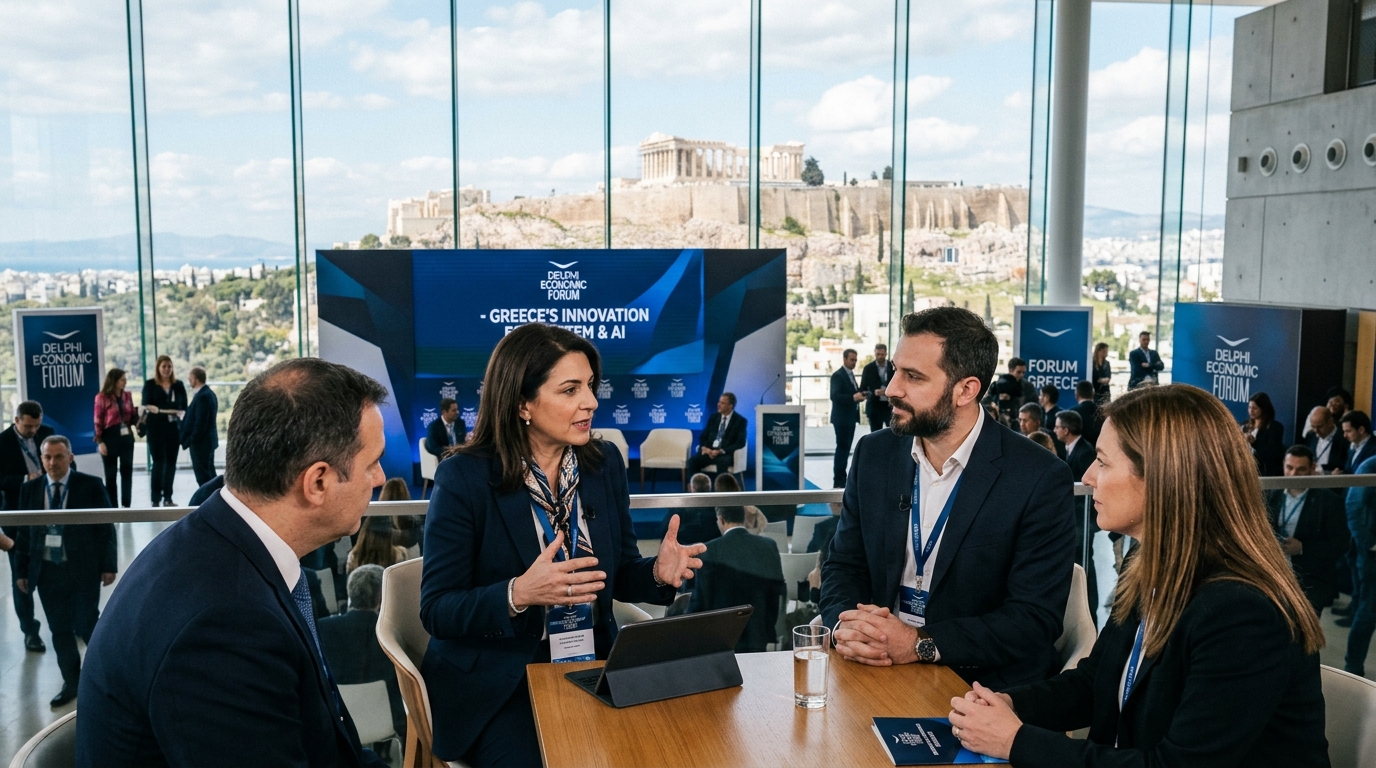
At the foot of Mount Parnassus, where the Oracle of Delphi once delivered prophecies for the future of city-states, the 2026 Delphi Economic Forum (DEF) sought to decode the new "prophecy" of our time: Artificial Intelligence (AI). This year's gathering marks a historic pivot. While previous agendas were dominated by bailouts, energy crises, and geopolitical shifts, the focus has now decisively shifted toward the digital transition and the integration of intelligent systems into every facet of the public and private spheres.
This shift is no coincidence. As Greece strives to establish itself as a regional hub for technology and data, the discussions at Delphi served as an accelerator for drafting a national strategy. Political leaders, academics, and top executives from Silicon Valley and Europe met to discuss how AI can serve as the fuel for a new period of sustainable growth, as well as the existential threats that accompany this evolution.
1. AI as a Catalyst for Economic Growth
The first and most fundamental pillar of the discussions concerned productivity. According to analyses presented, the adoption of AI in the Greek economy could add up to 2.5 percentage points to the annual GDP by 2030. Speakers emphasized that Greece should not limit itself to the role of a technology consumer but should evolve into a producer of solutions, leveraging its high-level human capital. The digitization of the state, which began successfully in recent years, is now entering the phase of "smart governance," where algorithms will predict citizen needs and optimize the management of public resources.
2. Geopolitical Power and Digital Sovereignty
The second pillar focused on Europe's position on the global AI map. With the US and China leading the arms race in software and semiconductors, the Forum highlighted the need for "European Digital Sovereignty." Discussions centered on the implementation of the EU AI Act, with many expressing concerns that over-regulation might stifle innovation. However, the prevailing view was that ethics and transparency could be Europe's competitive advantage, attracting investments that seek a stable and reliable environment.
3. The Revolution in the Labor Market and Education
One of the most thorny issues was the impact of AI on labor. The "creative destruction" brought by automation no longer affects only manual labor but also highly specialized professions. At Delphi, the need for a radical overhaul of the educational system was underscored. "Reskilling" and "upskilling" are no longer just marketing terms but a matter of survival for the workforce. The proposal for a "National AI Education Program" gained ground, aiming to familiarize students and workers with the new tools from an early stage.
4. Infrastructure and Energy Footprint
Artificial Intelligence requires immense computing power and, consequently, vast amounts of energy. The fourth pillar concerned the development of Data Centers in Greece. With investments from major giants underway, the conversation turned to connecting these infrastructures with Renewable Energy Sources. Greece has the unique opportunity to combine its rich wind and solar potential with the digital economy, creating "green" data centers that will serve the entire Southeastern Europe and the Middle East.
5. Ethics, Democracy, and Misinformation
Finally, the Forum did not fail to examine the darker aspects of technology. In a year of critical elections worldwide, the threat of deepfakes and algorithmic manipulation of public opinion was at the center of attention. Participants called for a "New Delphic Alliance" between tech companies and governments to protect democratic institutions. Artificial intelligence must remain human-centric, serving the values of freedom and justice, rather than turning into a tool for surveillance and control.
In conclusion, the 2026 Delphi Economic Forum proved that AI is no longer a topic for IT experts but the central issue of 21st-century political economy. Greece, standing at the crossroads of history and technology, is called to make decisions that will determine the prosperity of future generations.