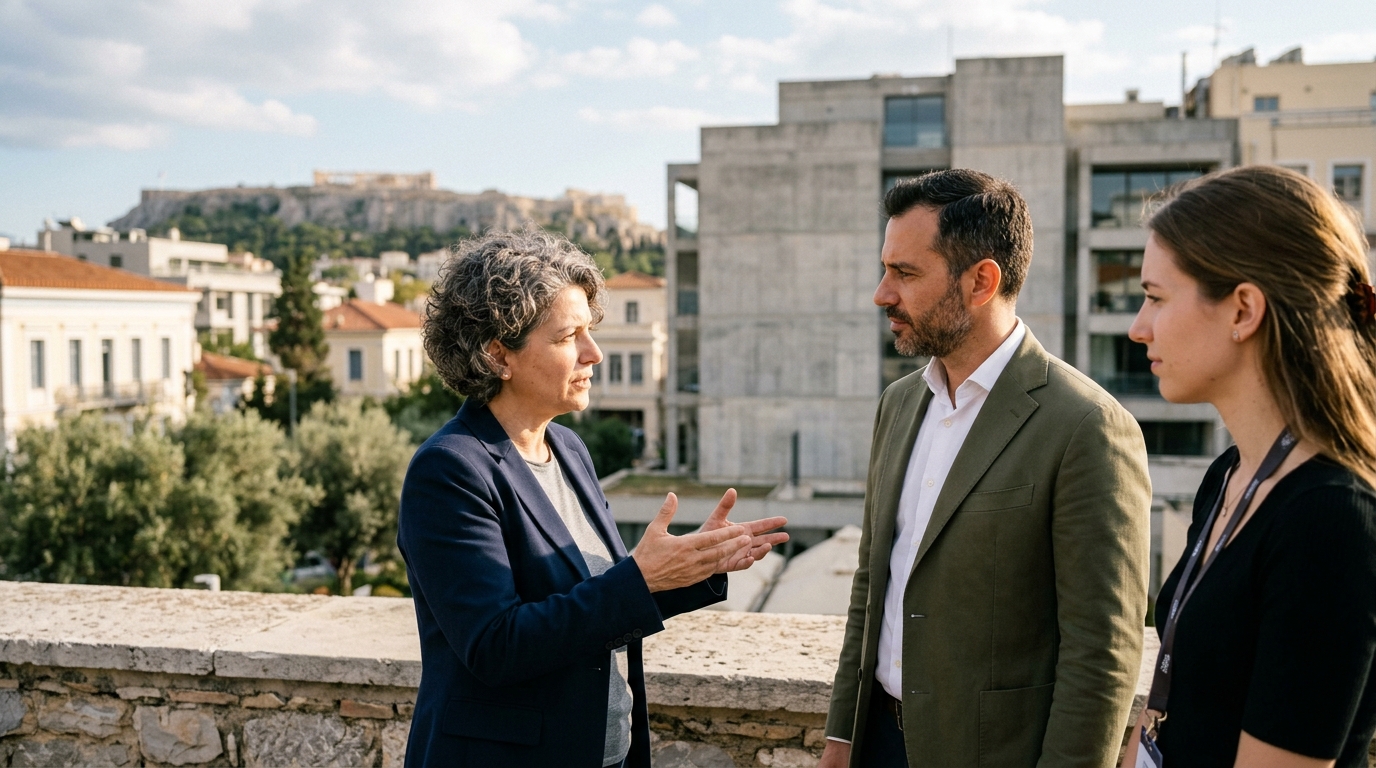
In the global technological landscape, the conversation surrounding Artificial Intelligence has shifted from mere text generation to the development of "agents"—systems that don't just answer questions but take autonomous action. At the heart of this revolution is a Greek scientist, Danai Antoniou, co-founder and Chief Scientist of Gradient Labs. Based in London and maintaining a strong presence in the international ecosystem, Antoniou is redefining how financial institutions manage complexity, security, and customer service.
From Chatbots to Autonomous Agents
The fundamental distinction Antoniou draws is the difference between a traditional chatbot and an AI agent. While the former often frustrated users with circular logic and limited understanding, Gradient Labs' agents are engineered for reasoning. As she explained during the Panathēnea conference, the challenge is no longer about producing a convincing response, but about executing a complex workflow with zero margin for error.
For a bank, this means an AI agent can handle the investigation of a disputed transaction, check historical data, apply compliance rules, and suggest or execute a resolution while simultaneously updating the customer. This transition from theory to practice requires a deep understanding of Large Language Model (LLM) architecture, coupled with the rigorous constraints governing the banking sector.
The Challenge of Trust and Hallucinations
One of the primary hurdles for AI adoption in financial services is the phenomenon of "hallucinations," where a model generates inaccurate information with high confidence. Gradient Labs focuses on building systems that are "inherently safe." Antoniou emphasizes that trust is not earned through promises but through the implementation of guardrails that ensure the AI agent remains within the boundaries of banking policy and regulation.
"We aren't just building technology; we are building infrastructures of trust for industries where error is not an option," Antoniou notes.
The company's approach is rooted in the "Human-in-the-loop" principle where necessary, but with the ultimate goal of automating 80-90% of the repetitive, time-consuming processes that currently burden banking staff. This allows human employees to focus on cases requiring empathy and critical judgment—elements that AI, despite its progress, cannot yet fully simulate.
Greek Talent on the Global Stage
Danai Antoniou's participation in Panathēnea highlights a broader trend: the emergence of a new generation of Greek founders who excel abroad while maintaining strong ties to their homeland. Gradient Labs exemplifies a company leveraging top-tier scientific talent to solve global-scale problems. Antoniou, with her background in data science and machine learning, serves as a role model for women in Deep Tech—a field traditionally dominated by men.
The strategy of Gradient Labs is not limited to technological superiority; it also encompasses a profound market understanding. Today’s banks face immense pressure from digital-first neobanks and the need for drastic operational cost reduction. AI agents offer a solution, allowing services to scale without a corresponding linear increase in headcount. However, Antoniou warns that AI adoption must be strategic rather than a rushed attempt at optics.
The Future of Financial Services
Looking ahead, Antoniou envisions a world where banks function as "invisible" partners in a citizen's daily life, thanks to AI. AI agents will be able to predict user needs, suggest optimal investment moves in real-time, and protect against fraud before it even occurs. Gradient Labs positions itself as the catalyst for this transition, providing the tools that turn this vision into reality.
In conclusion, the trajectory of Danai Antoniou and Gradient Labs underscores that the next phase of AI is not just about the models themselves, but their application in high-stakes environments. The ability to bridge the gap between academic research and business necessity is what will define the winners of the new economy. For Greece, the success of such founders serves as the best possible embassy for the local ecosystem and proof that innovation knows no borders.