In the heart of the Middle East, a new digital empire is being constructed at breakneck speed. From Abu Dhabi to Riyadh, Artificial Intelligence (AI) is no longer just a technological tool but the cornerstone of national strategies for the post-oil era. However, a fundamental contradiction exists: while AI models like the UAE’s Falcon "soar" in the clouds of digital innovation, their physical existence depends on a series of vulnerable cables lying on the seabed.
Geography as Destiny and Constraint
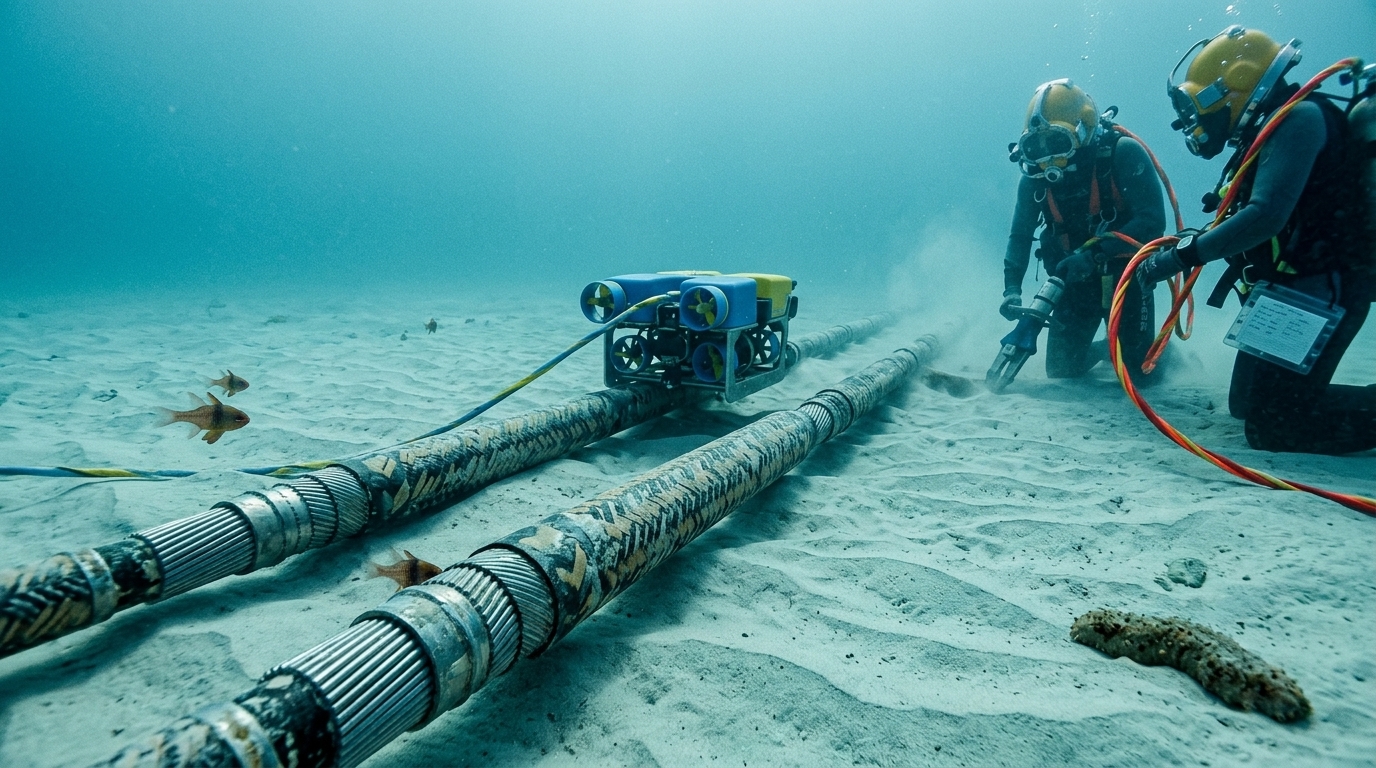
The Red Sea is one of the planet's most critical telecommunications arteries. Approximately 17% of global internet traffic passes through this narrow strait, connecting Europe to Asia. For Gulf states aspiring to become global AI hubs, this geographic bottleneck is a source of constant anxiety. Recent geopolitical instability, including Houthi attacks and accidents caused by ship anchors, has highlighted the extreme fragility of this network.
AI requires massive amounts of data and, crucially, low latency. When an undersea cable is severed, traffic is rerouted, often through longer paths around Africa, increasing latency and rendering real-time AI applications—from autonomous driving to high-frequency financial transactions—inefficient. For a region investing hundreds of billions of dollars in the future, this physical vulnerability is unacceptable.
Diversification Strategies and Terrestrial Routes
Facing this risk, "Hyperscalers" (such as Google, Microsoft, and Amazon), in collaboration with regional governments, are seeking alternatives. Saudi Arabia, under its Vision 2030, is promoting the creation of terrestrial telecommunications corridors crossing the Arabian Peninsula, bypassing the hazardous waters of the Red Sea. These routes, though more expensive to build and maintain, offer greater security and easier access for repairs.
"Mastery of Artificial Intelligence is not just about algorithms; it is about controlling the physical infrastructure that feeds them," market analysts note.
Furthermore, Google’s Blue-Raman project, connecting India to Europe via Israel, Jordan, and Saudi Arabia, is a prime example of how technology forces new geopolitical alliances. The need for stable data connectivity transcends, in some cases, traditional political rivalries, creating a new "Digital Silk Road."
Geopolitical Rivalry and Digital Sovereignty
The cable issue is not merely technical; it is deeply political. The United States is pressuring Gulf states to avoid Chinese infrastructure (such as Huawei Marine), citing espionage risks. Conversely, China offers competitive pricing and rapid implementation, making the choice difficult for countries wishing to maintain a balance between the two superpowers.
The concept of "Sovereign AI," heavily promoted in the Gulf, assumes that data and processing power remain within national borders. However, as long as AI models depend on global networks for training and operation, the notion of sovereignty remains incomplete without full control of the cables. The shift toward local data storage and domestic data centers is one response, but the need for international interconnectivity remains the critical single point of failure.
Conclusion: The Future is Material
The AI boom in the Gulf reminds us of a forgotten truth: the digital economy is deeply rooted in the physical world. The nations that succeed in securing their telecommunication routes, whether through undersea protection or terrestrial diversification, will be those that lead the AI revolution. For the Gulf, the challenge is to transform its geographic position from a vulnerability into an advantage, building an infrastructure as resilient as its ambitions.