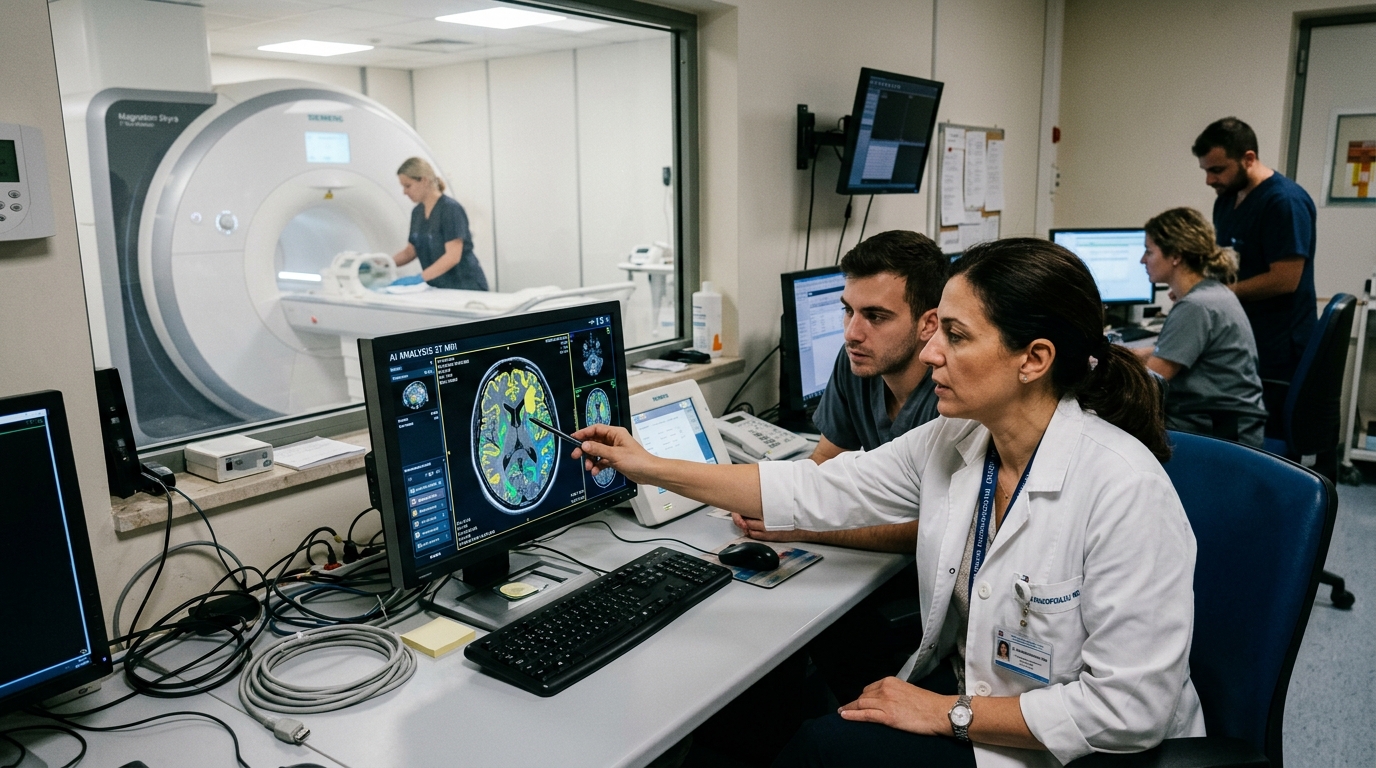
The arrival of cutting-edge medical technology in the Greek provinces has always been a bet on modernization and social justice. Starting this May, Corfu ceases to be merely a world-class tourist destination and transforms into a pivotal point of medical innovation for the wider region of Western Greece. The installation and operation of a state-of-the-art 3 Tesla Magnetic Resonance Imaging (MRI) scanner, incorporating Artificial Intelligence (AI) algorithms, marks a new era for the island's diagnostic capabilities.
The Technological Superiority of 3 Tesla
For the average citizen, the difference between a conventional 1.5 Tesla MRI and a 3 Tesla system might seem like a technical detail, but it is actually a quantum leap in image quality. The magnetic field strength is doubled, allowing for the production of images with exceptionally high resolution and detail. This is particularly critical for diagnosing conditions of the central nervous system, the spine, and joints, as well as for the early detection of oncological cases.
The 3 Tesla system does not just offer "clearer" images; it offers radiologists the ability to see structures that were previously indistinct. In neurology, for example, imaging the brain's microstructures can assist in more accurately mapping lesions in patients with multiple sclerosis or in the early diagnosis of neurodegenerative diseases such as Alzheimer's. In orthopedics, details of cartilage and ligaments are highlighted with such precision that they often render invasive diagnostic methods unnecessary.
Artificial Intelligence as a Catalyst for Speed and Precision
However, the real revolution in Corfu's new system lies not only in powerful magnets but in the integration of Artificial Intelligence. Traditional MRIs are often time-consuming, causing discomfort to patients, especially those suffering from claustrophobia. AI addresses this problem through sophisticated Deep Learning Reconstruction algorithms.
These algorithms can "clean" noise from the image in real-time, allowing for a reduction in examination time by up to 50% without any loss in quality. This means that an exam that once required 30 minutes of lying still in the scanner can now be completed in less than 15. Furthermore, AI helps automate patient positioning and slice planning, ensuring that the examination is standardized and free from human error in preparation. This efficiency also allows for more patients to be served daily, reducing waiting lists significantly.
Healthcare Decentralization and Social Impact
This investment in Corfu has deep social implications. Until now, many residents of the Ionian Islands were forced to travel to Athens or Ioannina to access high-definition 3 Tesla scans. This involved not only a financial burden but also psychological distress, particularly for the seriously ill or the elderly. Having such technology "at home" strengthens the sense of security and upgrades the standard of living for the local community.
Moreover, this move bolsters medical tourism. Corfu, as an international hub, can now offer high-level health services to visitors who might require urgent or scheduled diagnostic care during their stay. The convergence of cutting-edge technology with regional development represents the ideal model for the future of the National Health System, whether in the public or private sector. It proves that the periphery can lead in innovation when the right investments are made.
Challenges and the Future of Diagnostics
Of course, technology alone is not enough. The challenge lies in training medical and paramedical staff to make the most of AI tools. Radiologists are now called upon to become "supervisors" of algorithms, focusing on the clinical interpretation of findings while the machine handles the heavy lifting of data processing. The human-machine collaboration is the cornerstone of 21st-century medicine.
Looking to the future, the integration of AI into MRI is just the beginning. Soon, we expect the application of predictive models that will automatically compare a patient's current images with thousands of others from global databases, alerting the doctor to potential pathologies before they are even visible to the human eye. Corfu, with this step, places itself at the forefront of this global evolution, proving that innovation knows no geographical boundaries. The digitalization of health is not a luxury; it is a fundamental right that is finally reaching the edges of the Greek territory.