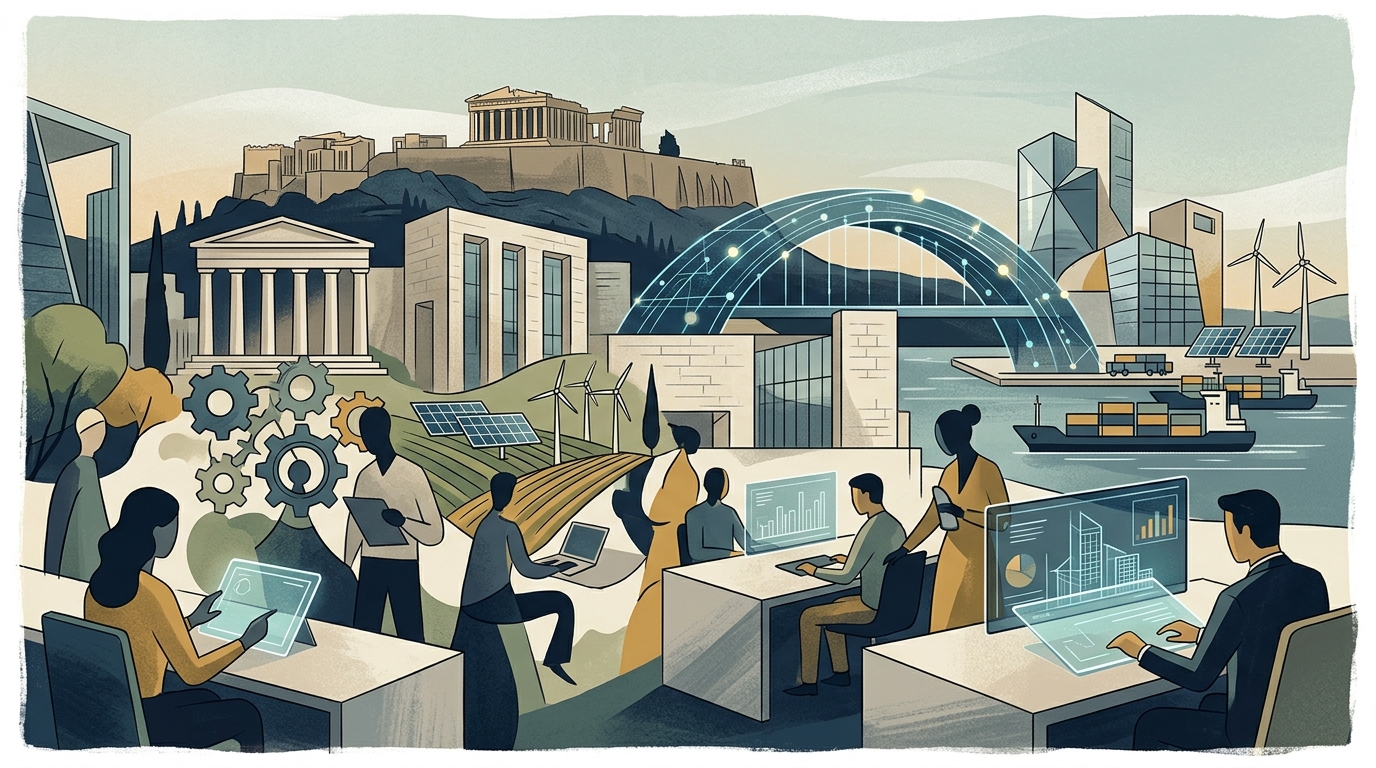
Greece, a nation historically balanced between Eastern spirituality and Western nodes of rationalism, finds itself at a critical crossroads today. As Artificial Intelligence (AI) reshapes the global economy, the question is no longer just how to increase GDP, but how to ensure quality of life and social cohesion. The recent dialogue sparked by the example of Bhutan and the legacy of Hippocrates offers a radical framework for the country's future.
From GDP to Gross National Happiness
The Kingdom of Bhutan, isolated in the Himalayas, became world-famous for introducing the Gross National Happiness (GNH) index. Unlike GDP, which measures only economic activity, GNH is built on four pillars: sustainable and equitable socio-economic development, environmental conservation, cultural preservation, and good governance. For Greece in 2026, this model is not a utopia but a necessity. AI can act as the catalyst to measure and enhance these intangible values.
Imagine AI systems that don't just optimize tax collection, but also citizens' access to green spaces, the quality of their sleep, or their sense of security within a community. Digital governance in Greece has made leaps, but the next phase must be anthropocentric. Technology must liberate time from bureaucracy so we can invest it in 'eudaimonia'—a concept our ancestors knew well.
Hippocrates and Holistic Digital Health
Hippocrates taught that health is not merely the absence of disease, but the balance of the human being with their environment. Today, Greece has a unique opportunity to lead in the field of 'Hippocratic Technology.' With the help of AI, preventive medicine can become personalized and accessible to every remote island or village. Using algorithms to analyze lifestyle, nutrition, and environmental factors can transform the national health system from a 'repair' system to a 'wellness maintenance' system.
This approach also holds immense economic interest. Greece can become a global destination for medical tourism and wellness, combining its natural beauty with high-tech services based on the principles of holistic medicine. AI here does not replace the doctor; it enhances their ability to see the patient as a whole, exactly as the physician from Kos proposed 2,500 years ago.
Greece as a Sanctuary of Quality of Life
In a world that is becoming increasingly noisy and digitally exhausting, Greece can offer the antidote: 'metron' (moderation). Our future strategy must focus on attracting not just tourists, but 'digital nomads' and investors seeking quality of life. AI enables decentralized work, making the Greek provinces ideal places to live.
- Sustainable Tourism: Using AI to manage flows and protect ecosystems.
- Cultural Heritage: Digitizing and highlighting philosophical thought as a tool for modern self-improvement.
- Green Energy: Harnessing sun and wind with smart grids that lower costs for citizens.
The challenge is whether we can integrate technology without losing our soul. Bhutan teaches us that development without spirituality is empty, and Hippocrates reminds us that nature is the ultimate healer. The Greece of the future must be the laboratory where high tech meets high humanity.
Challenges and the State's Duty
Of course, the transition to such a model requires political will and educational reform. It is not enough to buy software; we must cultivate a new mindset. Education must move away from mere rote learning and focus on critical thinking, the ethics of technology, and contact with nature. Greece cannot compete with Silicon Valley in hardware production, but it can compete in the production of 'meaning.'
"Life is short, the art long, opportunity fleeting, experiment treacherous, judgment difficult." - Hippocrates
These words resonate more loudly today than ever. The opportunity for Greece to redefine itself through the synthesis of tradition and innovation is now. If we succeed, we will not just have a better economy, but a society worth living in.