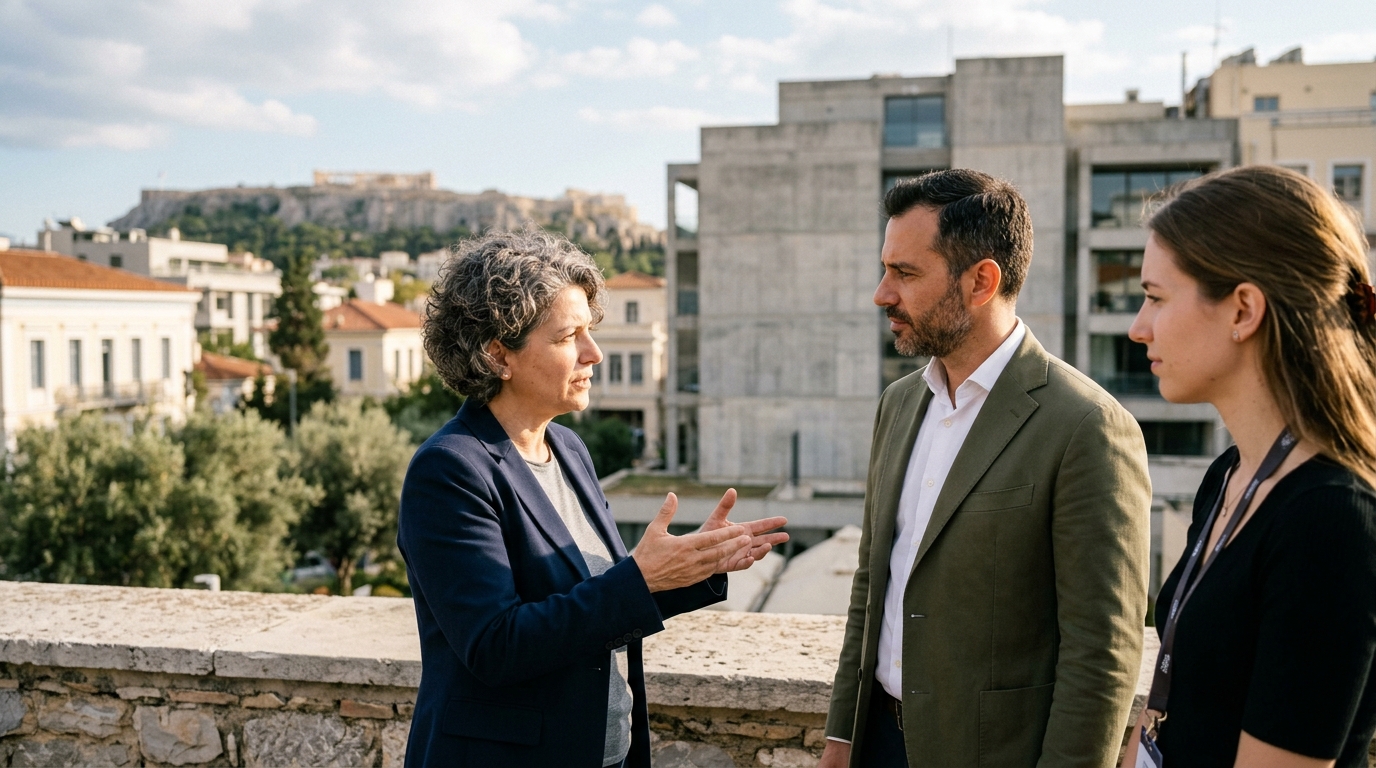
Artificial Intelligence (AI) is no longer a science fiction scenario or a topic exclusive to academic circles. In 2026, Greece stands at a pivotal junction, where educational efforts by media outlets, such as the recent comprehensive review by Cosmote TV, highlight the need for a deep and meaningful dialogue regarding our digital acceleration. The country, striving to bridge decades-old gaps, is called to balance the adoption of cutting-edge technologies with the protection of its social fabric.
The National Strategy and the Implementation of the EU AI Act
The enforcement of the European Artificial Intelligence Act (EU AI Act) has established a new regulatory framework, which Greece is integrating with careful steps. The establishment of the AI Advisory Committee under the Prime Minister has already borne fruit, laying the foundations for ethical and transparent use of algorithms in public administration. However, the challenge remains: how can a bureaucratic structure transform into an agile mechanism that leverages LLMs (Large Language Models) to serve the citizen?
According to analysts, the integration of AI into the Greek public sector is expected to reduce waiting times in critical areas such as justice and healthcare.
"AI is not a tool to replace humans, but a power multiplier for our creative and analytical abilities,"notes a digital governance official. The creation of a personal digital assistant for every citizen is now a reality, offering personalized information and processing requests in seconds.
The Greek Innovation Ecosystem
Alongside the state, the private sector in Greece is experiencing an unprecedented boom. Greek AI startups are attracting international capital, focusing on sectors like shipping, tourism, and energy. The use of predictive models to optimize shipping routes or forecast tourism trends has made Greek businesses more competitive in the global market. Athens and Thessaloniki are emerging as regional tech hubs, with major giants investing in data centers and R&D facilities.
- Development of specialized AI models for the Greek language.
- Strengthening collaboration between universities and industry.
- Investment in High Performance Computing (HPC) infrastructure.
- Upskilling and reskilling of the workforce.
Social Challenges and the Future of Work
Despite the optimism, concerns about the impact on the labor market remain intense. The automation of tasks that previously required human intervention causes uncertainty for thousands of workers. The answer cannot be technophobia, but investment in education. The Greek educational system must integrate algorithmic thinking from the earliest stages, ensuring that future generations are not mere consumers but creators of technology.
Furthermore, the issue of the "digital sovereignty" of the Greek language is critical. If major AI models are not properly trained in Greek, there is a risk of cultural erosion or the marginalization of our language in the digital world. Initiatives from NCSR "Demokritos" and other research institutions are working feverishly to create "Greek" LLMs that respect the nuances of our language and history.
Conclusion
Artificial Intelligence in Greece in 2026 is a bet that must be won. It is not just a technological upgrade, but a total rethink of how we live, work, and interact. Informing the public through high-quality productions and analysis is the first step toward forming a society that uses AI as a tool for progress rather than a means of exclusion.