The history of technology is, at its core, a story of augmenting human capabilities. For the visually impaired, the promise of Artificial Intelligence (AI) is not merely a convenience but a fundamental shift in how they interact with the physical world. From early text-to-speech readers to today’s sophisticated multimodal models, the journey has been long, but we are now at a tipping point where AI can truly function as 'eyes' for those in need.
The Convergence of Computer Vision and Natural Language
The most significant development in recent years is the transition from simple object recognition to full contextual awareness. Previously, an app could identify a 'table' or a 'chair.' Today, thanks to models like GPT-4o and Gemini 1.5, AI can describe an entire scene with stunning detail: 'On the table in front of you sits a cup of hot coffee to the right and an open book to the left, while someone is approaching from the door holding an envelope.'
This ability to translate visual data into vivid, descriptive language in real-time is revolutionary. Computer vision technology has now integrated with Large Language Models (LLMs), allowing users to ask questions about their environment. 'Where did I leave my keys?' or 'What does the menu say on the third row?' are questions AI can now answer by analyzing the video stream from a smartphone camera or a pair of smart glasses.
From Smartphones to Wearables: Hands-Free Freedom
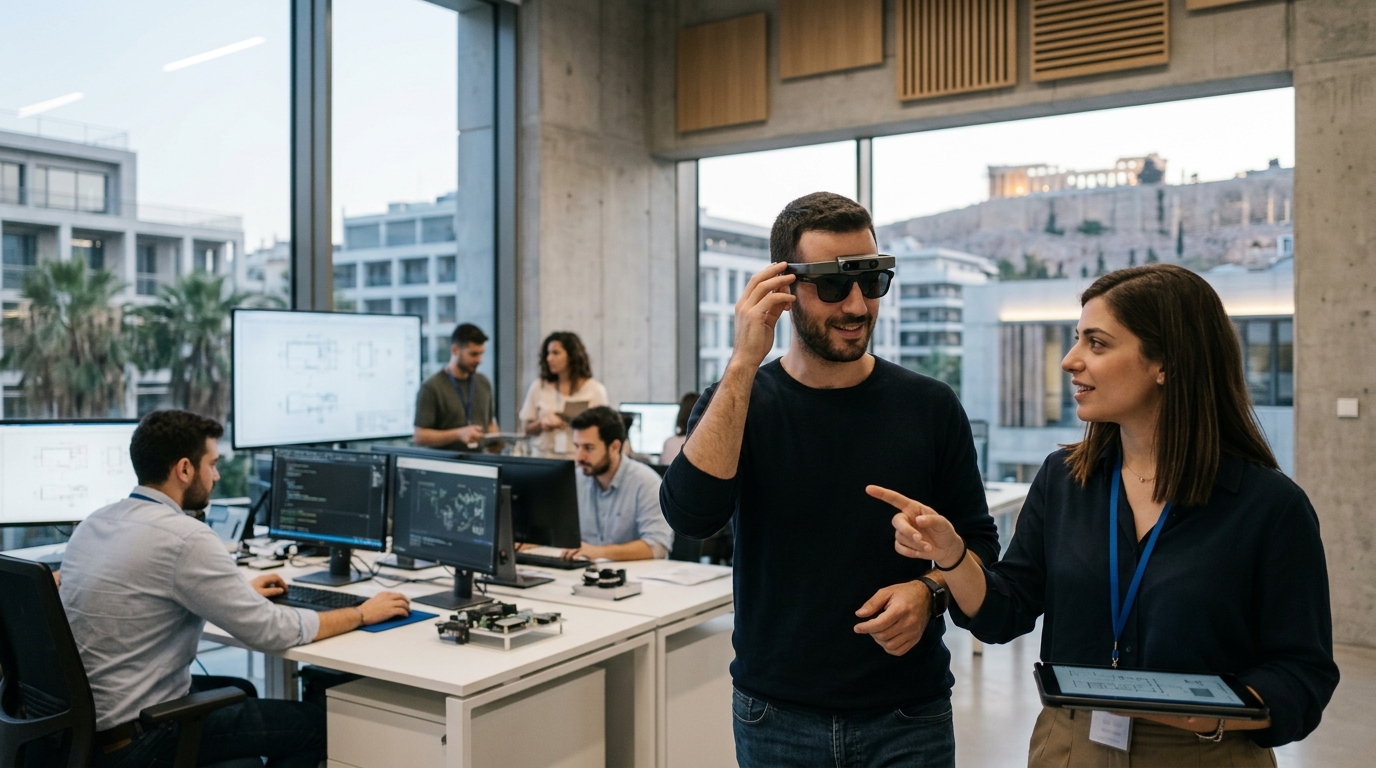
While mobile apps like Be My Eyes and Seeing AI were the first major step, true autonomy comes through wearable devices. Smart glasses equipped with cameras and bone-conduction headphones allow users to keep their hands free—a critical factor for those using a white cane or a guide dog.
Devices like the Orcam MyEye or the recent Meta-Ray-Ban collaborations point toward the future. These devices can recognize friends' faces in a room, read street signs from a distance, and guide the user through indoor spaces. AI integration also allows for information filtering. The system doesn’t 'bombard' the user with every single detail but prioritizes information crucial for safety and social interaction.
The Greek Context and Infrastructure Challenges
In Greece, the implementation of these technologies faces unique challenges. The architecture of Greek cities, with narrow sidewalks and frequent obstacles, makes the need for precise navigation even more urgent. However, the support for the Greek language by major AI models has improved dramatically, allowing for seamless use by the Greek population.
Furthermore, AI can assist in digital accessibility. Many Greek websites and public services remain difficult to navigate for the visually impaired. AI tools can now analyze a website's code in real-time and 'reconstruct' it audibly for the user, bypassing poorly designed elements and making digital citizenship a reality for everyone.
Ethical Considerations and the Cost of Access
Despite the excitement, serious questions remain. The first concerns privacy. When a device constantly records the environment to assist the user, what happens to the data of third parties captured in the frame? Companies must ensure that processing happens locally on the device (edge computing) and isn't stored in clouds without consent.
The second issue is the economic divide. The most advanced assistive devices cost thousands of euros, making them inaccessible to a large portion of the population. If AI-powered vision becomes a privilege of the few, then technology, instead of bridging inequalities, will create new ones. It is essential for national health systems and insurance providers to recognize these devices as essential medical aids and subsidize their acquisition.
Conclusion
Artificial Intelligence will never fully replace human sight, but it offers something equally valuable: the dignity of independence. As models become smarter and devices smaller, the world is becoming accessible again, filled with information and possibilities that were, until yesterday, locked behind a veil of darkness.