The Tempi tragedy remains an open wound in Greece's collective consciousness, a reminder of criminal negligence and the collapse of safety systems. Today, three years later, technology is called upon to play the role of an impartial arbiter in a field where the human factor proved fatal. The introduction of Artificial Intelligence (AI) in managing communication between station masters is not just a technical upgrade; it is an attempt to impose a new culture of professionalism and responsibility.
The End of "Impropriety" and Irresponsibility
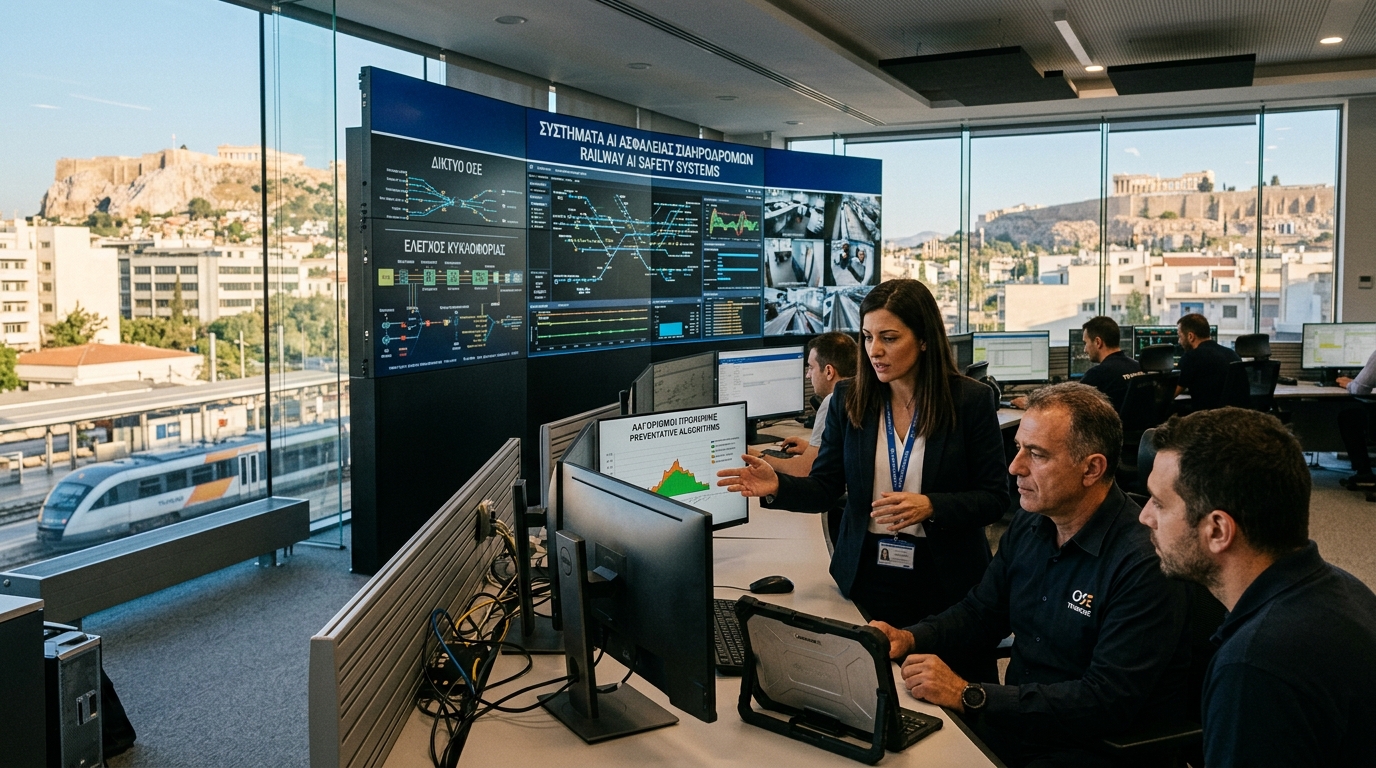
According to recent reports, the new AI system being installed in OSE (Hellenic Railways Organization) control centers aims to eliminate the "improprieties" and unacceptable familiarity that often characterized conversations between movement personnel. Slang, incomplete instructions, and the bypassing of official communication protocols—which in the past led to confusion and catastrophic errors—are now placed under the surveillance of algorithms.
The system operates using Natural Language Processing (NLP), recording and analyzing in real-time every word exchanged between station masters and drivers. If the AI detects a deviation from the predefined protocol—for example, if the necessary confirmation of the train's position is not given or if the language used is inappropriate—it emits an immediate warning to the operations center.
Strict Sanctions and Digital Traceability
This revolution is not limited to monitoring. The new framework provides for strict sanctions for those who do not comply with the new standards. Digital traceability means that every violation is recorded in an unalterable file that cannot be tampered with or deleted. This creates an environment of full accountability, where the station master knows that every word is part of a legally binding record.
- Automated recording and transcription of all voice commands.
- Detection of emotional stress or fatigue in staff voices via AI analysis.
- Direct linking of violations to the organization's disciplinary board.
- Mandatory use of standardized phraseology similar to civil aviation.
The implementation of these measures comes as a response to the need for a radical restructuring of railway operations. Critics, however, point out that AI cannot substitute for the lack of personnel or outdated infrastructure, but it can certainly reduce the percentage of human error due to negligence.
The Challenge of Adaptation
The transition to this new regime is not without obstacles. Labor unions express concerns about "digital policing" and the pressure exerted on staff. However, the government and OSE management remain firm: passenger safety is non-negotiable. AI does not act as a punisher but as a safety net ensuring that procedures are followed to the letter.
"This is not a simple technological addition, but a paradigm shift. The railway must operate with the precision and discipline that human life demands," says a Ministry of Transport official.
In the long run, the integration of AI is expected to extend to predictive maintenance for tracks and signaling systems, creating a holistic protection system. Until then, enforcing communication protocols remains the first and most critical step in regaining public trust.