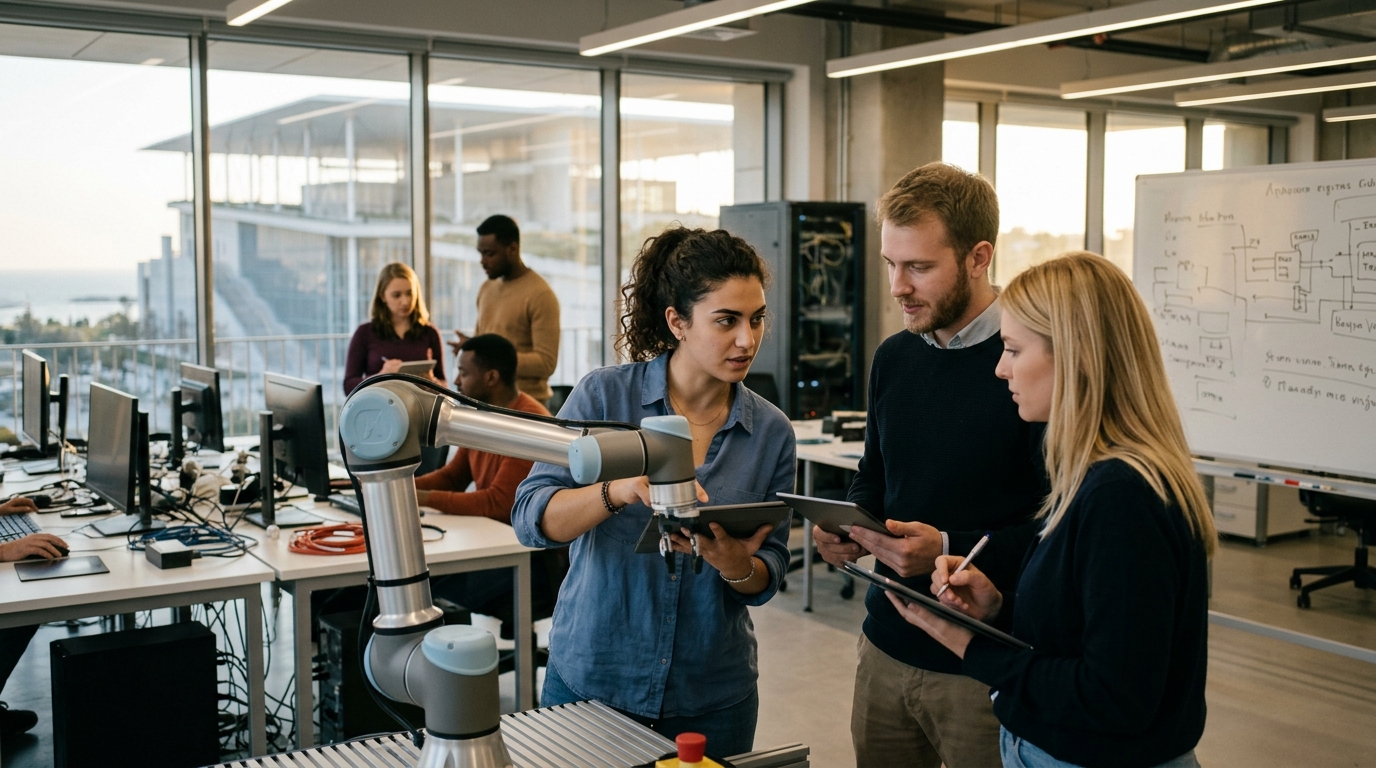
In an era where Artificial Intelligence (AI) is reshaping every facet of our daily lives, the traditional educational process stands at a critical crossroads. The "AI HUB," an initiative gaining momentum on the Greek educational map, seeks to overturn the stereotype of the "lesson" as a sterile transfer of knowledge from teacher to student. The motto is clear: "No more lessons, more action."
The Failure of the Traditional Model in the Digital Age
For decades, computer science education in schools was limited to learning office tools or basic programming languages through textbooks that were often outdated before they were even printed. In the world of AI, where developments move at a geometric progression, this approach is doomed to fail. Students today do not need to memorize definitions of what an algorithm is; they need to understand how to interact with it, how to guide it, and, most importantly, how to question it.
AI HUB proposes a model where learning happens organically. Instead of theoretical lectures, children engage in projects where AI is their "partner." From creating digital art to solving environmental problems through data analysis, technology ceases to be the object of study and becomes the medium for creation.
Experiential Learning: The Key to Critical Thinking
The core philosophy of AI HUB focuses on "mindful usage." It is not enough for a child to know how to use ChatGPT or Midjourney. They must understand the biases of the models, the ethical dimension of data usage, and the value of human creativity, which remains irreplaceable. Through workshops that resemble hackerspaces more than classrooms, students experiment with prompt engineering and training small machine learning models.
- Interactivity: Knowledge is acquired through play and exploration.
- Interdisciplinary approach: AI is linked to biology, history, and the arts.
- Ethics: Discussions on internet safety and intellectual property.
This approach boosts children's confidence. When a student sees they can "train" a computer to recognize recyclable materials, technology is demystified. It stops being a "magical" entity and becomes a tool in their hands.
The Challenge for the Greek Educational System
Adopting such initiatives in Greece requires a radical change in mindset. It is not just about equipping schools with tablets and high-speed internet, but about training educators to become facilitators rather than authorities. AI HUB acts as a beacon, showing that education can be engaging, modern, and, above all, useful for the future.
"AI will not replace humans, but humans who use AI will replace those who do not."
This phrase, often heard in the corridors of tech giants, is the driving force behind AI HUB. The goal is not for all children to become programmers, but to acquire the "algorithmic thinking" that will allow them to thrive in any profession they choose in the future, from medicine to law.
Conclusion: A New Era for Knowledge
AI HUB is not just an educational program; it is a statement of what 21st-century learning should look like. By abolishing the narrow boundaries of the traditional lesson, it gives children the tools to become architects of their digital future, rather than mere consumers. Greece, through such innovative actions, has the opportunity to close the gap and prepare a generation that does not fear technology but inspires it.