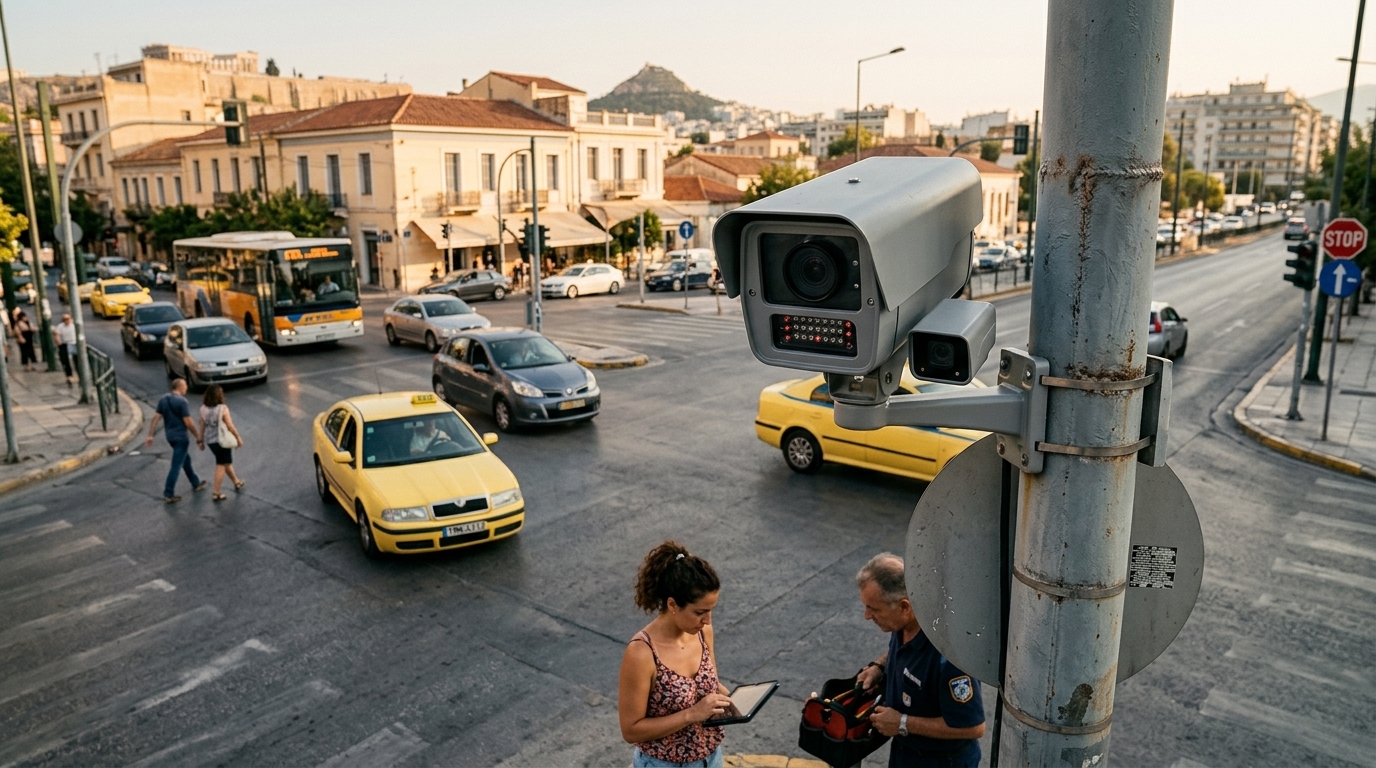
The image of a Greek traffic officer with a whistle and a paper ticket book is fading into history. With the Ministry of Digital Governance announcing a tender for the procurement and installation of 1,000 stationary smart cameras, Greece is making a quantum leap toward automated law enforcement. This is not merely an equipment upgrade; it is a structural overhaul of how the state interacts with traffic offenders.
The End of Impunity and 'Ticket Fixing'
For decades, road policing in Greece relied heavily on human presence and, unfortunately, human discretion—which often translated into political interventions to "erase" fines. The new system promises to eliminate this long-standing pathology. The 1,000 new cameras will function as an uninterrupted oversight mechanism that knows no "favors" or political connections.
The process will be relentlessly digital: the camera records the violation, the software recognizes the license plate, and the system cross-references the data with the national tax database (Taxisnet). Within minutes, the fine will be sent to the owner's digital wallet (Gov.gr Wallet) or notified via SMS. This immediacy is expected to serve as a powerful deterrent, as drivers will know that punishment is certain and instantaneous.
Cutting-Edge Technology at the Service of Safety
The cameras to be installed are far more than simple recording devices. They integrate Artificial Intelligence and latest-generation sensors capable of detecting a wide range of violations beyond just speeding. Running red lights, using a mobile phone while driving, failing to wear a seatbelt or helmet, and illegally driving in emergency lanes (LEA) will all be under constant surveillance.
- License plate recognition in low light and adverse weather conditions.
- Ability to simultaneously monitor multiple lanes of traffic.
- Real-time connection to the central traffic management system.
- Automatic archiving of evidence (photos/video) for legal use.
The project, with a multi-million euro budget, includes not only the purchase but also the maintenance of the network for the coming years, ensuring that these cameras do not end up "blind" due to a lack of resources, as has happened with older systems in the past.
Road Safety: A National Necessity
Greece remains high on the list of road fatalities in the European Union, despite improvements in national highways. The problem is primarily located in urban areas and the secondary road network, where policing is often sparse. According to road safety analysts, placing cameras at "black spots" (locations with high accident frequency) can reduce collisions by up to 40%.
"Technology is not here to punish, but to protect. Every camera that prevents a red-light violation is a potential life saved," ministry sources state.
However, criticism is not absent. Some civil liberties groups raise questions regarding data privacy and the possibility that this move is primarily revenue-driven. The government responds that data processing will be carried out in strict compliance with GDPR and solely for the purposes of road safety.
The Implementation Challenge
The challenge now lies in the speed of implementation. The tender includes strict timelines, as the pressure to reduce accidents is immense. Integrating the data from the cameras into the new, unified electronic violation certification system is key. If the system functions as designed, it will represent the most significant reform in the country's road culture since the introduction of mandatory seatbelts.
In a country where road violations are often viewed with a sense of entitlement or "bravado," digital surveillance comes to enforce the rule of law. When the law is applied automatically and horizontally, the culture of impunity begins to crumble. These 1,000 cameras are the first step toward a road network where safety depends not on luck, but on the rules.