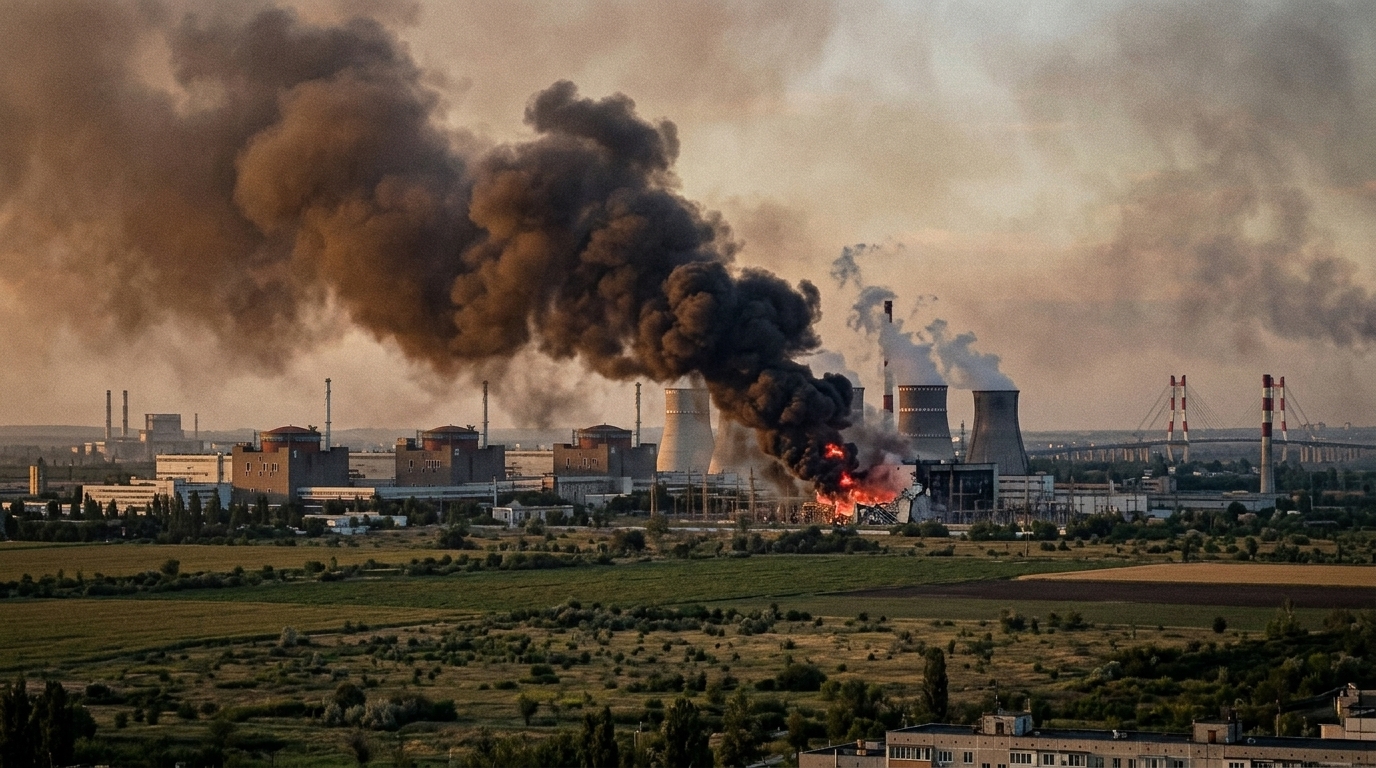
The history of humanity is marked by moments where technological progress collides violently with the madness of war. Today, in the heart of Russian-occupied southern Ukraine, the Zaporizhzhia Nuclear Power Plant (ZNPP)—the largest in Europe—has been transformed into a nightmarish theater of geopolitical blackmail. The recent announcement by the International Atomic Energy Agency (IAEA) regarding a drone strike on a building housing a turbine at the plant is not just another war report; it is a chilling reminder that the 'unthinkable' remains a terrifying possibility.
The Anatomy of a Persistent Threat
Rafael Grossi, Director General of the IAEA, once again employed stark language: "Whoever is attacking nuclear power plants is playing with fire." However, in the current phase of the conflict, this "fire" is not metaphorical. Drone strikes, artillery shelling in the plant's periphery, and the continuous disruption of power lines essential for reactor cooling create a landscape of absolute instability. Despite the fact that all six reactors are in a state of "cold shutdown," the need for a continuous flow of electricity and water remains critical to prevent a core meltdown.
The strategic significance of Zaporizhzhia extends far beyond energy production. For Russia, occupying the plant serves as a powerful bargaining chip and a "nuclear shield" for its military operations in the region. For Ukraine, regaining control is a matter of national sovereignty and energy security. In this stalemate, the IAEA finds itself in an awkward position: it is the sole international observer on the ground but lacks the executive power to enforce a demilitarized zone around the facility.
The Erosion of Nuclear Taboos
What we are witnessing at Zaporizhzhia is the erosion of the "nuclear taboo" painstakingly built after the Chernobyl disaster in 1986. The international community seems to have become desensitized to the danger, treating Grossi's warnings as "background noise" within the broader conflict. This normalization of risk is perhaps the most dangerous element of the current crisis. Drone attacks, regardless of who directs them—as mutual accusations between Moscow and Kyiv are daily—demonstrate that the rules of engagement have bypassed all safety limits.
- Violation of the "Seven Pillars" of nuclear safety as defined by the IAEA.
- Psychological pressure and fatigue of the Ukrainian staff working under Russian command.
- Difficulty in accessing spare parts and specialized maintenance equipment due to the blockade.
Risk analysis indicates that an accidental or intentional catastrophe at Zaporizhzhia would not be confined to Ukraine's borders. Depending on wind patterns, radioactive contamination could affect the Black Sea, the Balkans, and Central Europe, turning a regional conflict into an unprecedented global environmental and health crisis.
UN Inertia and the Need for a New Security Architecture
The UN Security Council remains paralyzed by Russia's veto, making any meaningful intervention impossible. International diplomacy appears to be helplessly watching a slow-motion accident. It is clear that existing treaties, such as the Convention on the Physical Protection of Nuclear Material, did not anticipate a scenario where a nuclear plant would become the epicenter of a high-intensity conventional war.
"We cannot rely on luck to avoid a nuclear accident. Luck eventually runs out," Rafael Grossi has repeatedly stated.
The solution requires more than rhetorical condemnations. It demands a new international consensus that recognizes nuclear power plants as "neutral zones" under the full protection of international law, with automatic sanctions for violators. Until then, Zaporizhzhia will remain an open wound in the heart of Europe, a constant reminder that humanity continues to "play with fire" in a room full of gunpowder.