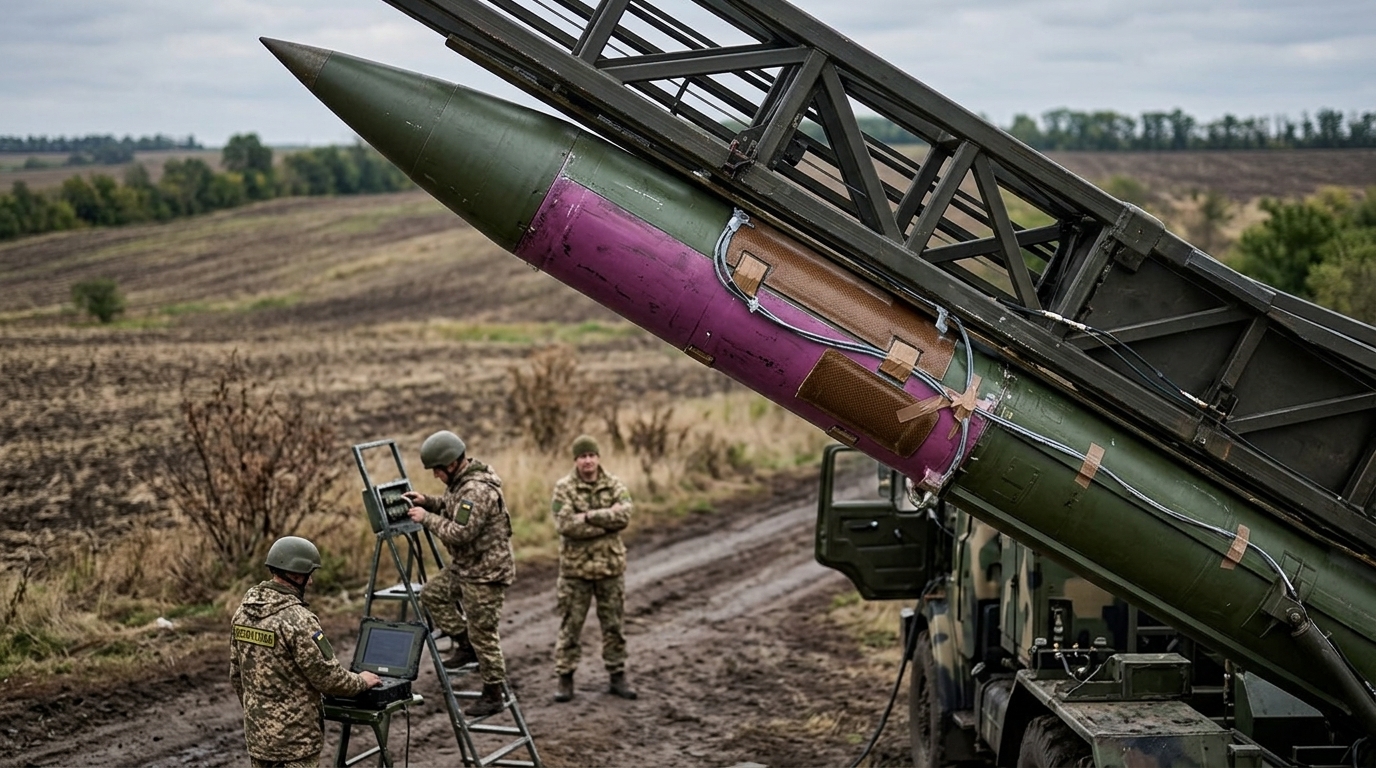
In a pivotal moment for the geopolitical balance in Eastern Europe, the Ukrainian company Fire Point has announced the successful test flight of the FP7.X ballistic missile. This development is not merely an addition to Ukraine's military arsenal; it is a resounding declaration of industrial and technological independence. As the conflict persists, the necessity for domestically produced strike and air defense systems has become imperative, reducing reliance on Western supplies that often come tethered to political caveats.
The Technological Edge of the FP7.X
The FP7.X is a short-range ballistic missile designed with mobility and precision at its core. According to preliminary data, the system integrates advanced guidance algorithms that allow it to bypass enemy electronic warfare (EW) suites. Fire Point, which has emerged as Ukraine's largest private missile manufacturer, focuses on the "smart" architecture of the projectile.
- Solid-fuel propulsion for rapid deployment and launch.
- Integrated AI-assisted navigation for terminal target recognition.
- Adaptable configuration for long-range anti-aircraft roles.
The true innovation of the FP7.X lies in its dual-role capability. While ballistic missiles are traditionally used for strikes against static ground targets, Fire Point is experimenting with a variant capable of intercepting aerial threats, such as strategic bombers or incoming ballistic missiles. This "hybrid" defense model could fundamentally shift the power dynamics in the skies over Ukraine.
The Strategy of "Missile Autonomy"
For Kyiv, the development of the FP7.X is part of a broader doctrine known as the "Missile Program." After years of waiting for ATACMS and Taurus systems, the Ukrainian leadership decided to invest billions into its domestic industry. President Zelenskyy has repeatedly emphasized that the only true security guarantee is the nation's ability to produce its own "long-reach" weapons.
Fire Point works in close collaboration with the Ministry of Digital Transformation and the Brave1 platform, which serves as an accelerator for defense technologies. The success of the FP7.X demonstrates that Ukraine has managed to establish a supply chain capable of withstanding heavy bombardment, by moving production to underground facilities and decentralizing factories across the country.
"We are not just building a missile. We are building the future of European security," a company executive stated during the release of the test flight footage.
Geopolitical Implications and Moscow’s Response
The emergence of a new Ukrainian ballistic missile is causing significant unease in the Kremlin. Until now, Russia relied on its superiority in Iskander and Kinzhal systems. If Ukraine manages to mass-produce the FP7.X, Moscow will face a threat that cannot be mitigated by applying diplomatic pressure on Washington or Berlin.
Furthermore, the FP7.X's potential as an anti-aircraft system endangers Russian aviation deep within occupied territories. Analysis of the tests suggests the missile has an exceptionally low radar cross-section, making interception extremely difficult. This technological advantage, coupled with the speed of production, may force Russia to reconsider the placement of its logistics hubs and command centers.
The Future: From the Battlefield to International Markets
While the immediate goal is national defense, Fire Point is looking further ahead. Following the end of hostilities, Ukraine is expected to emerge as one of the world's leading exporters of defense technology. Systems that have been "battle-proven" are in high demand in the global market.
The FP7.X is the first prototype of a new generation of weaponry that combines Soviet heritage in rocket engineering with Western superiority in electronics and software. The success of this program will determine not only the outcome of operations on the front lines but also Ukraine's position on the new global map of the defense industry.