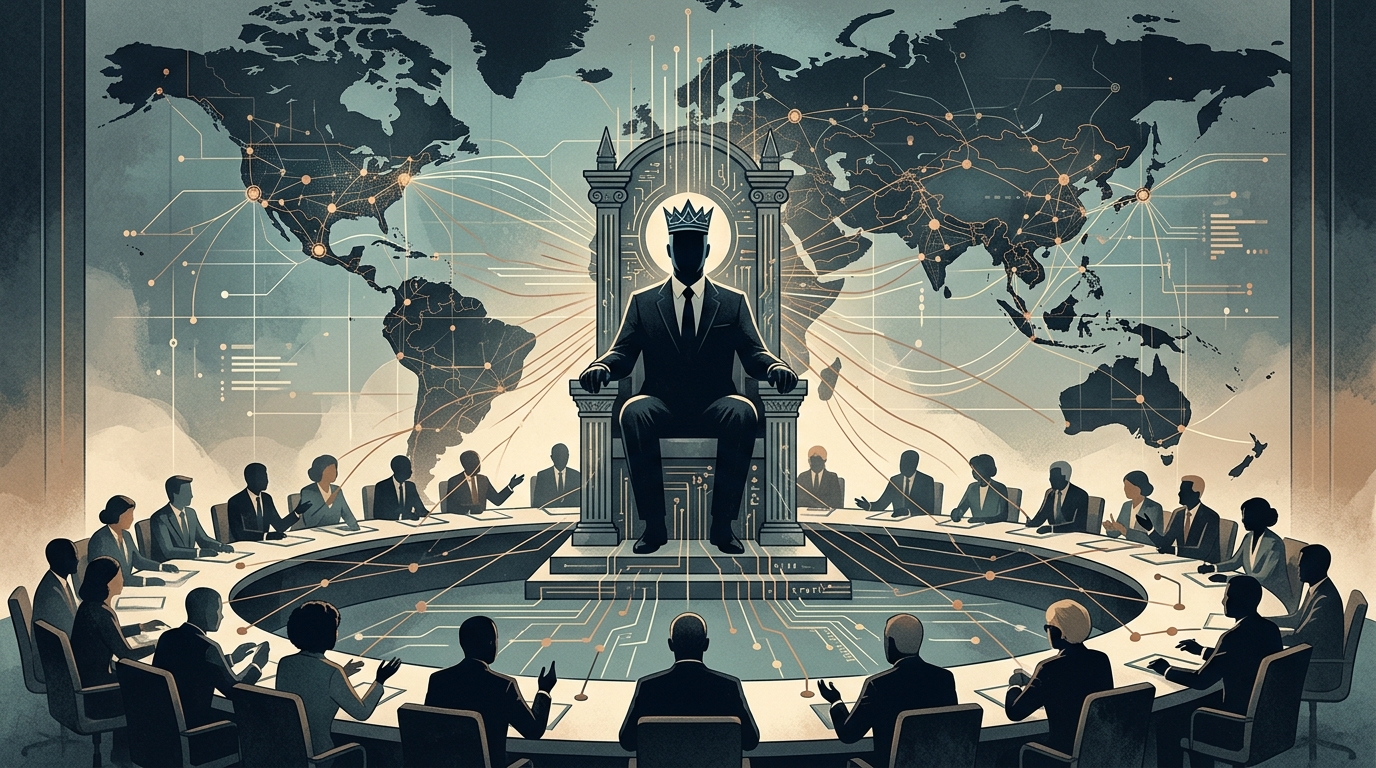
By mid-2026, the global community no longer views Artificial Intelligence (AI) as a mere technological advancement, but as the bedrock of national sovereignty. The transition from 'digital diplomacy' to the 'geopolitics of algorithms' is now complete. Much like the steam engine in the 19th century and nuclear energy in the 20th, AI determines who leads, who follows, and who is marginalized on the world stage. This analysis explores how the balance of power is shifting from oil fields to GPU clusters and data centers.
The Bipolar World: Washington vs. Beijing
The US-China rivalry forms the central axis of AI geopolitics. Washington, through the CHIPS Act and successive export controls on high-end semiconductors, seeks to maintain its 'strategic depth' in computational power. Conversely, Beijing has adopted a model of state-directed innovation, integrating AI into every facet of social governance and military prowess. China is not merely aiming for a tie; it seeks 'algorithmic supremacy' by 2030, investing billions in domestic chip architectures that bypass Western sanctions.
This conflict is not just about software. It is about the physical infrastructure of intelligence. The US controls the design (Nvidia, AMD) and the foundational software (OpenAI, Google, Meta), but China controls the rare earth elements and the manufacturing supply chain. This interdependence creates a fragile 'balance of terror,' where any disruption in the supply chain could trigger a global economic shock.
Europe and 'Regulatory Power'
The European Union, lacking the tech giants of the US or the state centralization of China, has chosen a different path: that of regulatory excellence. The AI Act is not just a legal document; it is a tool of geopolitical influence, known as the 'Brussels Effect.' By imposing strict standards of ethics and transparency, the EU attempts to export its values globally, forcing companies from Silicon Valley to Shanghai to comply if they wish to access the European market.
However, the challenge for Europe remains innovation. Without its own Large Language Models (LLMs) to rival American counterparts, the EU risks becoming a 'digital museum'—a place with excellent rules but without the computational power to apply them to its own technologies. The recent shift toward 'Sovereign AI' in Europe, with initiatives from France and Germany, indicates a belated but necessary awakening.
The Geography of Silicon: The Taiwan Question
No discussion of AI geopolitics is complete without Taiwan. TSMC (Taiwan Semiconductor Manufacturing Company) remains the most critical node on the planet. Its ability to produce chips at 2nm and 3nm scales is the island's 'silicon shield,' but also its greatest point of friction. A potential crisis in the Taiwan Strait would mean an immediate halt to global AI progress. Efforts by the US and Europe to bring manufacturing back home (onshoring) is a process that will take decades, leaving the world in a state of extreme geopolitical vulnerability.
The Global South and Digital Colonialism
Finally, a new danger is emerging: 'digital colonialism.' While major powers battle for dominance, countries in the Global South are often used as sources of cheap data and labor for model training (data labeling), without enjoying the benefits of the technology. Access to AI is becoming the new divide between rich and poor nations. Countries like India and Brazil are trying to carve out a third way, promoting 'Open Source AI' as a means to ensure their own strategic autonomy.
"Artificial Intelligence is not a weapon to be used in the future; it is the architecture upon which our present is being built," notes a senior UN official.
In conclusion, the geopolitics of AI in 2026 is a race for the control of human cognition at scale. The nation that manages to combine computational power, high-quality data, and the right regulatory framework will be the one to set the rules of the game for the remainder of the century.