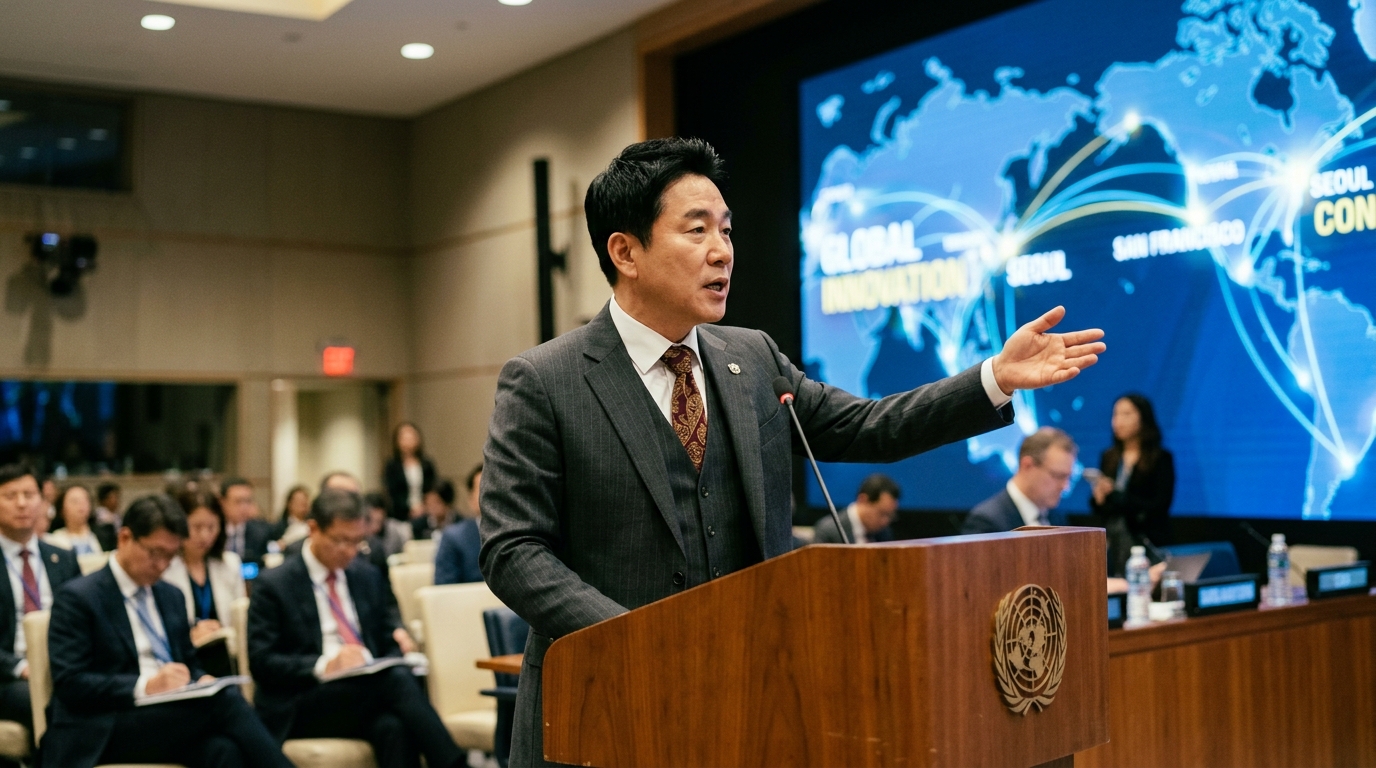
At a critical juncture for the global technological chessboard, the South Korean government today announced an ambitious spending plan aimed at cementing the country’s status as an indisputable "tech lighthouse." The program, unveiled during a presidential briefing on June 29, 2026, is not merely a financial injection; it is a survival strategy in a world where power is increasingly measured in nanometers and computational capacity. As the friction between Washington and Beijing intensifies, Seoul has chosen to accelerate its investments, betting everything on Artificial Intelligence (AI) and next-generation semiconductors.
Fortifying the "Silicon Shield"
The heart of the new plan beats within the semiconductor sector, which serves as the backbone of the South Korean economy. With prices for High Bandwidth Memory (HBM) chips skyrocketing due to the insatiable demand for AI servers, the government has committed to providing multi-billion dollar tax breaks and direct subsidies. The centerpiece is the creation of a semiconductor "Mega Cluster" on the outskirts of Seoul, projected to be the world's largest by 2030. This move is not just about the profitability of giants like Samsung and SK Hynix; it is about ensuring that South Korea remains an irreplaceable link in the global supply chain.
However, the challenge is twofold. On one hand, the U.S. is exerting pressure to restrict technology exports to China, which remains South Korea's largest trading partner. On the other, China is investing staggering amounts to achieve self-sufficiency in chips. Seoul must walk a tightrope, strengthening its ties with the West through cooperation with the U.S. CHIPS Act while simultaneously protecting the interests of its corporations in the Chinese market. The new plan also includes funds for developing indigenous AI software, ensuring the nation does not become solely dependent on American models from the likes of OpenAI or Google.
Beyond Hardware: The Battle for Talent and Energy
One of the most compelling aspects of the announcement is the recognition that technological supremacy requires more than just factories; it requires minds and energy. South Korea is grappling with a severe demographic crisis that threatens the future of its workforce. The plan outlines radical educational reforms, focusing on data science and quantum computing, alongside incentives to attract top-tier foreign scientists. Furthermore, the massive energy demands of new data centers and chip fabrication plants are driving the government toward a nuclear energy renaissance, viewing it as the only reliable solution for a "green" and stable power supply.
- Investments totaling tens of trillions of won in R&D infrastructure.
- A strategic focus on low-power semiconductors for sustainable AI.
- The establishment of a national testing grid for AI startups.
- Enhanced cybersecurity frameworks treated as critical national infrastructure.
The geopolitical dimension is unavoidable. South Korea does not merely seek to be a supplier; it aims to be a trendsetter. By boosting domestic production of AI chips, Seoul is attempting to lower costs for its own enterprises, granting them a comparative advantage in the global marketplace. As the President stated during the briefing, "The battle for AI is a war without bullets, where the victor will define the rules of the 21st century."
Conclusion: A High-Stakes Bet
The lingering question is whether these funds will bear fruit quickly enough. Technological progress is moving at an exponential pace, and competitors are not standing still. The success of South Korea’s plan will depend on its ability to translate state support into innovation that transcends the traditional boundaries of the Chaebols (large family-owned conglomerates). In a world fragmenting into technological blocs, Seoul is betting on specialization and scale to remain indispensable to all. It is a bold vision that, if successful, will establish South Korea as the digital heart of Asia for decades to come.