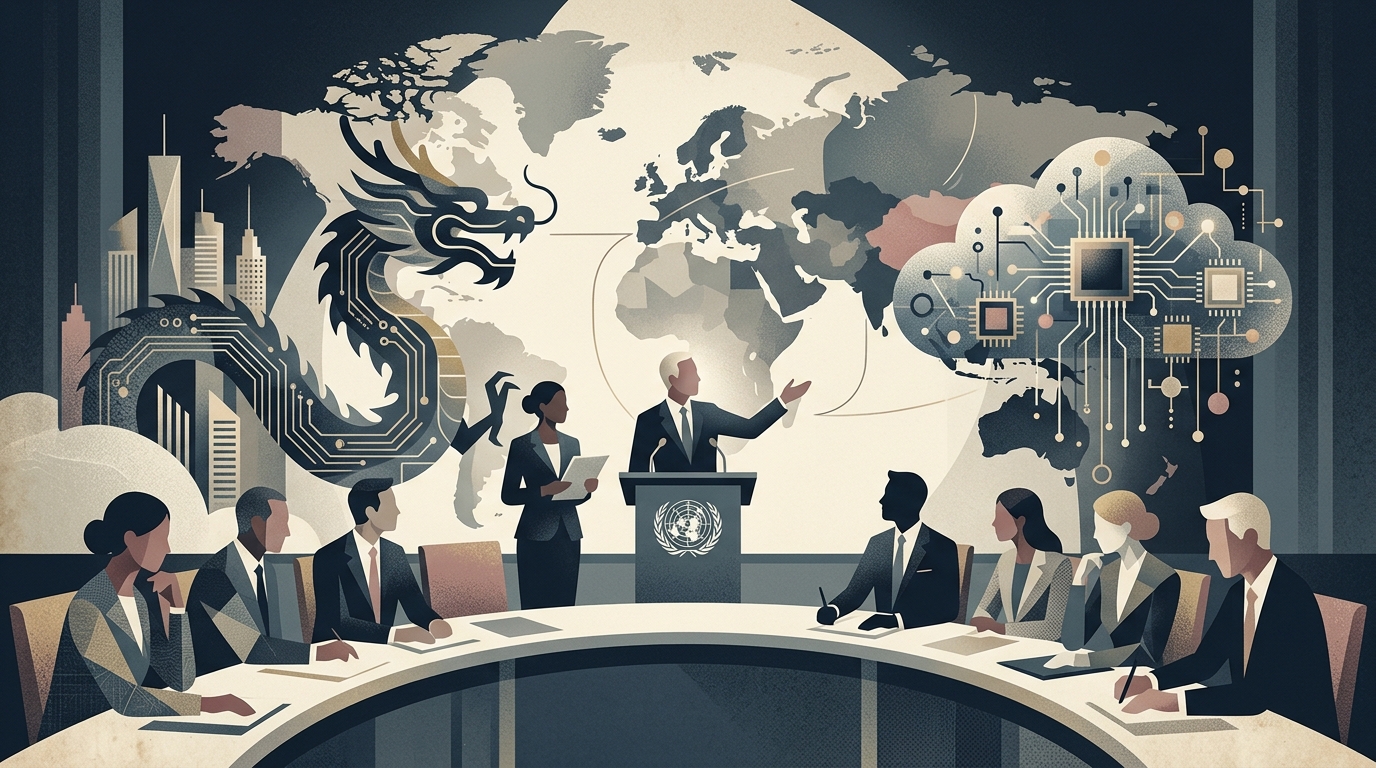
In the high-stakes world of semiconductor politics, the words of Jensen Huang, the visionary leading Nvidia to historic market valuations, carry the weight of a prophecy. When Huang publicly identifies Huawei as a "formidable" rival in the Artificial Intelligence (AI) space, the global market hears more than just a business assessment; it hears a geopolitical warning. Huawei's resurgence, despite the strangulating web of US sanctions, marks a new chapter in the technological Cold War—one where China is no longer merely reacting to Western innovation but is actively forging a parallel, autonomous ecosystem.
The Irony of Sanctions: Huawei’s Phoenix Moment
Huawei’s trajectory over the last five years is a masterclass in survival and strategic pivot. After being effectively banned from global 5G networks and severed from the US semiconductor supply chain, the company was forced to pour billions into domestic R&D. The byproduct of this isolation is the Ascend series of AI processors. According to analysts and Huang himself, these chips now offer performance levels that rival Nvidia’s legacy A100 series, which was once the undisputed backbone of AI training.
The US strategy to throttle China’s access to advanced AI silicon has acted as an unintended catalyst. Instead of crippling Chinese industry, it created a "captive" domestic market. Chinese tech giants, previously reliant on Nvidia, now have no choice but to subsidize and support Huawei’s development. Nvidia finds itself in a paradoxical bind: the very export controls designed to protect American hegemony have cleared the competitive field for Huawei to dominate the Chinese market—a territory that was once Nvidia’s most lucrative stronghold.
Beyond Silicon: The MindSpore Ecosystem
Dominance in AI is not merely a matter of hardware specs; it is defined by the software ecosystem. Nvidia’s supremacy is anchored in CUDA, the proprietary software platform that has become the global standard for AI developers. However, Huawei is countering with MindSpore, a deep-learning framework optimized specifically for its Ascend architecture.
- Vertical Integration: Huawei now controls the full stack, from chip design to software frameworks and cloud infrastructure.
- State Support: Beijing is funneling massive capital into national AI computing centers that exclusively utilize domestic hardware.
- Strategic Resilience: The push for "self-reliance" has made the Chinese AI ecosystem immune to further Western export shocks.
Huang recognizes that Huawei is not just a chipmaker; it is a provider of end-to-end solutions. This integrated approach allows China to build AI supercomputers that, while perhaps slightly trailing in raw per-chip performance, compensate through highly optimized system-level architectures. In the race for AI supremacy, efficiency and availability often outweigh peak theoretical speeds.
The Geopolitical Chessboard and Nvidia’s Dilemma
Nvidia is currently caught between the proverbial rock and a hard place: the commercial necessity of the Chinese market and the national security mandates of Washington D.C. Huang has consistently warned that if Nvidia is permanently severed from China, it will suffer a significant blow to its revenue, which in turn funds the massive R&D required to stay ahead of the curve.
"We cannot ignore Huawei. They are capable, they are determined, and they have the full backing of a state that views AI as a matter of national survival," is the underlying sentiment from Nvidia's leadership.
Looking ahead, the primary concern is not just a loss of quarterly earnings. It is the emergence of a bifurcated world with two incompatible technological stacks. If Huawei succeeds in exporting its ecosystem to markets across Asia, Africa, and parts of Latin America, American "silicon diplomacy" will face its greatest challenge yet. AI is no longer just a tool for productivity; it is the new currency of global power, and Huawei is learning the language faster than anyone in Washington anticipated.