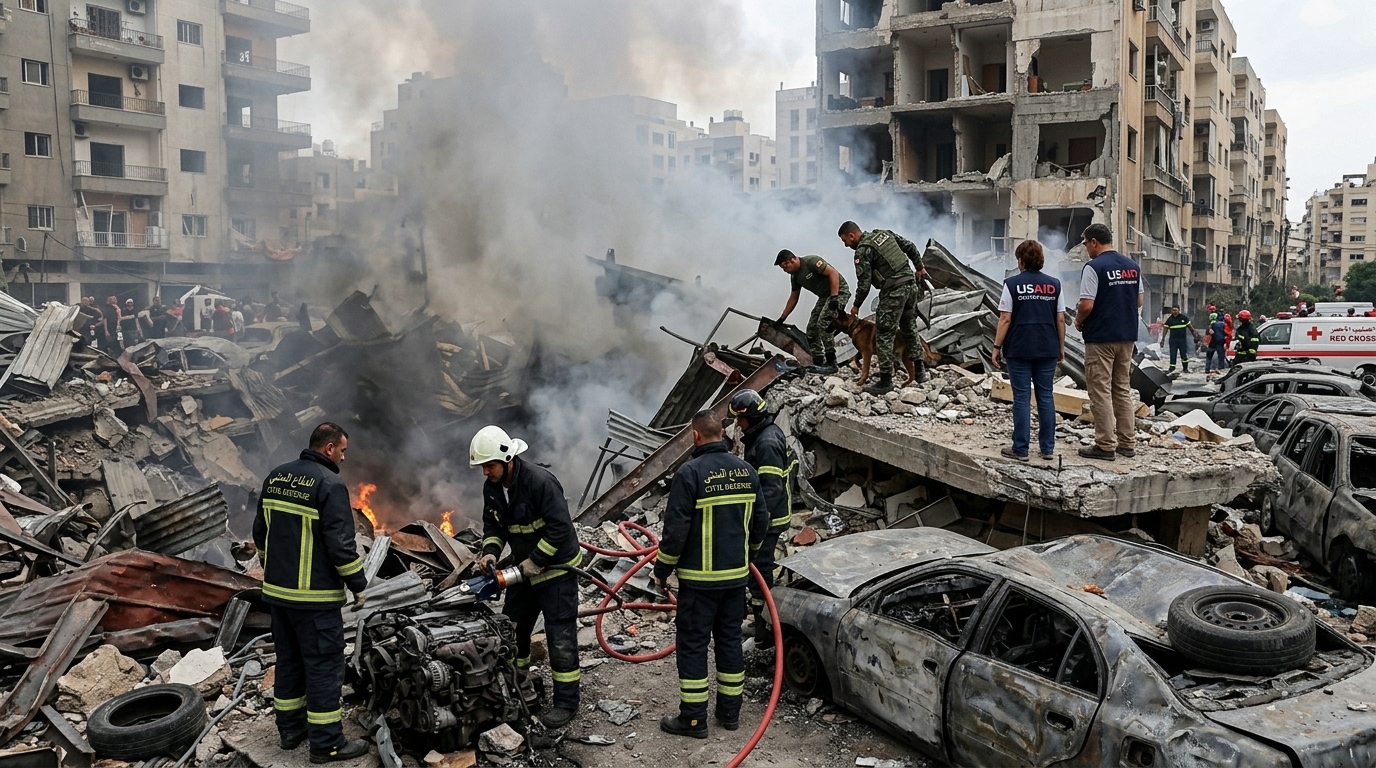
The recent Israeli military operation in the heart of Beirut is not merely another chapter in the long-standing history of Middle Eastern conflict; it marks a critical juncture that redefines power dynamics and communication protocols between Jerusalem and Washington. According to reports surfaced by journalist Barak Ravid, the Israel Defense Forces (IDF) notified the U.S. Central Command (CENTCOM) moments before launching the strike. This move, while technically falling under the umbrella of 'deconfliction,' carries profound political and strategic weight, highlighting the delicate balance between Israeli operational autonomy and the American need for regional oversight.
The Dynamics of Notification and Strategic Significance
The decision to notify CENTCOM 'shortly before' the strike suggests a calculated strategic choice by Israel to keep its closest ally informed without granting it the opportunity to exercise a veto or delay the operation. In the realm of geopolitics, timing is everything. By informing the U.S. at the eleventh hour, Israel ensures that no intelligence leaks could jeopardize the mission, while simultaneously shielding itself from accusations of a total lack of coordination. CENTCOM, responsible for U.S. military operations across the Middle East, Central Asia, and parts of South Asia, serves as the vital link that prevents direct friction between friendly forces in the theater.
However, this 'zero-hour' tactic frequently causes friction within the corridors of the Pentagon and the State Department. Washington consistently seeks to avoid a general conflagration that could pull the U.S. into a new Middle Eastern war. When Israel acts with such speed, it presents the American administration with a fait accompli, forcing it to manage the fallout of an attack it never explicitly sanctioned. This creates a paradox: the U.S. appears complicit in the eyes of the international community and its adversaries, yet it lacks full control over the trigger.
The Lebanese Front and the Shadow of Hezbollah
Beirut is Hezbollah’s stronghold, and any strike there conveys a clear message: no location is beyond reach. The escalation of recent months has shown that the 'red lines' which held for decades have now blurred. Israel seems determined to degrade Hezbollah’s infrastructure and leadership, operating under the belief that deterrence can only be achieved through absolute military pressure. Conversely, Hezbollah, backed by Iran, faces a retaliatory dilemma: an overly harsh response could lead to an all-out war that would devastate Lebanon, while a tepid response would expose its strategic vulnerability.
The strike in Beirut, preceded by the CENTCOM notification, also indicates that Israel is factoring in the possibility of Iranian intervention. The presence of U.S. forces in the region acts as a deterrent against Tehran. By keeping the U.S. in the loop, Israel is essentially preparing the ground for potential defensive cooperation should the situation spiral out of control. It is a high-stakes game of chess where every move in Beirut resonates from the Persian Gulf to Washington D.C.
Diplomatic Balancing and International Law
Beyond the military aspect, the strike raises serious questions regarding international law and the protection of civilians in densely populated areas. Beirut is a city still trying to heal from previous crises. Strikes on urban centers, regardless of the target's precision, trigger international outcry and place the U.S. in a difficult position, as it must defend Israel’s right to self-defense while simultaneously preaching respect for human rights and international norms.
The notification to CENTCOM could also be interpreted as an attempt to legitimize the operation in the eyes of the international community. If the U.S. was aware, even minutes prior, Israel can claim it acted within a broader allied understanding of counter-terrorism. However, this strategy has its limits. The international community, particularly the European Union, continues to push for a ceasefire and diplomatic resolution, viewing the military path as a dead end that only generates more violence and displacement.
Conclusion: Toward a New Normal?
The notification of CENTCOM before the Beirut strike is not an isolated incident but part of a 'new normal' in the Middle East. Israel will likely continue to test the boundaries of its allies and enemies alike, seeking to eliminate threats before they become existential. The U.S., for its part, will continue to provide necessary military cover while attempting to restrain the more aggressive impulses of the Israeli government. The question that remains is how much longer this tightrope can hold before it snaps, plunging the region into a vortex from which no one will emerge unscathed.
Key Takeaways
- IDF-CENTCOM communication is vital for preventing accidental military friction.
- The timing of the notification highlights Israel's push for operational independence.
- Lebanon remains the most volatile front in the current regional landscape.
- International diplomacy is struggling to keep pace with rapid military developments on the ground.