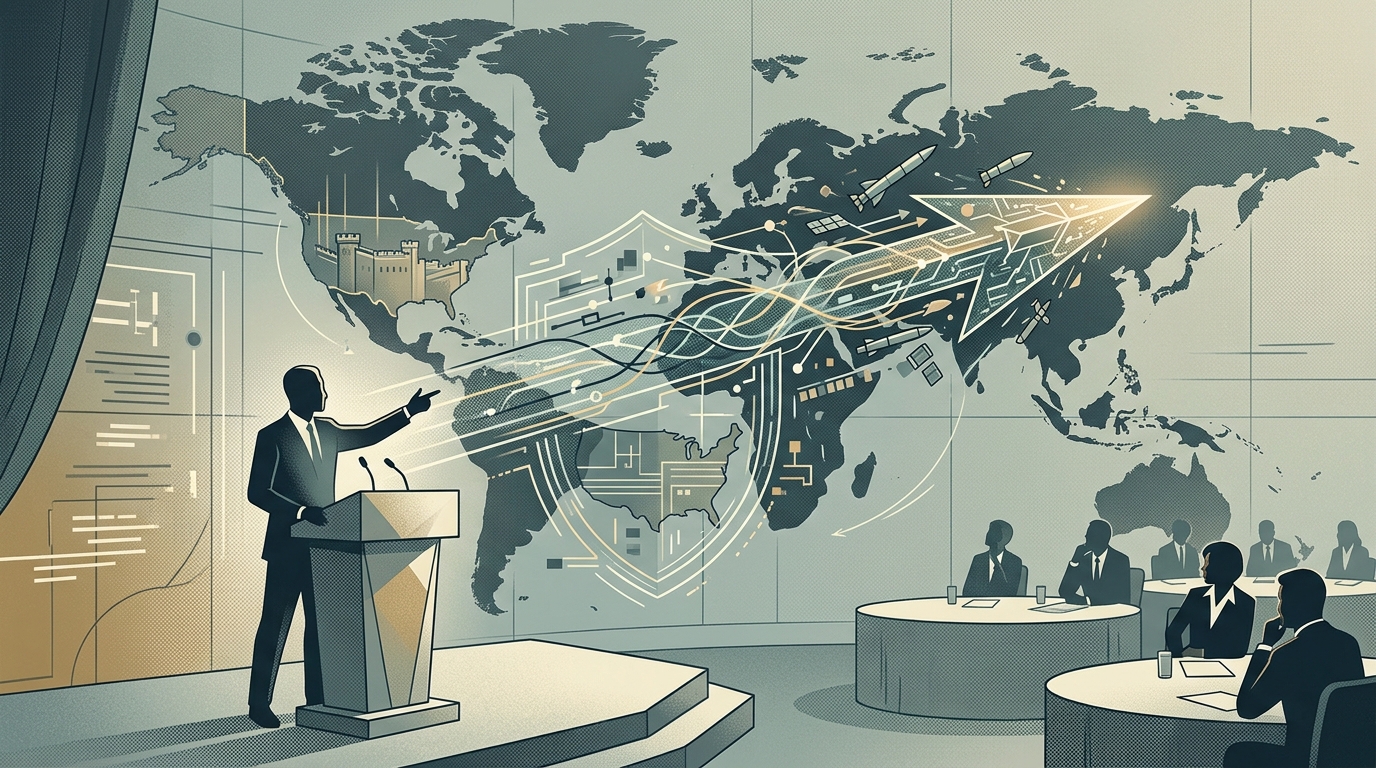
As we navigate the early months of 2026, humanity finds itself at a critical juncture where technological advancement is no longer merely a tool for prosperity, but the primary arena of geopolitical confrontation. The recent United Nations University (UNU) report, titled "From Black Box to Watchtower," highlights a fundamental paradigm shift: Artificial Intelligence (AI) can no longer be treated as an internal matter for tech giants or individual nation-states, but as a global infrastructure requiring international oversight.
AI as a Power Multiplier in Modern Conflict
In today’s international relations landscape, AI has ceased to be a theoretical threat. From autonomous weapon systems operating on the front lines in Eastern Europe and the Middle East to sophisticated cyber-warfare algorithms, this technology acts as a "power multiplier." The UN report emphasizes that the opacity—the so-called "black box"—of algorithms creates a dangerous degree of uncertainty. When leaders and military commanders cannot predict or interpret the decisions of an AI system, the risk of unintended conflict escalation increases exponentially.
The geopolitics of AI is not just about weaponry. It is about the control of information and the ability to influence public opinion through advanced disinformation campaigns. In a year marked by global elections, the use of generative AI to create deepfakes has tested the resilience of democratic institutions. The UNU argues that AI governance must incorporate mechanisms that make these processes transparent, turning the "black box" into a "watchtower" that warns of risks before they become irreversible.
The Challenge of Global Consensus
The primary obstacle to effective governance remains fragmentation. While the European Union has moved forward with the AI Act and the US has issued executive orders on safety, a significant gap persists between the "Global North" and the "Global South." Developing nations express fears that new governance rules may act as barriers to their technological development, solidifying a new form of digital colonialism.
- The need for an International Ethical Framework binding both governments and the private sector.
- The creation of an international body, modeled after the International Atomic Energy Agency (IAEA), to monitor critical AI systems.
- Ensuring access to computing power and data for developing economies so they are not left behind in the new era.
The report suggests that governance must be multilateral and inclusive. An agreement between Washington and Beijing is not enough; a global architecture is required to protect human rights and ensure that AI is not used for citizen suppression or the further destabilization of vulnerable regions.
From Reaction to Prevention
The "Watchtower" concept introduced by the UNU is not just metaphorical. It refers to specific tools for monitoring algorithmic behavior in real-time. In an age of conflict, the ability to discern whether a cyber-attack or a military move is guided by an autonomous algorithm or a human command is vital for deterrence. Transparency of training data and the accountability of model creators are the cornerstones of this new approach.
"Artificial Intelligence is a dual-use technology with an unprecedented rate of evolution. If we do not build the watchtower of global oversight today, we risk becoming spectators to a conflict that no one will be able to stop," the report states.
In conclusion, AI governance in 2026 requires more than technical regulations. It requires the political will to transcend national rivalries for the sake of collective security. The transition from the "black box" to full transparency is the only way to ensure that artificial intelligence remains a beacon of progress rather than a catalyst for global destabilization.