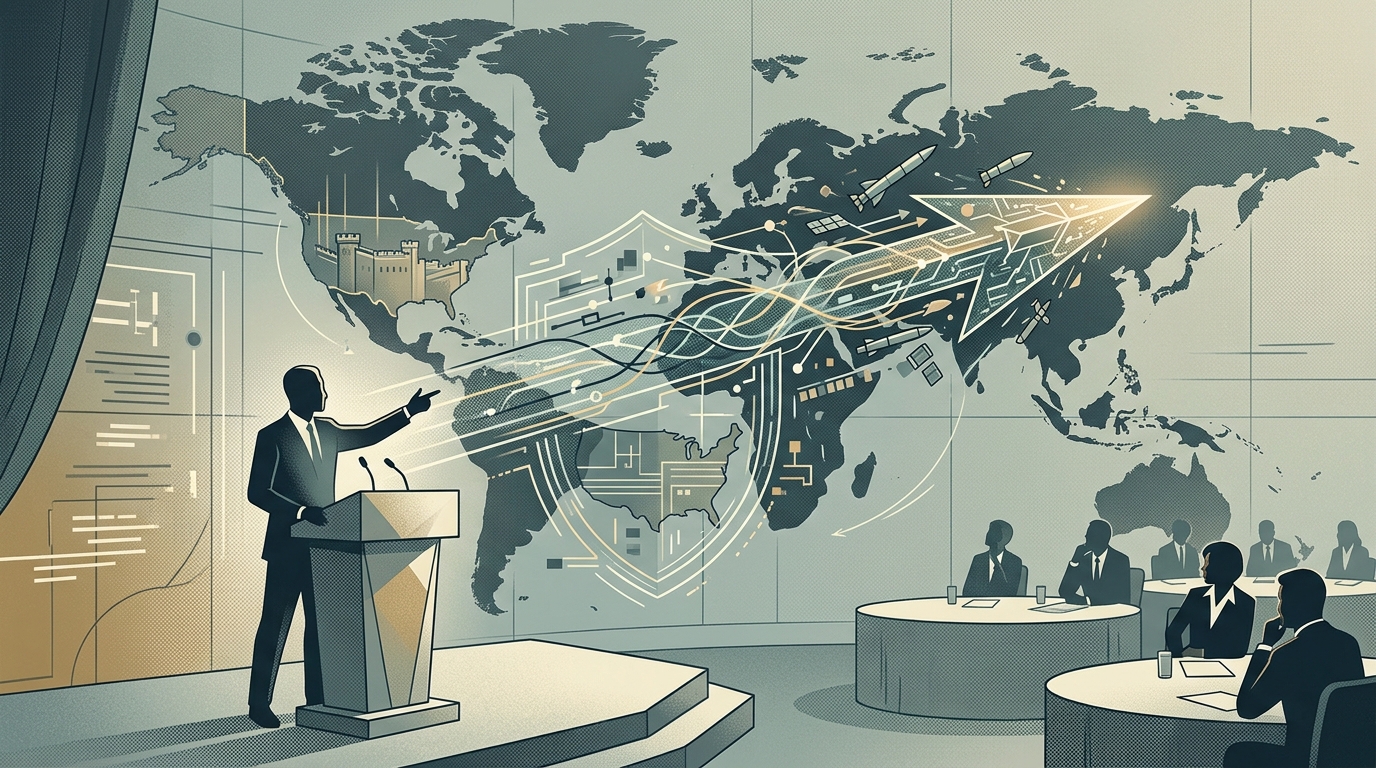
In the history of technological evolution, certain moments act as catalysts, altering the course of nations and the global balance of power. What we now call the "DeepSeek moment" is not merely the release of another AI model; it is the official announcement that China is no longer just following the West, but competing on equal terms, despite concerted efforts to restrict its access to critical resources.
DeepSeek, a company that originated from the quantitative trading sector, has managed to shake the foundations of Silicon Valley. With the release of its V3 and R1 models, it proved that brute computing force—the dogma of "GPU-rich" entities like OpenAI and Google—is not the only path to intelligence. DeepSeek's success was built on algorithmic ingenuity and training efficiency, achieving GPT-4 level performance at a fraction of the cost.
Innovation Born of Necessity and Efficiency
For years, U.S. strategy relied on the belief that controlling advanced Nvidia semiconductors would act as a "silicon curtain" for Chinese AI. However, DeepSeek proved that necessity is the mother of invention. Constrained by sanctions, Chinese engineers focused on software optimization and Mixture-of-Experts (MoE) architecture. The result was a model that requires significantly less energy and computational resources to train and operate.
- Multi-head Latent Attention (MLA): An innovation that drastically reduces memory requirements during inference.
- FP8 Precision Training: Using lower data precision without quality loss, enabling training on older hardware.
- Open Source Philosophy: The decision to release model weights freely caused a market earthquake, demystifying the "closed" ecosystems of Western giants.
This approach is not just technical; it is deeply political. China is sending a message to the Global South: artificial intelligence does not have to be an expensive privilege of a few American conglomerates. It can be accessible, efficient, and most importantly, independent of the U.S. supply chain.
The Geopolitical Chessboard: From Sanctions to Autonomy
The rise of DeepSeek forces Washington to reassess the effectiveness of export controls. If China can produce world-class AI using less advanced chips or by optimizing existing hardware, then the "chokehold" strategy on semiconductors may have reached its limits. Furthermore, this success bolsters domestic chip production in China, as companies like SMIC and Huawei accelerate efforts to bridge the gap.
"DeepSeek didn't just win a benchmark; it won the battle of perception. It showed that spirit and code can defeat silicon," notes a geopolitical analyst in Beijing.
The Chinese government, while initially cautious about the freedom of large language models, seems to be embracing DeepSeek as its national "crown jewel." The ability to export this technology to countries wary of U.S. digital hegemony is a powerful soft power tool. Beijing now presents itself as the guarantor of a "democratic" and "multipolar" AI, despite its internal censorship practices.
The Challenge for the West
For Silicon Valley, the DeepSeek moment is a wake-up call. The "scorched earth" model, where billions of dollars are poured into data centers without a clear path to profitability, is now being challenged by Chinese efficiency. Investors are beginning to ask why OpenAI needs $100 billion when a Chinese team achieved comparable results with a fraction of that amount.
In conclusion, China's long march to tech supremacy does not only pass through factories but through lines of code. DeepSeek proved that in the 21st century, geopolitical power is measured in tokens per second and algorithmic elegance. The West must now choose: will it continue down the path of protectionism, or will it return to the roots of innovation that made it a leader in the first place?