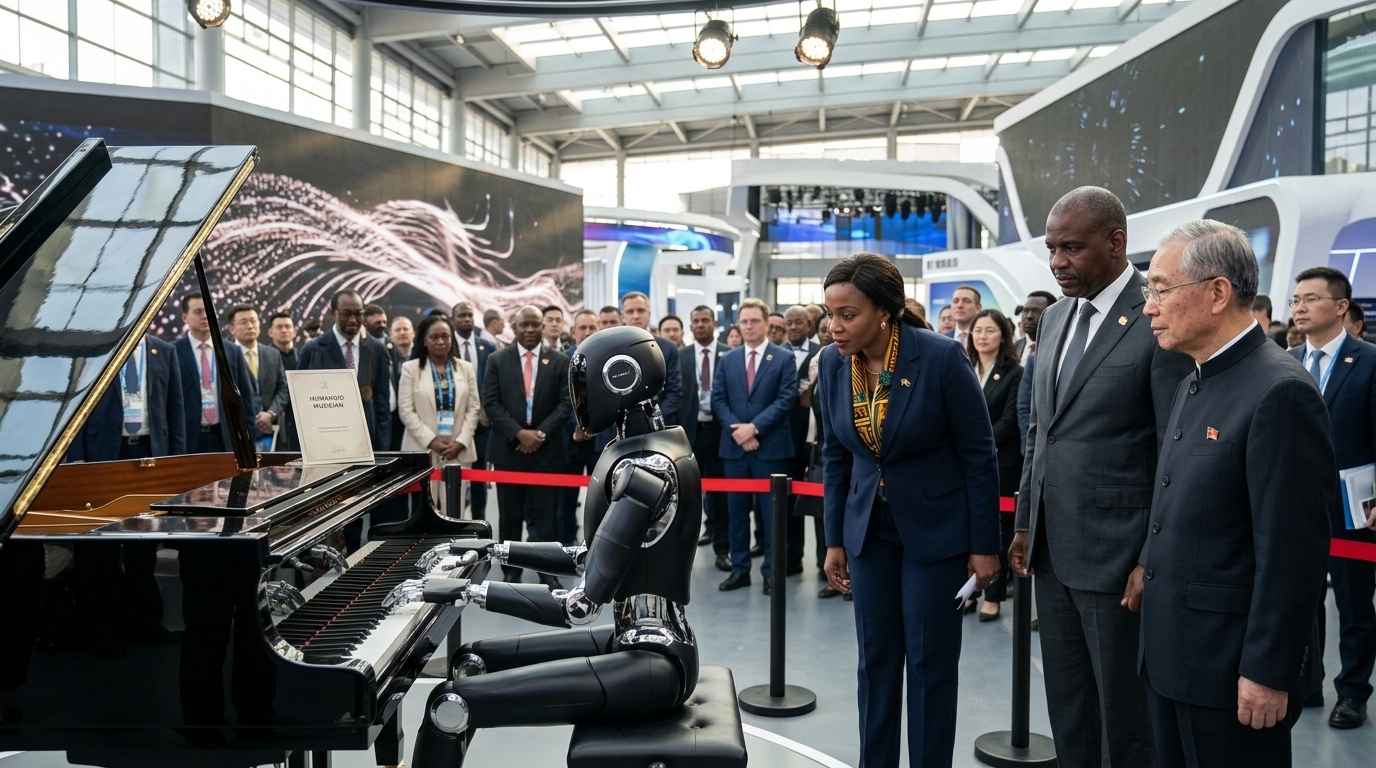
In the heart of Guangdong province, the industrial engine of China, an unusual group of visitors recently came face-to-face with the future. Diplomats from 37 countries—spanning Europe, Latin America, and the Middle East—witnessed an orchestrated display of power that transcends traditional military drills. This time, China's "weapons" were humanoid robots performing classical music on pianos, electric vertical take-off and landing (eVTOL) aircraft, and medical exoskeletons promising to bridge the gap of physical disability.
The Strategy of 'New Quality Productive Forces'
This visit was far from a mere tourist junket. It serves as a prelude to the strategy governing China's upcoming 15th Five-Year Plan (2026-2030). The term "New Quality Productive Forces," introduced by President Xi Jinping, lies at the core of this endeavor. It represents a pivot from low-cost mass manufacturing toward cutting-edge innovation, green energy, and artificial intelligence. China seeks to prove that its economy is not slowing down but transforming into something more sophisticated and, crucially, more autonomous from Western supply chains.
In Shenzhen, the "Silicon Valley of the East," diplomats watched EHang and Xpeng Aeroht present their vision for urban air mobility. Flying taxis are no longer science fiction in China; they are a regulated reality with approved airworthiness certificates. For nations of the "Global South," this imagery is compelling: an alternative path to development that doesn't necessarily route through Washington or Brussels.
Robotics and Automation: The New Power Multiplier
Among the most striking exhibits were the humanoid robots from UBTECH and other local firms. Their ability to perform delicate tasks, such as playing piano or assembling minute components, signals profound progress in real-time data processing and high-precision actuators. China is investing billions into robotics, not only to counter its demographic decline but also to dominate the next phase of global manufacturing.
- Autonomous Driving: Companies like WeRide and Baidu’s Apollo demonstrated fleets of robotaxis already operating on public roads without drivers, surpassing the scale of implementation in many Western cities.
- Medical Technology: Exoskeletons helping paralyzed patients walk again, showcasing the human-centric side of Chinese AI.
- Green Transition: Solid-state battery technologies promising to double the range of electric vehicles and revolutionize energy storage.
Geopolitical Implications and the Western Response
The timing of this showcase is critical. As the US and EU impose tariffs on Chinese EVs and restrict access to advanced semiconductors, Beijing responds with "tech diplomacy." By inviting diplomats from 37 nations, China sends a clear message: Western technological containment will not halt its progress; instead, it will catalyze the creation of a parallel, self-sufficient innovation ecosystem.
"What we saw in Guangdong are not just products, but a comprehensive vision of how society and production will be organized in the 21st century," remarked one of the participating diplomats under the condition of anonymity.
However, the challenge remains: can China sustain this pace of innovation without unfettered access to global capital and expertise? The 15th Five-Year Plan will be the ultimate litmus test. China is betting that its massive domestic market and alliances with emerging economies will suffice to crown it the undisputed leader of the Fourth Industrial Revolution.