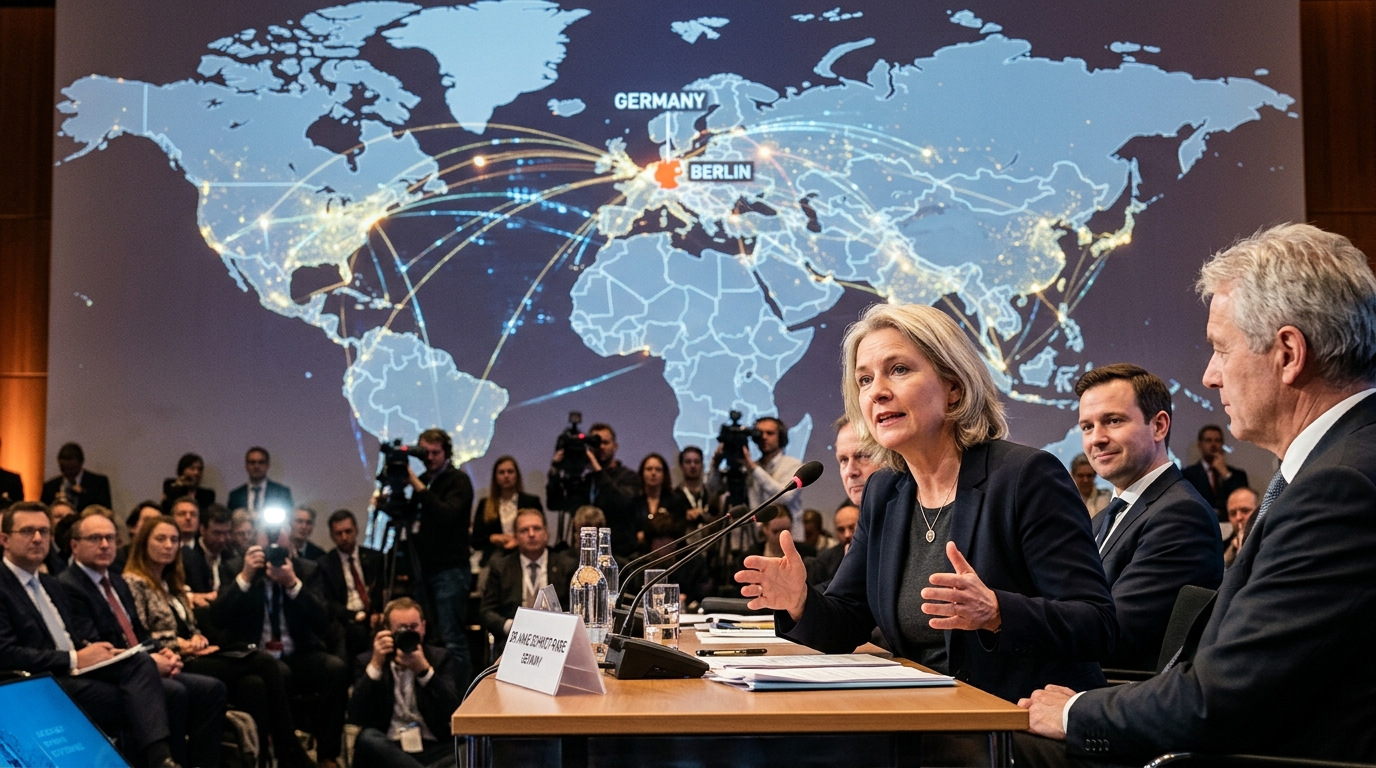
For decades, Berlin was famously characterized as being "poor but sexy." Today, the German capital is shedding that old skin, transforming into a global high-tech hub that aspires to lead the fourth industrial revolution. Berlin's recent "big AI win," highlighted by international outlets like Politico, is not merely a piece of economic news; it is a geopolitical statement of power in a Europe struggling to find its footing between the United States and China.
The Landmark Investment and Strategic Importance
The driving force behind this optimism is Microsoft's commitment to a €3.2 billion investment in Germany, with a significant portion of these resources flowing into the Berlin-Brandenburg region and North Rhine-Westphalia. This marks the company's largest investment in the country in 40 years. The goal is to double the capacity of AI and cloud infrastructure while training over 1.2 million Germans in the digital skills of the future.
This move comes at a critical juncture. The German economy, traditionally anchored in heavy industry and automotive manufacturing, faces headwinds from high energy costs and intense international competition. The pivot toward AI is seen as a "kiss of life" for the German Mittelstand—the small and medium-sized enterprises that form the backbone of the nation's economy. By accessing local data centers and advanced AI models, German businesses can now integrate technology into their production lines without compromising on data sovereignty.
The Rivalry with Paris and London
Berlin’s success did not happen in a vacuum. French President Emmanuel Macron has made Herculean efforts to establish Paris as Europe’s "AI capital," successfully attracting firms like Mistral AI. However, Germany appears to be gaining ground thanks to its infrastructure stability and the deep integration of technology into the industrial fabric.
While France focuses heavily on large language models (LLMs) and "cultural sovereignty" in AI, Germany is doubling down on Applied AI. This translates to AI optimized for supply chain logistics, predictive maintenance in factories, and the automation of complex bureaucracy. Berlin, with its vibrant startup ecosystem, acts as the bridge between theoretical research and industrial application.
The Regulatory Framework: Hurdle or Advantage?
One of the most debated aspects of Berlin's win is the European Union's AI Act. Many critics argued that the EU's stringent rules would deter investment. However, reality suggests the opposite. Major tech companies seem to prefer a clear, albeit strict, regulatory framework over the ambiguity found in other markets.
- Data Security: Germany maintains some of the world's toughest data protection laws. For companies, compliance in Berlin serves as a "seal of quality" for the global market.
- Ethical AI: An emphasis on the ethical development of technology attracts top-tier talent who want to work on projects with meaningful social impact.
- Public-Private Collaboration: The German government has streamlined licensing processes for data centers, recognizing them as infrastructure of national importance.
Nevertheless, the challenge remains: can Europe foster its own "champions," or will it remain a privileged hosting ground for American giants? The case of Aleph Alpha in Heidelberg shows there is domestic momentum, but the sheer scale of Microsoft's investment is difficult to match without a unified European capital market.
Conclusion: A New Chapter for Europe
Berlin’s victory is not just a German success story. It is a signal that Europe can remain relevant in the global tech race by leveraging its traditional strengths: specialized industry and a high level of education. Berlin is no longer just the city of artists and nightlife; it is the laboratory where tomorrow's European economy is being forged. The success of this endeavor will determine whether the Old Continent will be a primary player or a mere spectator in the century of Artificial Intelligence.