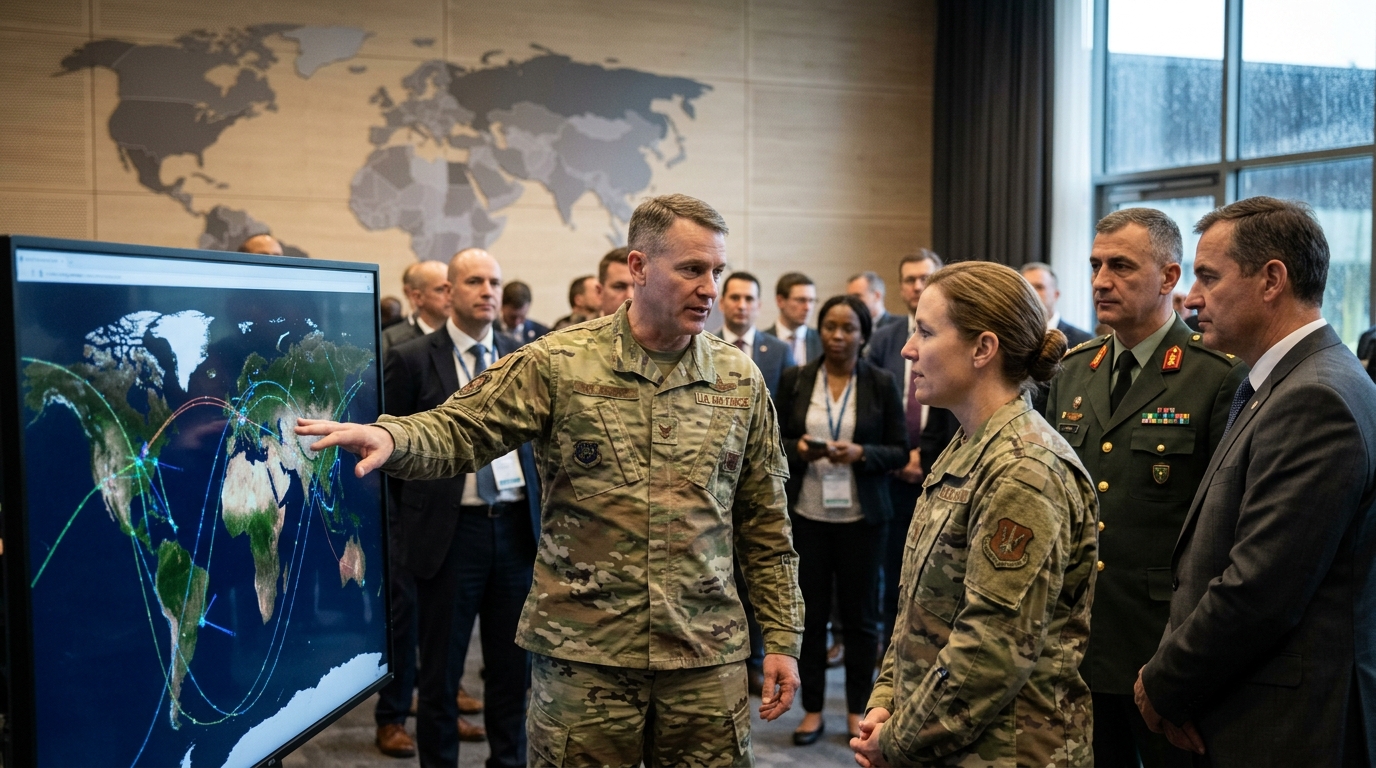
In the shifting sands of modern geopolitics, speed is no longer just an advantage; it is the very essence of survival. The U.S. Air Force (USAF) and Space Force recently concluded a series of experiments integrating multiple Artificial Intelligence (AI) tools into their battle management systems, seeking to transform how military commanders make split-second decisions. This development is a cornerstone of the Joint All-Domain Command and Control (JADC2) strategy, which aims to connect every sensor to every shooter across all domains: land, sea, air, space, and cyberspace.
The Architecture of 'Machine Speed'
The recent experiment, conducted under the auspices of the Advanced Battle Management System (ABMS), did not focus on a single tool but rather on the integration of an entire AI suite. These tools include Large Language Models (LLMs) for synthesizing vast amounts of intelligence, alongside specialized machine learning algorithms designed to process data from satellites and radar arrays. The ultimate goal is to collapse the 'kill chain'—the time elapsed from detecting a threat to neutralizing it.
According to reports from DefenseScoop, the trials allowed staff to 'query' the AI system for alternative courses of action, receiving responses based on real-time data streams. This ability to fuse information from disparate sources—such as enemy troop movements on the ground and satellite trajectories in orbit—provides a holistic operational picture that the human brain alone could not process with comparable velocity.
Geopolitical Competition and Deterrence
This move does not occur in a vacuum. The primary driver behind the acceleration of AI integration is the strategic competition with China. Beijing is investing heavily in 'intelligentized warfare,' and the U.S. recognizes that traditional superiority in hardware (aircraft, ships) is insufficient if the software controlling them is obsolete. The Space Force’s ability to feed space-based data directly into Air Force operations is critical, as space has become the 'ultimate high ground' of modern conflict.
"It is no longer about who has the fastest plane, but who has the fastest decision-making algorithm," Pentagon analysts suggest.
The application of AI on the battlefield also raises profound questions about deterrence. If an adversary knows that the U.S. response system is automated and lightning-fast, does that deter an attack? Or does the existence of such systems increase the risk of accidental escalation, where machines might misinterpret a maneuver as a hostile act, triggering an automated response before diplomacy can intervene?
Challenges and Ethical Constraints
Despite the technological optimism, significant hurdles remain. The reliability of LLMs—which are prone to 'hallucinations'—is a critical concern. In a combat scenario, a single piece of misinformation could lead to catastrophic loss of life. Furthermore, integrating these tools requires a seismic shift in military culture, where hierarchy and human control are foundational tenets.
The Pentagon maintains that a human will always remain 'in the loop,' making the final decision regarding the use of force. However, as the tempo of operations increases, the human role risks being relegated to a mere rubber stamp for machine-generated suggestions. The balance between operational efficiency and ethical accountability will be the defining challenge of the coming decade.
Conclusion
The integration of AI tools by the Air Force and Space Force is a bold step into the future of conflict. As the boundaries between battle domains blur, the need for a unified, intelligent 'nervous system' becomes imperative. The success of these experiments will determine not only U.S. defensive capabilities but also the new global order in the age of algorithmic power. The race for AI supremacy in the military sphere has moved from theory to the testing grounds, and the implications are global.