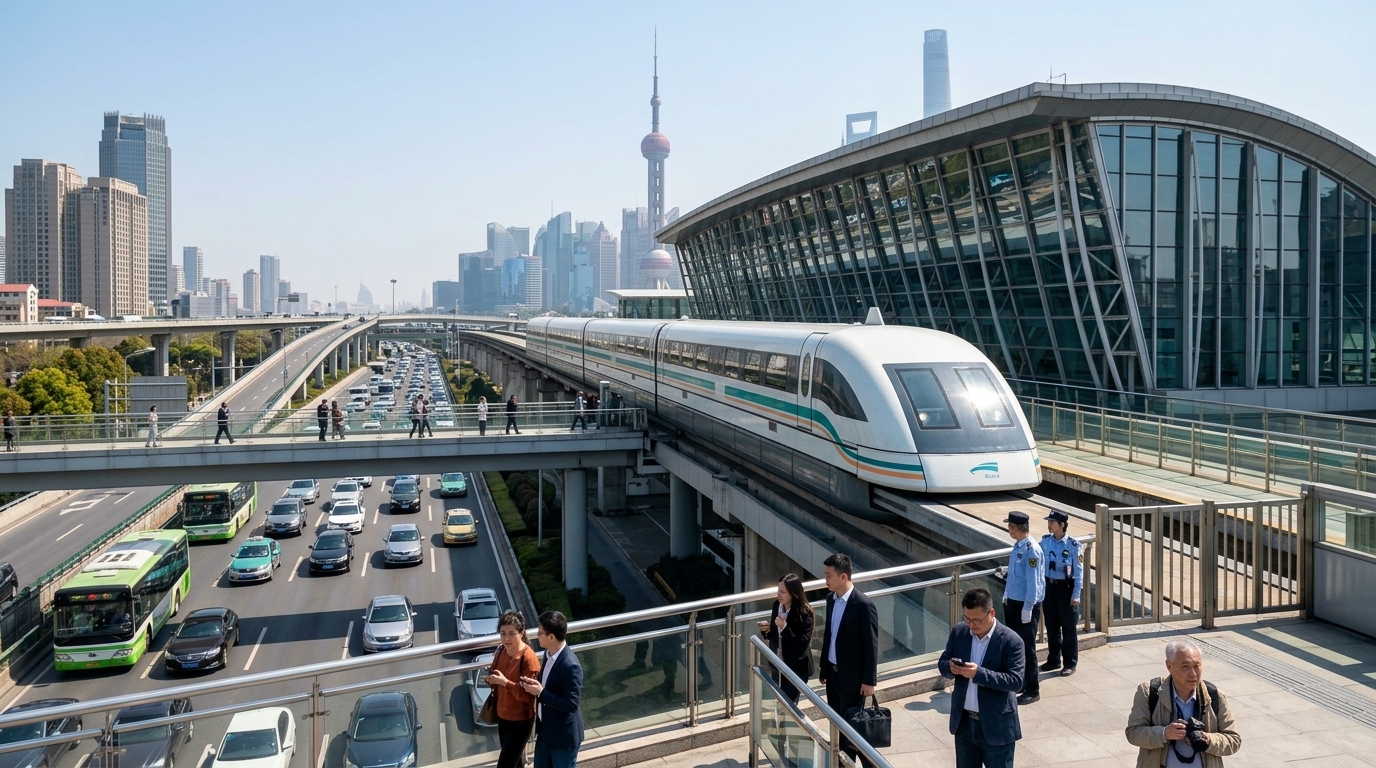
In the heart of Shanghai, where tradition meets futurism, the Shanghai Maglev (Magnetic Levitation) stands as a living testament to human engineering pushing the boundaries of nature. This is no ordinary train. It has no wheels, it doesn't touch the rails, and its movement isn't based on rotating motors. Instead, it "flies" above the ground, using the power of magnetism to shrink distances.
The Science of Magnetic Levitation
The Maglev utilizes an Electromagnetic Suspension (EMS) system. Powerful magnets located on the train's underside and the specialized guideway create opposing magnetic fields, allowing the vehicle to hover approximately 10 millimeters above the structure. This lack of contact eliminates rolling friction, the primary obstacle to achieving high speeds in conventional rail systems. The only resistance the Maglev must overcome is aerodynamic drag.
The result is a transit experience that feels more like flight than rail travel. Passengers boarding at Longyang Road Station destined for Pudong International Airport cover a distance of 30 kilometers in just 7 minutes and 20 seconds. The operating speed reaches 431 kilometers per hour (268 mph), although in test runs, the train has exceeded 500 km/h.
German Technology on Chinese Soil
Despite operating in China, the technology finds its roots in Germany. A consortium of Siemens and ThyssenKrupp developed the Transrapid system, which finally found its commercial application in Shanghai in 2004. The project cost was astronomical, reaching approximately 1.2 billion USD, which explains why this technology has not been more widely adopted globally.
However, for China, the Maglev was never just about profitability. It was a prestige project, a way to demonstrate to the world that the nation could lead in adopting cutting-edge technologies. The success of the Shanghai Maglev paved the way for China's massive High-Speed Rail (HSR) network, which is now the largest in the world.
The Next Step: Reaching 600 Kilometers per Hour
China isn't stopping here. Recently, the state-owned CRRC unveiled a new Maglev prototype designed to reach 600 kilometers per hour. This speed places the train in a "sweet spot" between conventional high-speed rail (350 km/h) and commercial aircraft (800-900 km/h). The goal is to create a viable alternative for trips spanning 1,000 to 1,500 kilometers, where the total travel time (including airport transfers and security checks) would be shorter by train.
Environmental Footprint and Challenges
Despite its blistering speed, the Maglev is considered more environmentally friendly than aircraft for similar distances, as it operates entirely on electricity and emits no direct pollutants. Furthermore, the absence of friction means less wear and tear on components and lower maintenance costs over the long term.
However, the primary challenge remains infrastructure cost. Maglev lines are incompatible with existing rail networks, meaning entirely new tracks must be built from scratch. This requires massive capital investment and political will, factors that currently limit its use to very specific, high-density corridors.
- Speed: 431 km/h in regular operation.
- Technology: Magnetic levitation without wheels.
- Route: Connecting downtown Shanghai to Pudong Airport.
- Cost: Approximately $1.2 billion for 30 kilometers.
The Shanghai Maglev remains a beacon of what is possible when physics and ambition collaborate. As the world seeks faster and greener ways to move, the Shanghai experience will always serve as the benchmark for what the transportation of tomorrow looks like.