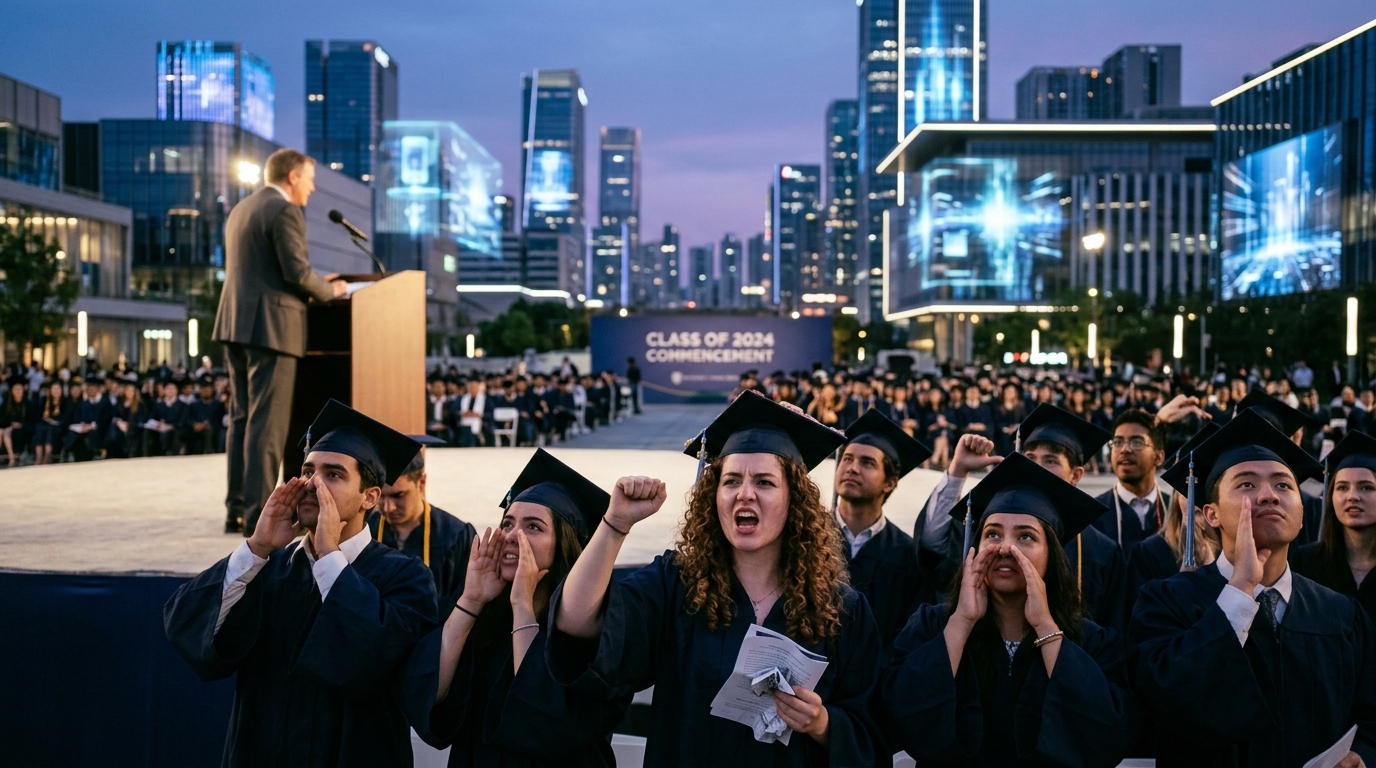
The scene is a staple of academic tradition: a high-achieving entrepreneur, politician, or celebrity stands at the podium of a commencement ceremony, offering platitudes about "following your dreams" and "staying hungry." Yet, in 2024 and 2025, this script has been upended. Instead of applause, many speakers are met with boos, turned backs, and a chilling silence. According to recent reports, this reaction isn't just about political protest; it is the symptom of a profound, "ambient anxiety" that Artificial Intelligence is set to make their degrees obsolete before the ink on their diplomas even dries.
The Collapse of the Social Contract
For decades, the social contract of higher education was straightforward: invest time and money into a degree, and the labor market will reward you with a career path. Today, graduates feel this contract has been unilaterally breached. The rise of Generative AI has targeted the very "entry-level" positions that traditionally served as the first rung of the professional ladder for young people.
From data analysts and copywriters to junior coders and legal assistants, tasks that once required a fresh university graduate are now being performed by algorithms in fractions of a second. This creates a sense of betrayal. When a billionaire speaker takes the stage to talk about "passion," debt-laden students see a world where their hard-earned skills are being devalued daily by technology.
'Ambient Anxiety' and the Psychology of Rejection
The term "ambient anxiety," highlighted in a CNBC analysis, describes a state where fear doesn't stem from a single event but from a generalized sense of instability. Young people aren't just afraid of losing a job; they are afraid that the very concept of a "career" as we knew it is disintegrating. Commencement speeches, often built on outdated 20th-century models of success, now feel out of touch, if not outright insulting.
"We don't want to hear about what the world was like in 1990. We want to know how we are going to survive in a world where ChatGPT can do our jobs better and cheaper," says one Columbia University graduate.
This disconnect fuels the rage. Booing is a way for graduates to reclaim their voice in a system that seems to be ignoring their reality. Speakers who avoid the elephant in the room—economic displacement due to automation—are viewed as insincere and disconnected from the existential threats facing Gen Z.
The Need for a New Educational Paradigm
The problem lies not just with the speakers, but with the educational system itself. Universities are accused of preparing students for a world that no longer exists. While AI evolves at an exponential pace, academic curricula remain sluggish and bureaucratic. Graduates are realizing that the technical knowledge they acquired may already have an expiration date.
- The Revaluation of Skills: Students are demanding a focus on skills that AI cannot easily replicate, such as strategic ethics, complex human empathy, and crisis management.
- The Cost of Education: With tuition costs skyrocketing, the return on investment (ROI) is being questioned when junior roles are at risk of disappearing.
- Authentic Leadership: Graduates are looking for leaders who acknowledge uncertainty instead of masking it with clichés.
In conclusion, the boos at commencement ceremonies are the cry of a generation that feels it is being thrown into an ocean without a life jacket. Artificial Intelligence is not just a tool; it is the catalyst for a social upheaval that demands a radical rethink of how we educate, hire, and support young people at the dawn of this new era. The traditional commencement speech is dead; what replaces it must be an honest dialogue about the future of human labor.